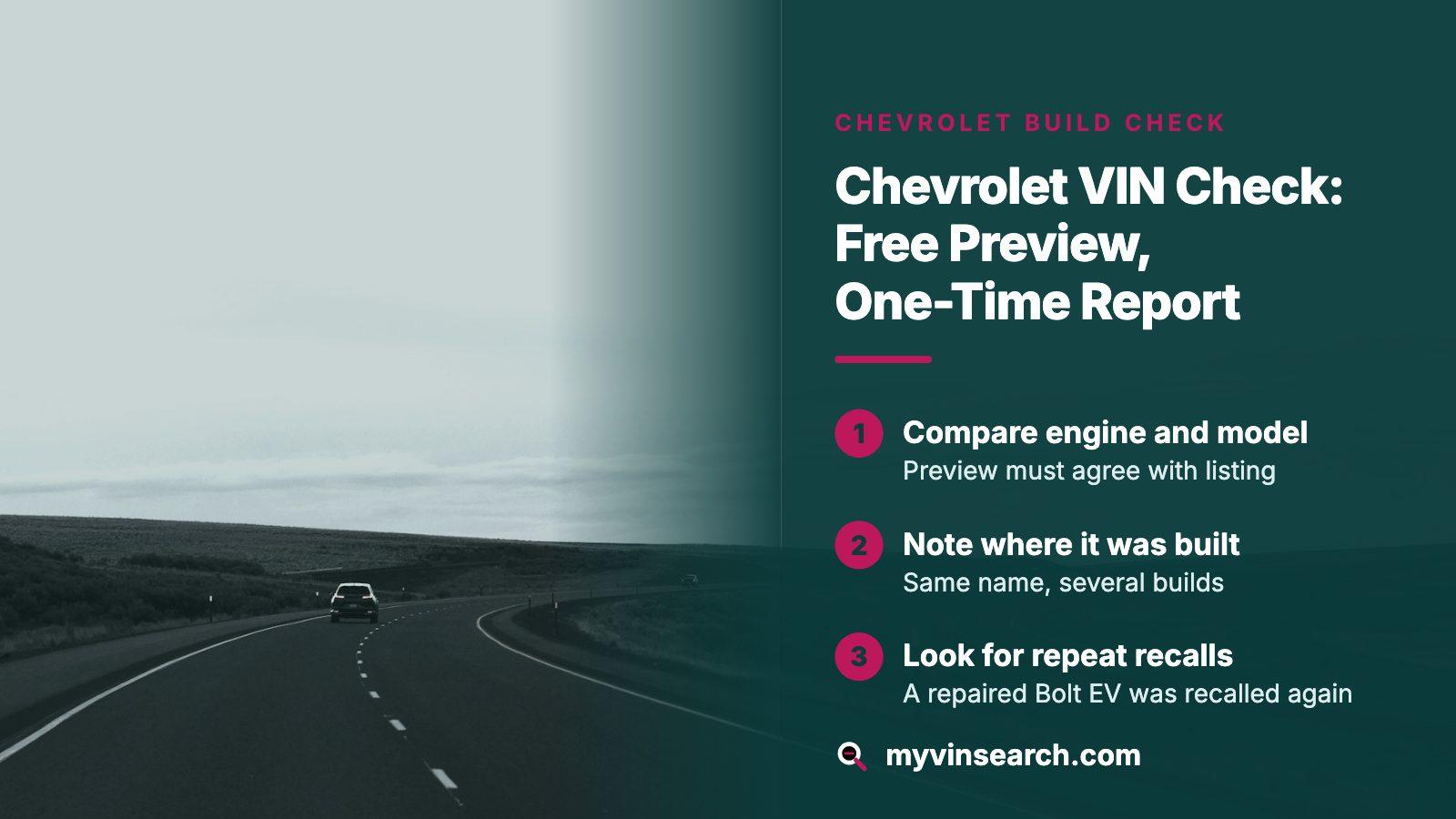
THE SHORT ANSWER
Enter the VIN in the preview and compare the model, year and engine it returns with the listing. If they agree, buy the report once and read the odometer, title and recall lines first. A Chevrolet needs two extra looks: one model name can sit on several VIN starts, and a finished recall can be followed by a second campaign on the same car.
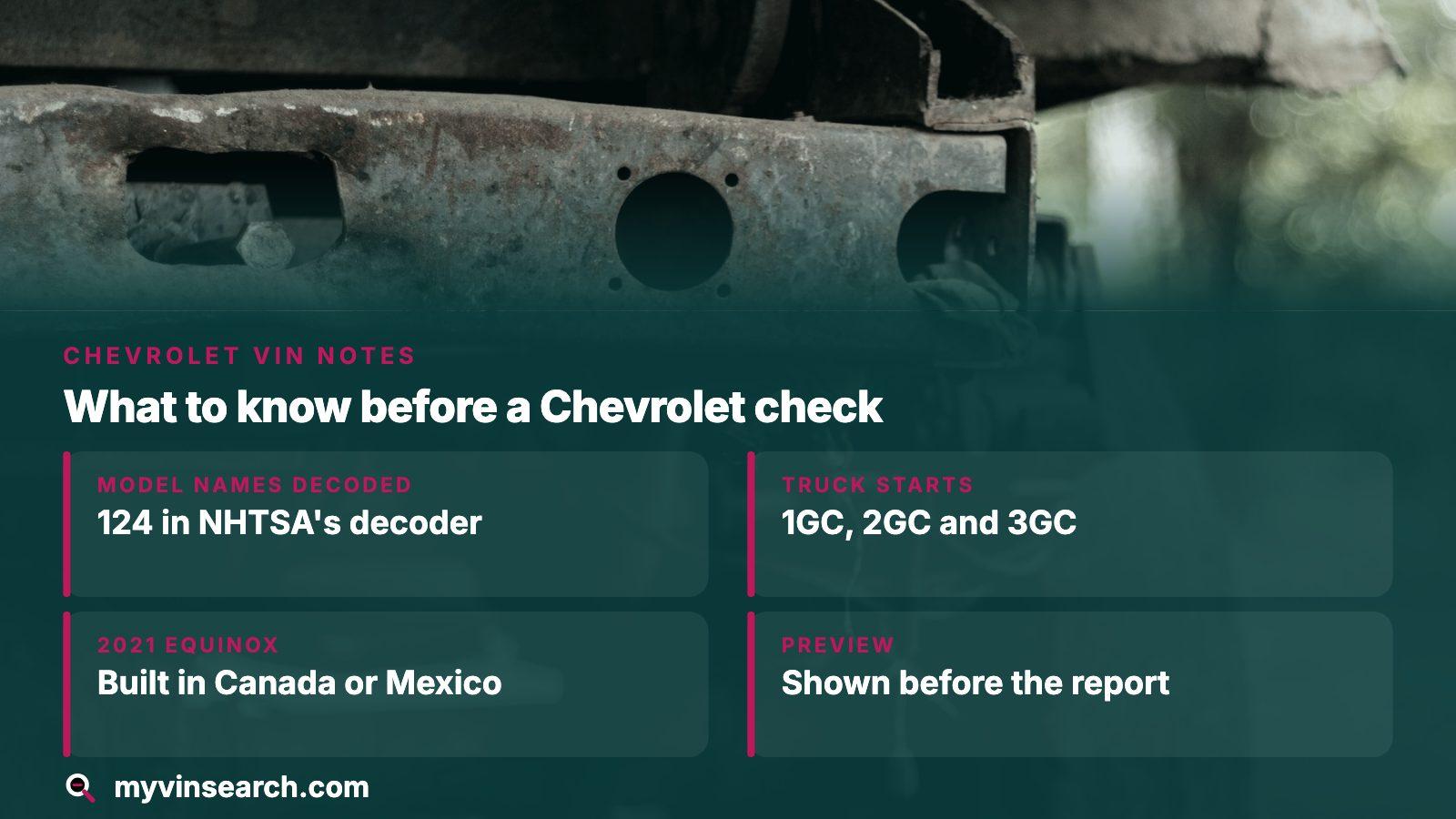
- Chevrolet names in NHTSA's decoder
- 124 model names
- Truck starts
- 1GC, 2GC and 3GC
- 2021 Equinox
- Built in Canada or Mexico, by VIN start
- Preview
- Free; the report is one payment
What the check reads off a Chevrolet
Chevrolet sells everything from a Spark to a heavy-duty Silverado, so the record behind a VIN can differ a lot between cars. For the number you enter, the check pulls:
- Title: any salvage, junk or flood brand a state has filed.
- Odometer: dated readings, so a rollback or a jump stands out.
- Damage: logged crashes, plus auction photos if the car was sold as salvage.
- Claims and liens: insurance entries, theft reports, impounds and money still owed.
- Recalls: campaigns still open on that VIN for its model and year.
- Owners and use: owner count, use type and market value.
How NHTSA files the Chevrolet starts
A VIN opens with three characters naming the maker and the kind of vehicle. NHTSA's decoder lists General Motors LLC as builder for every start below and sorts each by class.
| Starts with | Filed as | Seen on |
|---|---|---|
| 1G1, 2G1, 3G1 | Passenger car | Malibu, Camaro, Corvette, Impala, Cruze, Bolt EV |
| KL8 | Passenger car | Spark |
| 1GC, 2GC, 3GC | Truck | Silverado 1500, Colorado |
| 1GN, 2GN, 3GN, KL7 | Multipurpose passenger vehicle | Tahoe, Suburban, Traverse, Equinox, Blazer, Trax |
| 1GB, 3GB | Incomplete vehicle | Chassis finished in a second stage |
A start never names the model or the engine. Those are encoded in characters 4 to 8, while the 10th is the model-year code and the 11th the plant.
One Chevrolet name, several builds
Complaint records print just the first 11 characters of a VIN. NHTSA's decoder calls that incomplete but still names model, engine and plant, and the answers show why a badge proves little.
| VIN start | Decodes as | Built at |
|---|---|---|
| 2GNAXKEV9M6 | 2021 Equinox LT, 1.5-liter four-cylinder | Ingersoll, Ontario |
| 3GNAXKEV1MS | 2021 Equinox LT, 1.5-liter four-cylinder | Ramos Arizpe, Mexico |
| 1GCPWCED0KZ | 2019 Silverado 1500 LT, 5.3-liter V8 | Fort Wayne, Indiana |
| 3GCUYGED9KG | 2019 Silverado 1500 LTZ, 5.3-liter V8 | Silao, Mexico |
| 2GCVKPEC4K1 | 2019 Silverado LD LT, 5.3-liter V8 | Oshawa, Canada |
| KL7CJLSB8MB | 2021 Trax 1LT, 1.4-liter four-cylinder | Bupyeong, South Korea |
| 3GNCJKSB0FL | 2015 Trax LS, 1.4-liter four-cylinder | San Luis Potosí, Mexico |
The two Equinox rows share trim and engine yet come from different countries. The Oshawa truck decodes as a Silverado LD, a separate name in NHTSA's model list, so match the whole number, not the tailgate.
How to run the check on a Chevrolet
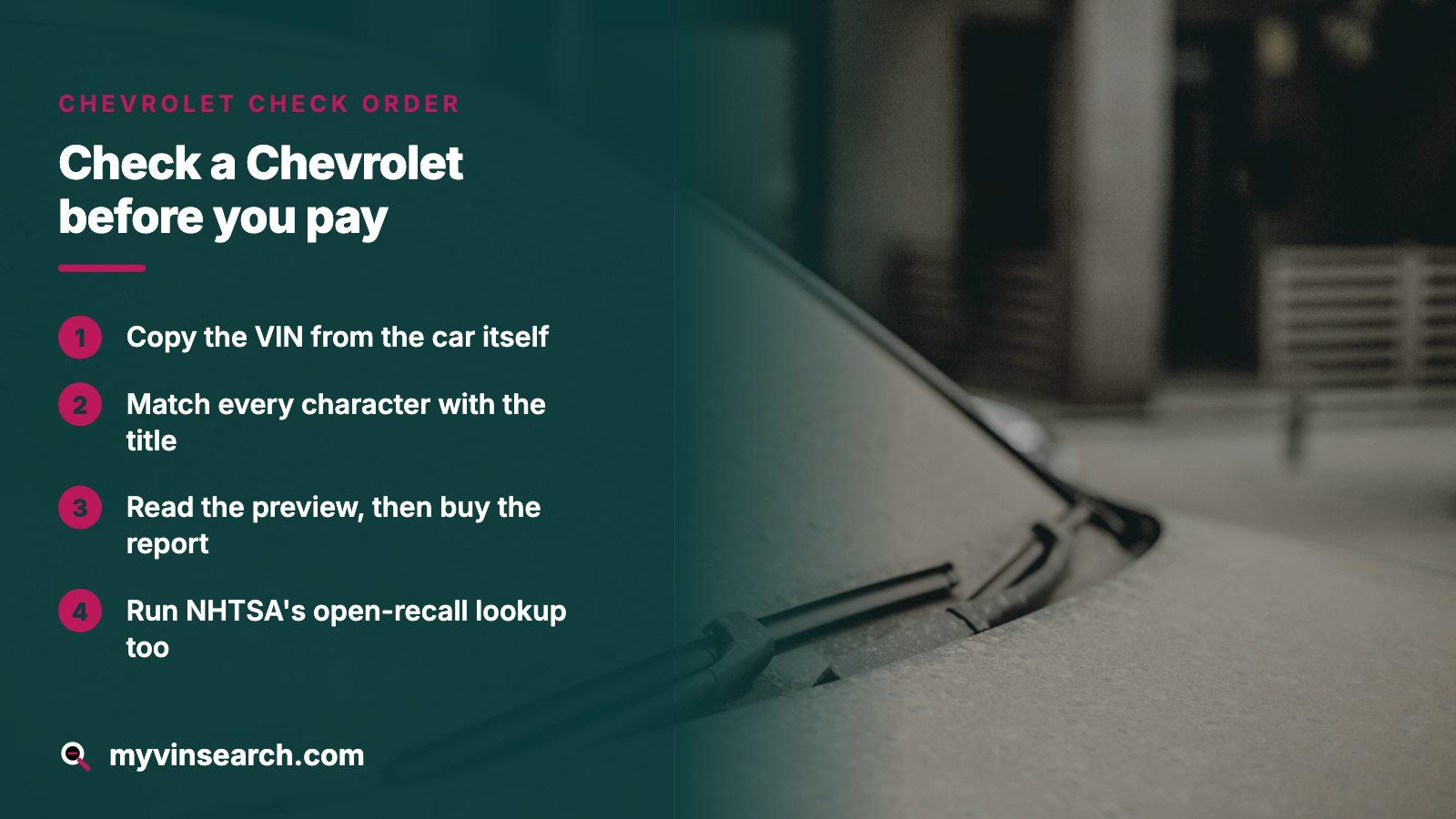
- Copy the VIN from the car itself, since ads get copied wrong. Peer through the windshield from outside, near the driver's pillar, where the number has to be readable. It is marked or plated onto a part built to stay put, so a loose plate deserves a question.
- Match every character with the title paperwork. The alphabet used in VINs skips I, O and Q, so any of those three in your copy is a slip.
- Type it into MyVINSearch. The preview is free and shows whether model, year and engine fit the listing. If not, stop and ask the seller why.
- When the preview fits, pay for the report once and read the odometer, title and recall lines first.
- Run the VIN through NHTSA's open-recall lookup as well, which costs nothing, and note anything still open.
From an NHTSA owner complaint
A would-be buyer of a 2013 Tahoe told NHTSA in July 2026 that, while inspecting the vehicle, the dash read 88,000 miles but a history report supplied by an auto-parts store listed 162,000.
That gap surfaced while the buyer was still looking. Run the check before any deposit changes hands, not after the paperwork.
What Chevrolet buyers report about mileage
Among 60,438 NHTSA complaints on 20 Chevrolet model names, 52 open with the words Odometer Fraud, filed from April 2025 to October 2026. The Silverado 1500 has 15, the Equinox 10 and the Tahoe 6. Twenty-five describe a private sale and 22 a dealer sale; the rest do not say. They are owners' accounts, not findings.
Gaps run large. One 2018 Equinox changed hands showing 75,000 miles and registered at 252,000, while a 2013 Silverado 1500 that sold with 72,000 on the dash was later reported at 268,000. Twenty-seven filings mention a history or similar report, so running one before paying is the cheaper moment to learn this.
A repaired Chevrolet can be recalled again: the Bolt EV
Recall counts vary widely by model and year: NHTSA's data returns 16 campaigns for a 2021 Tahoe and one for a 2018 Colorado. The Bolt EV battery recall shows why a closed repair is not always final.
| Campaign | Filed | Cars named | What it did |
|---|---|---|---|
| 20V-701 | Nov 2020 | All 2017-2018 and some 2019 cars | Software cap on charging; superseded |
| 21V-560 | Jul 2021 | Some 2017-2019 cars from 20V-701 | Defective battery modules replaced at no charge |
| 21V-650 | Aug 2021 | Some 2020-2022 Bolt EV, 2022 EUV | Module replacement widened |
| 24V-481 | Jun 2024 | Cars already fixed under 21V-650 | Diagnostic software may be wrong; reinstalled |
| 24V-812 | Oct 2024 | Same group again | Software install may have failed; reinstalled |
From an NHTSA owner complaint
An owner told NHTSA in August 2025 that a 2020 Bolt EV, repaired under every recall remedy and given a new battery in May 2023, was immobilized by another high-voltage battery failure. The dealer parked it away from other vehicles over fire concerns, and the owner says GM refused two buyback requests.
A completed recall on a report records a repair, not a guarantee. On a used Bolt, ask a dealer which campaigns are closed and whether a later one applies.
Reading the result, flag by flag
| You see | It usually means | What to do |
|---|---|---|
| Model, year or engine differs from the ad | The VIN belongs to a different Chevrolet | Stop and have the seller explain |
| Odometer entry above the dash reading | A later record conflicts with the display | Ask for dated service invoices; leave if none |
| Salvage, junk or flood brand | A state filed a total-loss style label | Get repair papers and an independent inspection |
| Open recall | The maker still owes a repair on this car | Ask a Chevrolet dealer if parts are in before agreeing a price |
| Recall marked done, model has follow-ups | A second campaign may apply | Have the dealer confirm every later campaign |
| Nothing flagged | Nothing adverse on file today | Rerun the VIN before signing, then book an inspection |
Where the record stops
Federal title data covers about 87 percent of US vehicles, while over half the states supply records. A reporter that has not joined can leave a hole, and brand rules vary by state, so a clear result still leaves room for hidden history. The federal page urges buyers to pull the state's own title record too.
Wear is invisible to it as well. The FTC cautions that a history report cannot replace a hands-on inspection and seldom lists mechanical trouble. Have the mechanic put findings in writing, VIN included, so the estimate backs your offer.
Cost and the next move
The preview is free and answers one question at once: do model, year and engine fit the ad? Reports are priced per VIN, with packs of three, five and ten for comparing several cars. Nothing renews on its own, and the pricing page has the figures.
- Take the VIN to a Chevrolet dealer and ask which campaigns are open or finished, later ones included.
- Order the state title record if the report shows a brand or a mileage conflict.
- Book an independent mechanic; a history report cannot judge wear.
Where this information comes from
- NHTSA vPIC: decode of a 2021 Equinox VIN start — The decoder call behind the table of VIN starts. The prefix classes and the list of Chevrolet model names come from the same service.
- NHTSA recalls data: Chevrolet Bolt EV, model year 2020 — The Bolt battery campaigns and their scope. Campaign counts for other models come from the same service.
- 49 CFR Part 565: Vehicle identification number requirements — Federal rules for VIN length, allowed characters, where the number must be readable and what positions 10 and 11 hold.
- NMVTIS consumer information — What federal title records hold, who reports to them, and why a clean result can still miss history.
- FTC: Buying a used car — Why a history report does not replace an independent inspection, and what to ask the mechanic for.
- NHTSA owner complaint 11749051 — owner experience, paraphrased
- NHTSA owner complaint 11683892 — owner experience, paraphrased
Sources and photos: Facts checked against the sources above in November 2026. Photos by John Kakuk, JavyGo and Zoshua Colah on Unsplash; diagrams by MyVINSearch.
Keep reading
- Chevrolet recall check by VIN: find the model line, then the open campaignsOpen campaigns by Chevrolet model line, and how a lookup by VIN works.
- GMC VIN check: what the VIN shows for a Sierra, Yukon, Acadia or TerrainThe Sierra and Yukon share platforms and recall filings with the Silverado and Tahoe.
- Sample reportSee each section of the report before you buy one.
- PricingHow one report and the packs of three, five and ten are priced.
Frequently asked questions
Can I run a Chevrolet VIN check for free?
Only the preview. Enter the VIN to see whether model, year and engine match the ad; each full report is a one-off purchase, and nothing recurs. NHTSA's recall lookup by VIN is also free of charge, so use both before you commit.
Which VIN starts does Chevrolet use?
NHTSA files 1G1, 2G1, 3G1, KL1, KL8 and 6G1 as passenger cars, 1GC, 2GC and 3GC as trucks, 1GN, 2GN, 3GN and KL7 as multipurpose vehicles, and 1GB and 3GB as incomplete vehicles. One model can wear several starts, so read all 17 characters.
Why does my 2019 Silverado decode as an LD?
NHTSA lists Silverado, Silverado LD, Silverado HD and Silverado LTD as separate names. A 2019 start beginning 2GC, built in Oshawa, returned Silverado LD in the table above; the 1GC and 3GC starts returned Silverado 1500.
What if the report shows more miles than the dash?
Hold off until someone explains it. Ask for dated service invoices, order the state title record and have a mechanic judge the wear. Many owners in the NHTSA filings found the conflict only at registration, a costly time to find out.
Is a clean Chevrolet report enough to buy?
No. Clean means nothing adverse was on file that day, and reporting has gaps. Reports rarely list mechanical faults, so get an independent shop to examine the car, and rerun the VIN on signing day in case something new has landed.
Now check the car itself
The guide explains what to look for. The report shows what this VIN has on record.