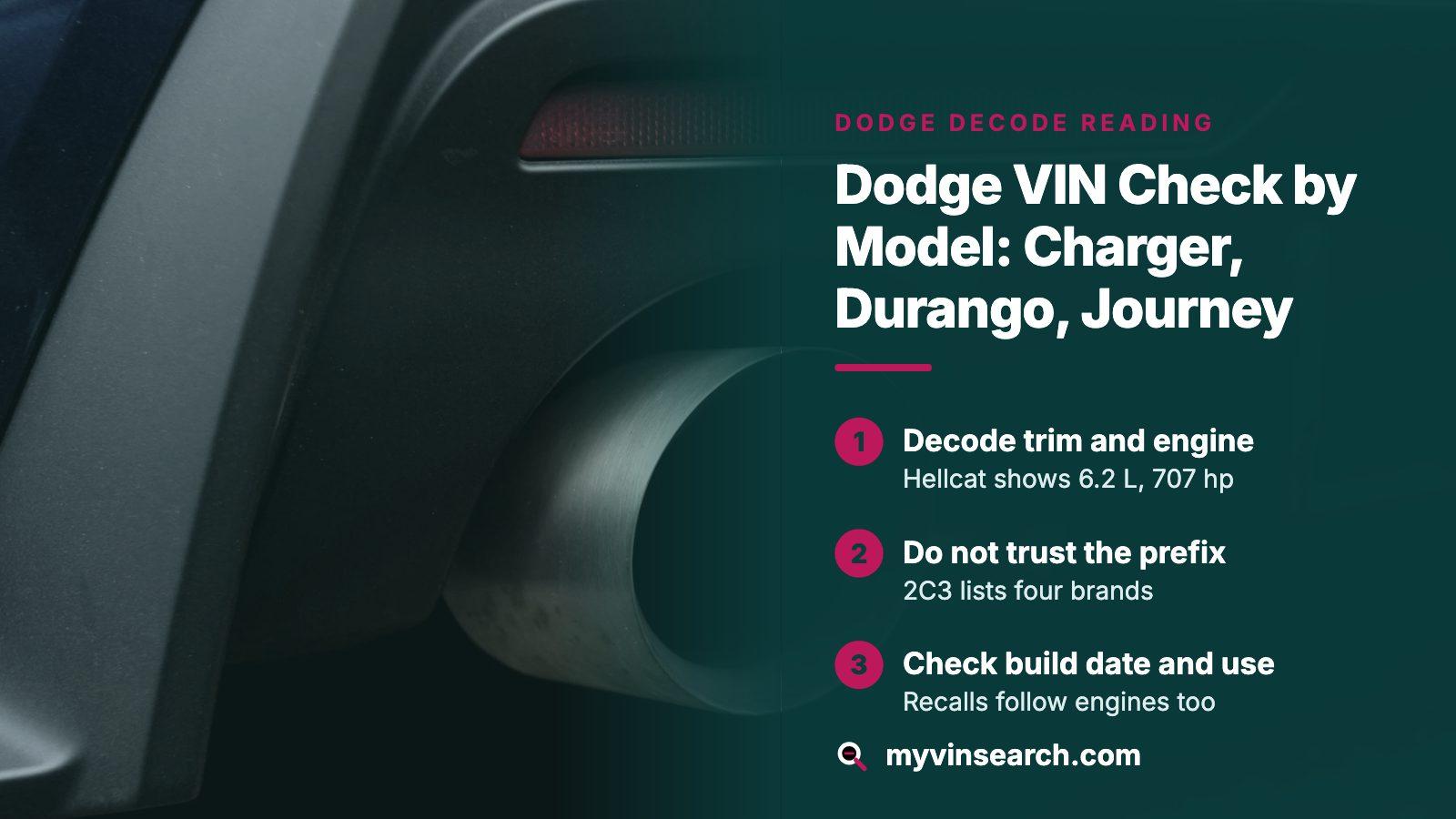
THE SHORT ANSWER
Enter the VIN in the preview, which costs nothing, and confirm that the decoded model, trim and engine match the listing. Then buy the report once and read title brands and mileage before anything else. On a Dodge the decode earns extra attention: the first three characters often fail to name the brand, while the engine characters inside the number separate a base Challenger from a Hellcat.
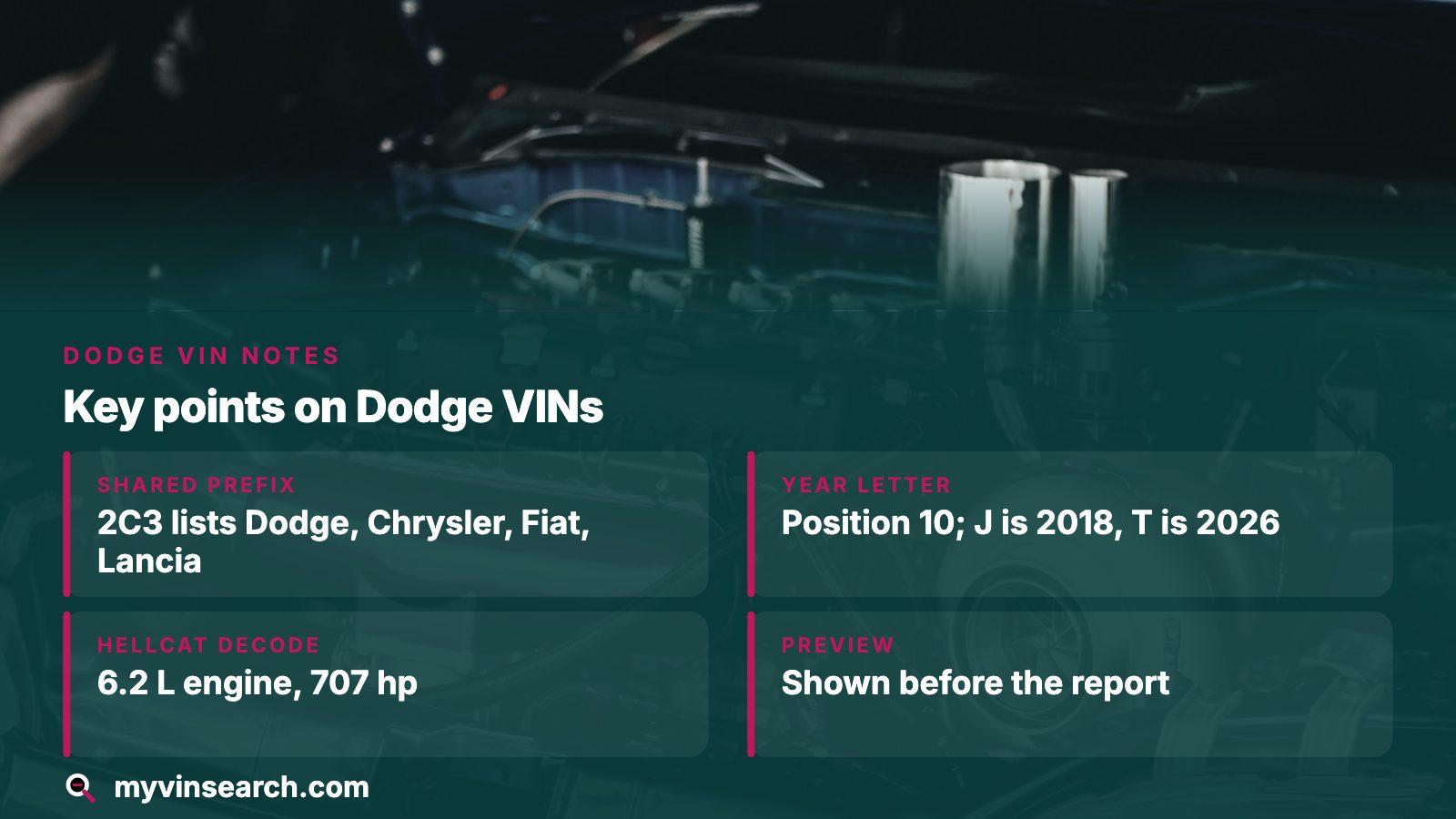
- Shared prefix
- 2C3 lists Dodge, Chrysler, Fiat and Lancia
- Year letter
- Position 10; J is 2018, T is 2026
- Hellcat decode
- 6.2 L engine, 707 hp
- Preview
- Free; the report is one payment
What a Dodge search returns for one car
Two Chargers built in the same week can have opposite pasts, so the report describes one VIN and nothing wider. On a Dodge these lines tend to settle the purchase:
- Mileage readings in date order, so a drop or a leap stands out.
- Salvage, junk or flood labels on the title, and damage entries with auction photos where a sale took place.
- Use type, such as private, rental or fleet.
- Open recalls on this VIN, plus liens, theft entries and a market value.
Why the first three characters often do not say Dodge
NHTSA's decoder lists the makes that can sit behind each three-character prefix. A few are Dodge alone. In the decodes run for this page every car from 2012 on carried a shared prefix, while a 2009 Charger and a 2005 Stratus carried Dodge-only ones.
| Prefix | Makes NHTSA lists | Maker named |
|---|---|---|
| 1B3 | Dodge | FCA US LLC |
| 2B7 | Dodge | FCA Canada |
| 3D7 | Dodge | Chrysler de Mexico Toluca |
| 2C3 | Dodge, Chrysler, Fiat, Lancia | FCA Canada |
| 3C4 | Dodge, Chrysler, Volkswagen, Jeep, Fiat, Ram, Lancia | Chrysler de Mexico Toluca |
The tenth character is the model year: J is 2018, K 2019, L 2020, M 2021, N 2022, P 2023, R 2024. The eleventh names the plant.
Trim and engine: reading a Charger or Challenger decode
Characters four to eight describe the car as built, engine included, so a swapped badge cannot change what the number decodes to. These partial VINs went through NHTSA's decoder, an asterisk replacing the check digit:
| VIN start | Decodes as | Engine and output |
|---|---|---|
| 2C3CDXBG*GH | 2016 Charger SE | 3.6 L, 292 hp |
| 2C3CDXCT*GH | 2016 Charger R/T | 5.7 L, 370 hp |
| 2C3CDZBT*JH | 2018 Challenger R/T | 5.7 L, 375 hp |
| 2C3CDZFJ*KH | 2019 Challenger Scat Pack | 6.4 L, 485 hp |
| 2C3CDZC9*JH | 2018 Challenger SRT Hellcat | 6.2 L, 707 hp |
| 2C3CDZH9*JH | 2018 Challenger SRT Demon | 6.2 L, 840 hp |
A Challenger that decodes to 5.7 L and 375 horsepower is an R/T, whatever the hood scoop suggests. Compare the decoded engine with the one under the hood and bargain from the decode.
Durango, Journey, Grand Caravan, Dart and the missing pickups
The same lookup separates the family models, down to engine, drive wheels and assembly plant.
| Decoded start | Result | Built at |
|---|---|---|
| 2019 Durango GT, 1C4RDJDG*KC | 3.6 L, 295 hp, all-wheel drive | Detroit, Michigan |
| 2018 Grand Caravan SE, 2C4RDGBG*JR | 3.6 L, 283 hp, front-wheel drive | Windsor, Ontario |
| 2017 Journey SE, 3C4PDCAB*HT | 2.4 L, 4 cylinders, 173 hp | Toluca, Mexico |
| 2014 Dart SE, 1C3CDFAA*ED | 2.0 L, 4 cylinders | Belvidere, Illinois |
Two list quirks matter. NHTSA shows no Challenger under Dodge for model year 2024, and by 2026 only the Charger and Durango remain. Pickups run the other way: through model year 2012 the decoder files a Ram under Dodge, and from 2013 the same truck decodes as make Ram.
Recalls follow build dates, engines and use
NHTSA's recall data returns 10 campaigns for a 2012 Durango and 1 for a 2020 Challenger, so the model year only starts the answer.
- Build dates: a 2012 Journey brake-fluid campaign covers cars assembled from October 24 to October 26, 2011, three days in all.
- Engine: a Journey campaign on an engine cover that can touch the exhaust manifold names only 2.4 L engines built from July 19, 2010 to May 26, 2015.
- Use: police-package Charger Pursuit cars carrying a V8 and all-wheel drive are named in a separate front driveshaft campaign.
- Replacements: a Durango ABS campaign was superseded, so cars fixed under the old one need the new remedy. The Dart shifter cable works the same way.
- Air bags: side curtain inflators on 2018 to 2021 Chargers can rupture, and the dealer swaps both curtain bags.
A salvage or rebuilt brand can block recall work
NMVTIS keeps a brand on a car's record for good once a state applies one. At least four complaints in NHTSA's Dodge data, filed from 2014 to 2026, say recall work was refused over a salvage or rebuilt title.
From an NHTSA owner complaint
In March 2026 a 2020 Charger Scat Pack owner reported a side curtain air bag firing in ordinary driving, with no impact, tearing trim and throwing fragments. A Dodge dealer agreed the VIN carried an open air bag recall, yet refused to work on the car, pointing to its rebuilt title.
Find the brand before you pay, not at the first service visit. A cheaper branded car can mean trouble getting recall work done.
Odometer disputes in Dodge owner complaints
NHTSA's Dodge complaint data, ten models from 2008 to 2024, holds 29,267 entries. Sixteen open with the words odometer fraud: eight on the Durango, four on the Charger, three on the Grand Caravan, one on the Challenger. Eight were dealer sales and eight private. Treat them as unverified owner reports, which say nothing about how common rollbacks are.
From an NHTSA owner complaint
A buyer took a 2018 Durango from a dealer in late December 2025 showing 82,000 miles, then was refused an extended warranty. A record shown to the buyer had it at 186,000 miles that October, and a history report later said 194,000. The buyer told the dealer.
A reading below an earlier one is the whole warning. Sellers must put the mileage in writing at transfer; ask for that statement and hold it against the report.
Running a Dodge through the preview
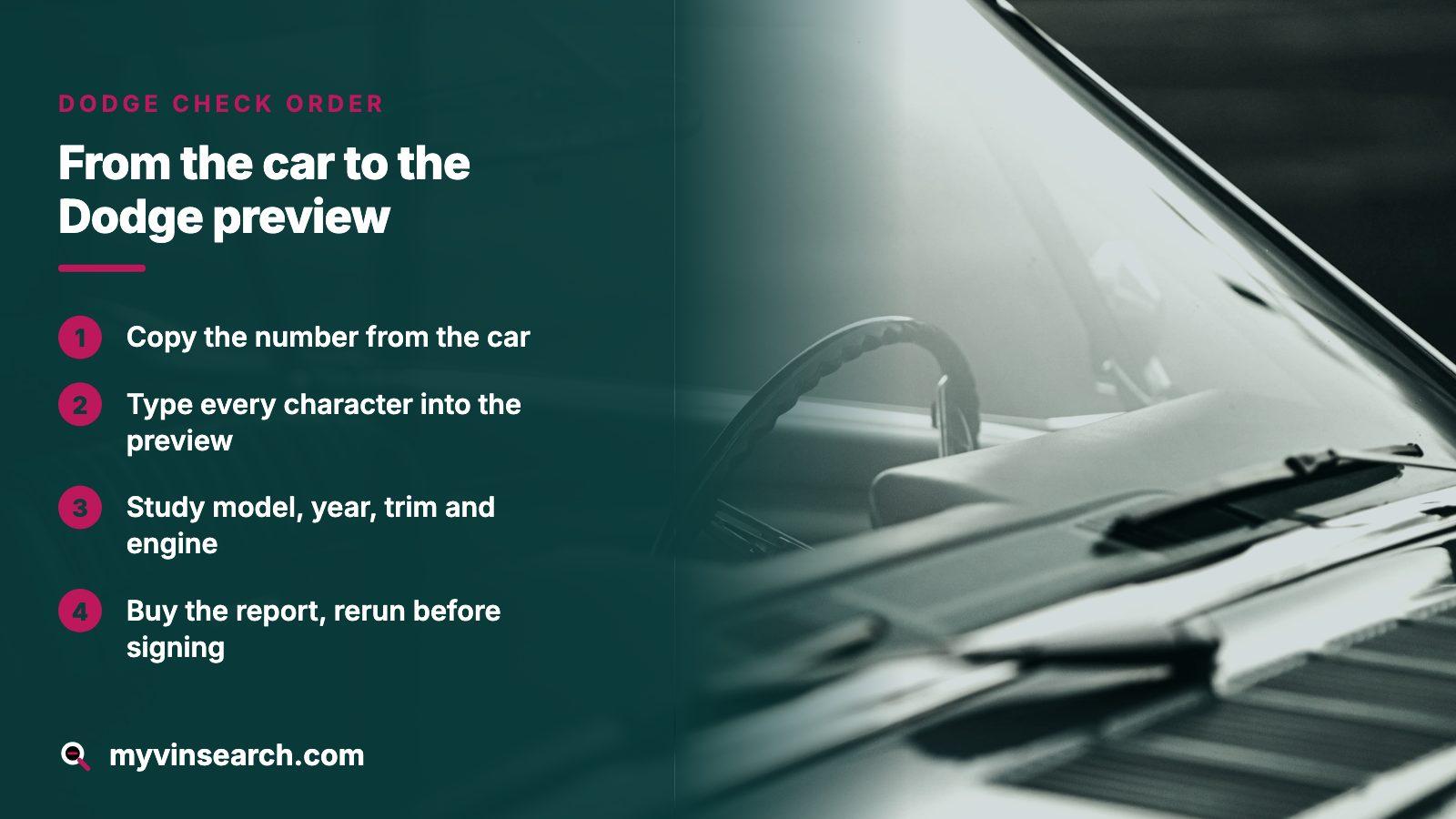
- Copy the number from the car: it can be read through the glass beside the driver's windshield pillar. Compare it with the title.
- Type all 17 characters into MyVINSearch. Since VINs never contain I, O or Q, anything resembling those letters is really a digit.
- Study the free preview: model, year, trim, engine. A decode naming a smaller engine than the advert is a reason to stop.
- If it agrees, buy the report once and read brands and mileage first, then damage, use type and recalls.
- If weeks pass before signing, run it again: a rear spoiler filing on 2021 to 2023 Durangos reached NHTSA in August 2026.
Reading the result: red flags and next moves
| Finding | What it tells you | Next move |
|---|---|---|
| Engine smaller than the advert says | Badge or ad does not match the build | Reprice to the decode or walk away |
| Police, rental or fleet use | Not a private car's first life | Ask for service records; check brakes and suspension |
| Reading below an earlier one | Dash and record disagree | Ask for service invoices; leave if none |
| Salvage, rebuilt, junk or flood label | A state or insurer marked it damaged | Get the repair file; ask a dealer about recall service |
| Open recall | A free repair is owed on this VIN | Ask whether parts are in stock |
A quiet report is not a verdict. NMVTIS holds 87 percent of vehicles, yet more than half the states feed it, so a reporting gap can read as no history. Order the state's own title record to fill what the database leaves out.
Cost, and the steps once you hold the report
The preview costs nothing. One report is one payment covering one VIN, and anyone weighing several cars can buy three, five or ten reports together; nothing renews. Amounts sit on the pricing page.
- Ask a Dodge dealer to run the VIN against open campaigns and confirm parts are available for the repair.
- Order the state title record if a brand or a mileage conflict appears, since the federal database leaves some of it out.
- Have a mechanic you choose look the car over before signing.
Where this information comes from
- NHTSA vPIC: partial VIN decode of a Charger R/T start — The decode tables, the prefix lists and the model-by-year listings come from this decoder service.
- NHTSA recalls data: Dodge Journey, model year 2012 — Campaign counts, build windows and engine limits. The Charger, Durango and Dart listings come from the same service.
- 49 CFR Part 565: Vehicle identification number requirements — What each VIN position means, the year letters and the characters a VIN may use.
- 49 CFR Part 580: Odometer disclosure requirements — What a seller must write down about mileage at transfer.
- NMVTIS consumer information — What the federal title database holds, its coverage figures and why a state title record is worth ordering.
- NHTSA owner complaint 11721443 — owner experience, paraphrased
- NHTSA owner complaint 11726621 — owner experience, paraphrased
Sources and photos: Facts checked against the sources above in November 2026. Photos by Dain Lindo, Dylan Michaud and Willian Cittadin on Unsplash; diagrams by MyVINSearch.
Keep reading
- Ram VIN check by line: 1500, 2500, 3500 and ProMasterPickups moved from the Dodge listing to Ram at model year 2013, so this is the next stop for a truck.
- Chrysler VIN check by model: Pacifica, 300, 200 and Town and CountryChrysler and Dodge cars share prefixes, and a 300 can sit beside a Charger on the same recall.
- Sample reportSee each section of a report before you pay for one.
- PricingWhat one report costs, and how bundles of three, five and ten are priced.
Frequently asked questions
Is the Dodge VIN check preview really free?
Yes. Type the VIN in and compare the decoded model, year and engine with the listing. Only the full report costs money, as a one-time purchase per VIN with no subscription.
Can a VIN tell a Hellcat from a base Challenger?
The decoded engine can. In the decodes on this page, a 6.2 L engine at 707 horsepower marks the Hellcat, while 5.7 L at 375 marks an R/T. Badges and hood scoops can be bought, so trust the decode, then confirm the engine in person.
Does the VIN show whether a Dodge was a police car?
Sometimes the decoder says so: a 2016 Charger start came back with the trim Police. The report's use type entry adds to that picture, and Charger Pursuit cars have their own recall filings, so check both.
Why does my Dodge VIN start with 2C3 but name Chrysler?
The first three characters point to a maker group, not a brand. NHTSA lists Dodge, Chrysler, Fiat and Lancia for 2C3, so decode all 17 characters to learn the model.
Do Dodge recall repairs cost anything?
Every remedy in the Dodge filings read for this page is called free of charge. If a dealer refuses over a title brand, call the customer line in the recall notice and file an NHTSA complaint.
Now check the car itself
The guide explains what to look for. The report shows what this VIN has on record.