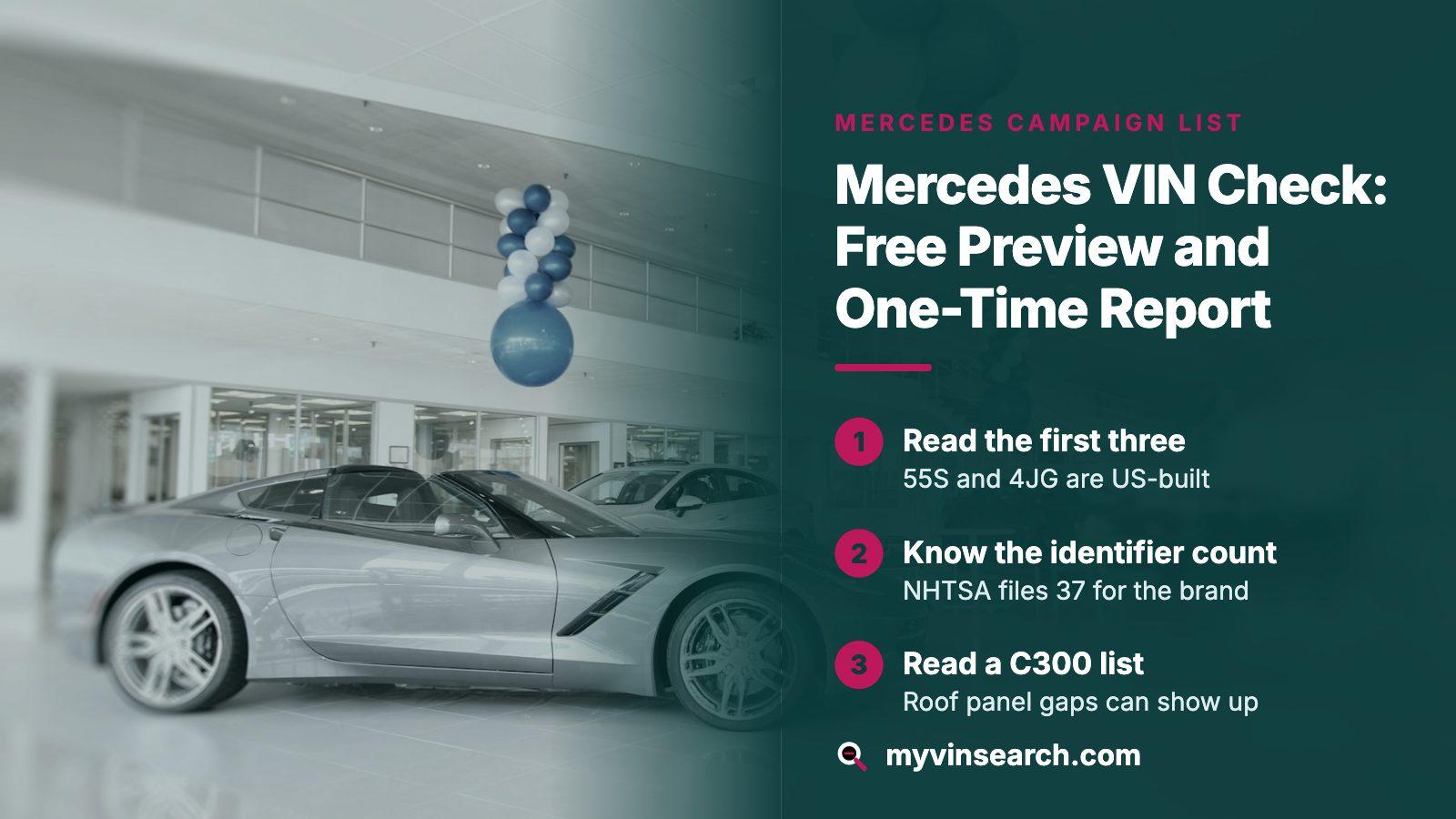
THE SHORT ANSWER
Read the 17-character VIN off the car, run it for the free preview, and buy the one-time report once the preview matches. The report adds that VIN's title, damage, mileage, salvage and recall entries. Mercedes recall notices often name build dates, a drivetrain or a panoramic sunroof, so the VIN, not the model name, decides which apply. Nothing renews.
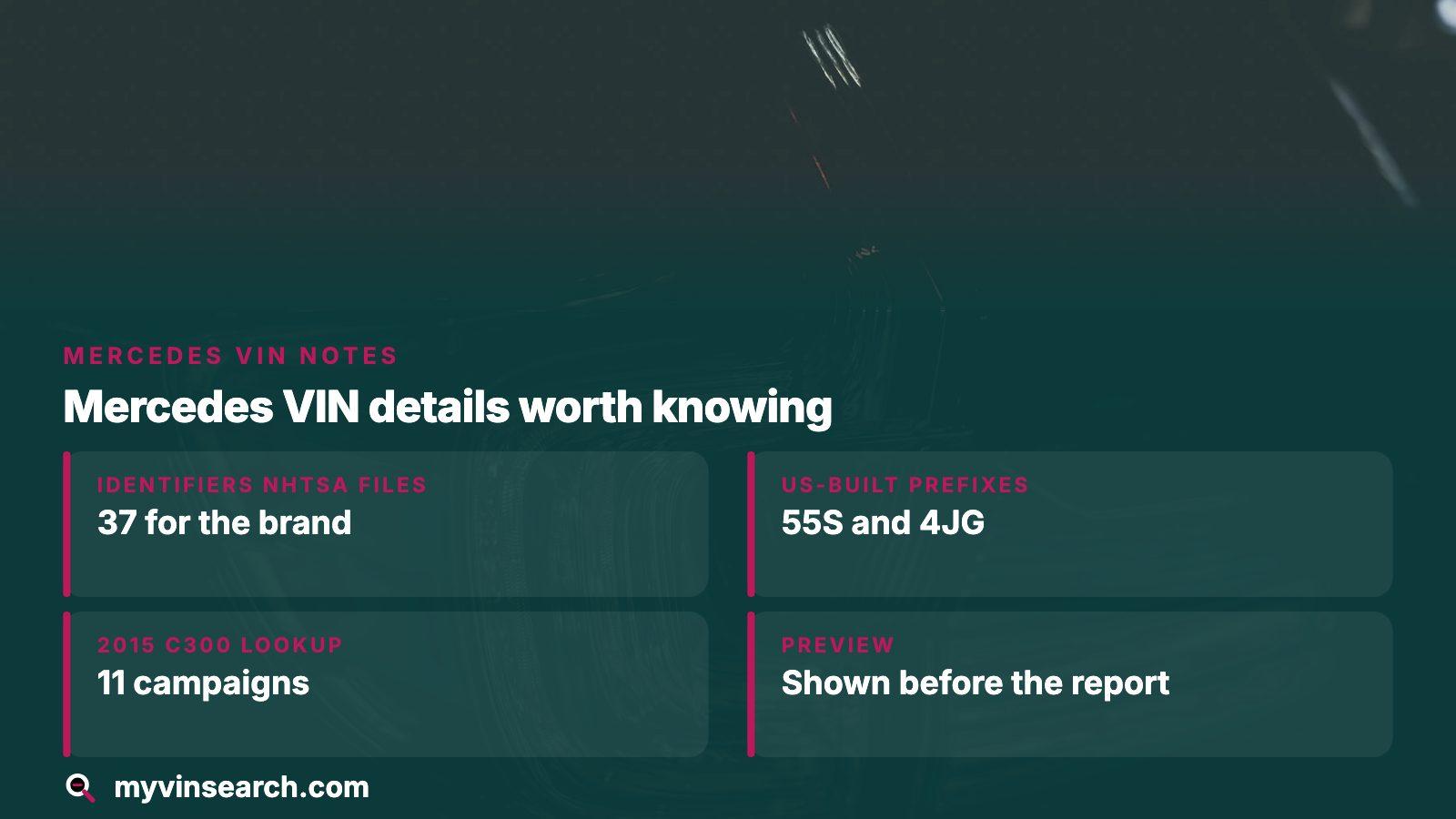
- Identifiers NHTSA files for the brand
- 37
- US-built prefixes
- 55S and 4JG
- Campaigns on a 2015 C300 lookup
- 11
- Preview
- Free; the report is one payment
What a Mercedes-Benz VIN check shows for the car you are eyeing
Records attach to the VIN, not the badge, so two Mercedes from the same model year can have unrelated pasts. A check collects them in one place:
- Title brands: junk, salvage or flood labels set by a state agency or an insurer.
- Crashes on file, with auction photos where a salvage sale took place.
- Odometer readings logged at different dates, so a drop stands out.
- Liens, impounds, theft entries and insurance claims.
- Recalls still open on that VIN, with the market value and factory specs.
Find the VIN, then read its first three characters
By federal rule the number sits where a person outside the car can read it through the windshield at the driver's side, and it is also marked on a part made to stay on the car. Copy it slowly: a VIN never holds the letters I, O or Q, so one in your entry is a typo.
NHTSA's decoder files 37 identifiers under Mercedes-Benz across five vehicle classes. These are the ones buyers meet most often.
| Starts with | Country on file | NHTSA class |
|---|---|---|
| WDD or WDB | Germany | Passenger car |
| 55S | United States | Passenger car |
| WDC or W1N | Germany | Multipurpose passenger vehicle |
| 4JG | United States | Multipurpose passenger vehicle |
| WD3 | Germany | Truck |
A prefix names a maker and a class, never a model. The model line sits in positions 4 to 8, in a code Mercedes-Benz gives NHTSA, and position 9 is a check digit that catches typing slips. A US prefix is no red flag: NHTSA files 55S and 4JG for the brand.
One badge, eleven campaigns: reading the 2015 C300 list
NHTSA's lookup for a 2015 C300 returns 11 campaigns, filed from 2014 to 2023, and they do not all reach the same car. Six show how tightly the notices are drawn.
| Campaign | Cars it names | What it covers |
|---|---|---|
| 14V598 | 4MATIC cars built March 28 to September 18, 2014 | Steering coupling may not be locked |
| 15V087 | Cars built June 18 to September 5, 2014 | Headlight aim adjusters owners can turn |
| 15V138 | 4MATIC cars built April 7 to July 25, 2014 | Fuel module loose or wires pinched |
| 17V114 | 2015 to 2017 C300 and many other models | Starter current limiter can overheat |
| 18V850 | Rear-wheel-drive cars | Steering rack locknut can break |
| 21V197 | Cars with a panoramic sunroof | Front roof panel can come loose |
A 4MATIC car built in May 2014 sits inside the windows of 14V598 and 15V138 but outside that of 15V087. Whether 18V850 applies turns on the drivetrain, and 21V197 on the sunroof. A 2015 E350 lookup, for comparison, returns 6. Build date, drivetrain and equipment sit behind the VIN, which is why the VIN decides.
The roof panel campaigns: when the maker's list leaves a car out
Campaign 21V197 is about the roof panel that sits between the windshield and a panoramic sunroof. The filing says the bond may have been made badly in an earlier repair, and the glue can weaken until the panel comes away. In December 2023 Mercedes-Benz USA filed 23V854 to widen it, naming the C-Class and CLA plus GLA, GLC, GLE and S-Class cars from 2014 to 2020, and sending readers to its own report for exact vehicles.
From an NHTSA owner complaint
A 2015 C400 owner described water seeping in at the front of the roof, near the windshield, inside a high-pressure car wash in February 2025. The owner was told campaign 23V854 did not list the car's VIN, though the owner states the car had the very fault the recall describes. It stood at 100,000 miles, and the owner says the maker offered no help.
That is one owner's account, and the maker's list may have been right. Even so, a match on model and year settles nothing, so have a dealer search the VIN and put the result in writing.
A recall repair on record is not a guarantee
When a history report lists a recall as completed, it tells you a repair was logged. It cannot tell you the repair held.
From an NHTSA owner complaint
A 2015 C300 owner reported an odd noise while driving in April 2026, then found the roof panel had flown off the car. The 21V197 repair had been done in 2021. The owner was told a repair would not be covered by warranty, and says the maker gave no help. Mileage was about 62,612.
Read the date and the repair order behind each completed recall, and have an independent mechanic look over the roof edge and glass seams on any car with a panoramic top.
Run the check in five steps
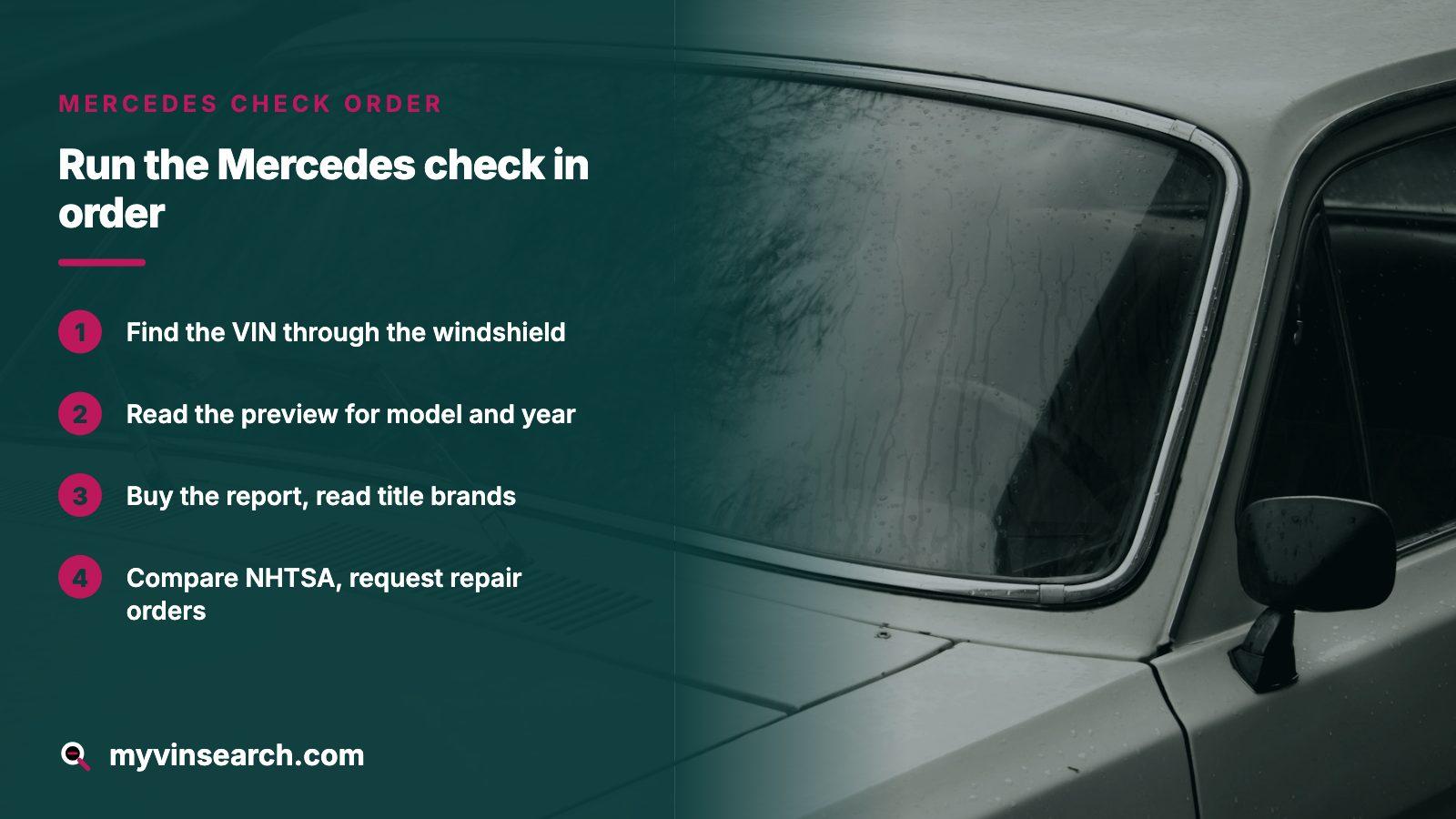
- Find the VIN through the windshield, then check each character against the title or the seller's documents.
- Enter it and read the free preview. If the model, year or engine differs from the ad, stop and ask why.
- Buy the report once the preview fits, and read title brands, damage and mileage first.
- Set the recall list beside NHTSA's own lookup by VIN, then ask a Mercedes dealer to confirm the result for that VIN.
- Request the repair order behind each recall marked complete, and rerun the VIN on signing day.
Red flags in a Mercedes result, and what to do with each
- A title brand: a state or insurer once called the car junk, salvage or flood. Ask for the repair papers and book an independent inspection.
- A reading below an earlier one: the odometer went backward somewhere. Get the seller's explanation in writing.
- Auction photos: set the damage shown against what the seller says was fixed.
- An open campaign: a recall repair is still owed on this VIN. Ask whether parts are in stock before you agree on a price.
- A model, year or engine unlike the ad: the number belongs to another car. Settle that before you talk price.
What the federal title data can and cannot settle
The federal title database, NMVTIS, is fed by state agencies, insurers, recyclers and salvage yards, and its limits show what any title search can miss. The Justice Department's consumer page gives its coverage as 87 percent of all US vehicles, though the states do not all report, so a clean search can still overlook a brand. States also set their own rules: one calls a damaged car salvage where another does not. An insurer can tag a car total loss when it stays stolen for 30 days, and the tag stays after a clean recovery. The same page describes stolen cars fitted with the VIN of an ordinary look-alike, same make, model and year, so match the preview's model and engine to the car itself. A state's own title record holds more than NMVTIS does; pull it when a price looks too good.
Price, and what to do after the preview
Seeing the preview costs nothing, and it shows whether model and year match the ad. A full report covers one VIN for a single payment, with no subscription. For a shortlist of Mercedes cars, the pricing page lists bundles holding 3, 5 or 10 reports.
- Open the sample report to read each section, from title brands to market value, before you pay.
- Ask an independent Mercedes mechanic to check what no database sees, from the brakes to the roof seals.
Where this information comes from
- 49 CFR Part 565: Vehicle identification number requirements — VIN length, allowed characters, the check digit and where the number must be readable.
- NHTSA vPIC: Mercedes-Benz manufacturer identifiers — The 37 identifiers filed for the brand, with country and vehicle class.
- NHTSA recalls data: Mercedes-Benz C300, model year 2015 — The 11 campaigns behind the table, with the build dates, drivetrains and equipment each names.
- NHTSA recalls data: Mercedes-Benz E350, model year 2015 — The shorter list returned for an E350, used as a comparison.
- NMVTIS consumer information — What federal title records hold, where they come from, and why a clean result can still miss history.
- NHTSA owner complaint 11679248 — owner experience, paraphrased
- NHTSA owner complaint 11733048 — owner experience, paraphrased
Sources and photos: Facts checked against the sources above in November 2026. Photos by Richard R, Tigran Shishmanyan and A n v e s h on Unsplash; diagrams by MyVINSearch.
Keep reading
- Sample reportSee each section of the report before you pay for one.
- PricingHow one report is priced, and how the multi-car bundles work.
- BMW VIN check: read the VIN, then match your engine and build dateA common cross-shop for a C-Class, and how that check reads engines and build dates.
- Lexus VIN check: what the VIN shows for an ES, RX, IS, GX or NXAnother luxury make buyers weigh against Mercedes-Benz, run through the same steps.
Frequently asked questions
Can I run a Mercedes VIN lookup for free?
Only the preview. It is free and reads the model and year from the VIN; the full report costs a single payment for one car, with no renewal. NHTSA's recall lookup by VIN is free too, and worth running alongside.
Does a Mercedes VIN check show open recalls?
Yes, recalls still open on that VIN are part of the report. Mercedes notices often depend on build dates, drivetrain or equipment, so compare the result with NHTSA's lookup and ask a dealer to confirm it in writing.
What does 55S or 4JG at the start of a Mercedes VIN mean?
NHTSA files both under Mercedes-Benz as United States identifiers: 55S for passenger cars and 4JG for multipurpose passenger vehicles. German-built cars start with letters such as WDD, WDB or WDC. A prefix gives the maker and class only, so the model comes from later characters.
Is a clean Mercedes VIN check a guarantee?
No. Not every state reports title data, states define brands differently, and a clean result says nothing about wear or unreported damage. Pair it with the state's title record and an independent mechanic's inspection before you pay.
My dealer says no recall applies, but the roof panel campaign names my model. Who is right?
Both can be. Campaign 21V197 reaches only cars fitted with a panoramic sunroof, and the 2023 expansion refers readers to the maker's own report for exact vehicles. Ask the dealer to search your VIN, run NHTSA's lookup yourself, and file an NHTSA complaint if the symptom matches.
Now check the car itself
The guide explains what to look for. The report shows what this VIN has on record.