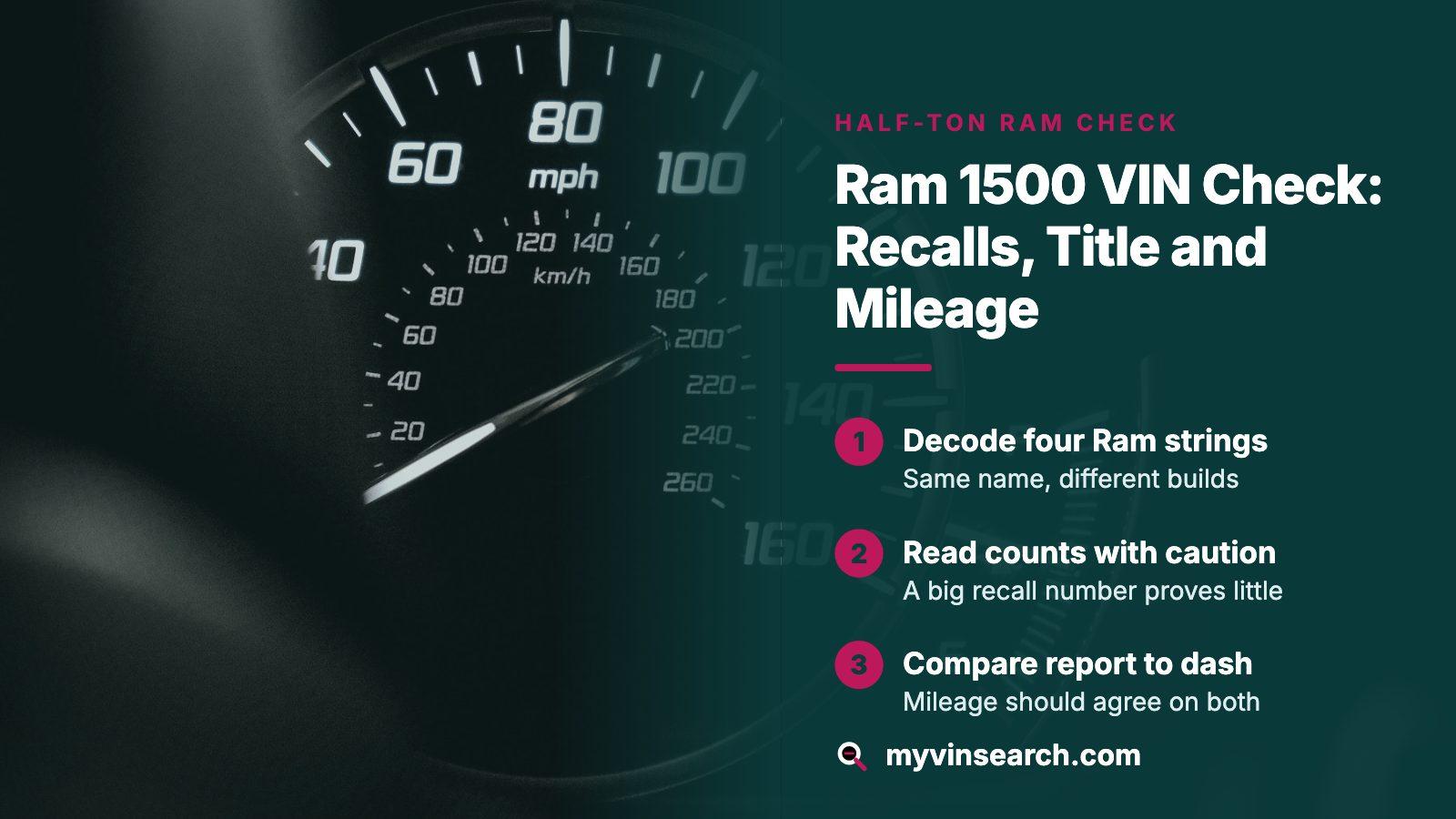
THE SHORT ANSWER
Read the VIN off the truck, type it into MyVINSearch and look at the free preview. It tells you whether year, trim, engine and plant agree with the listing. If they do, one paid report shows brands, damage and odometer entries. Then enter the same number in NHTSA's recall search, because Ram campaigns apply only to certain builds.
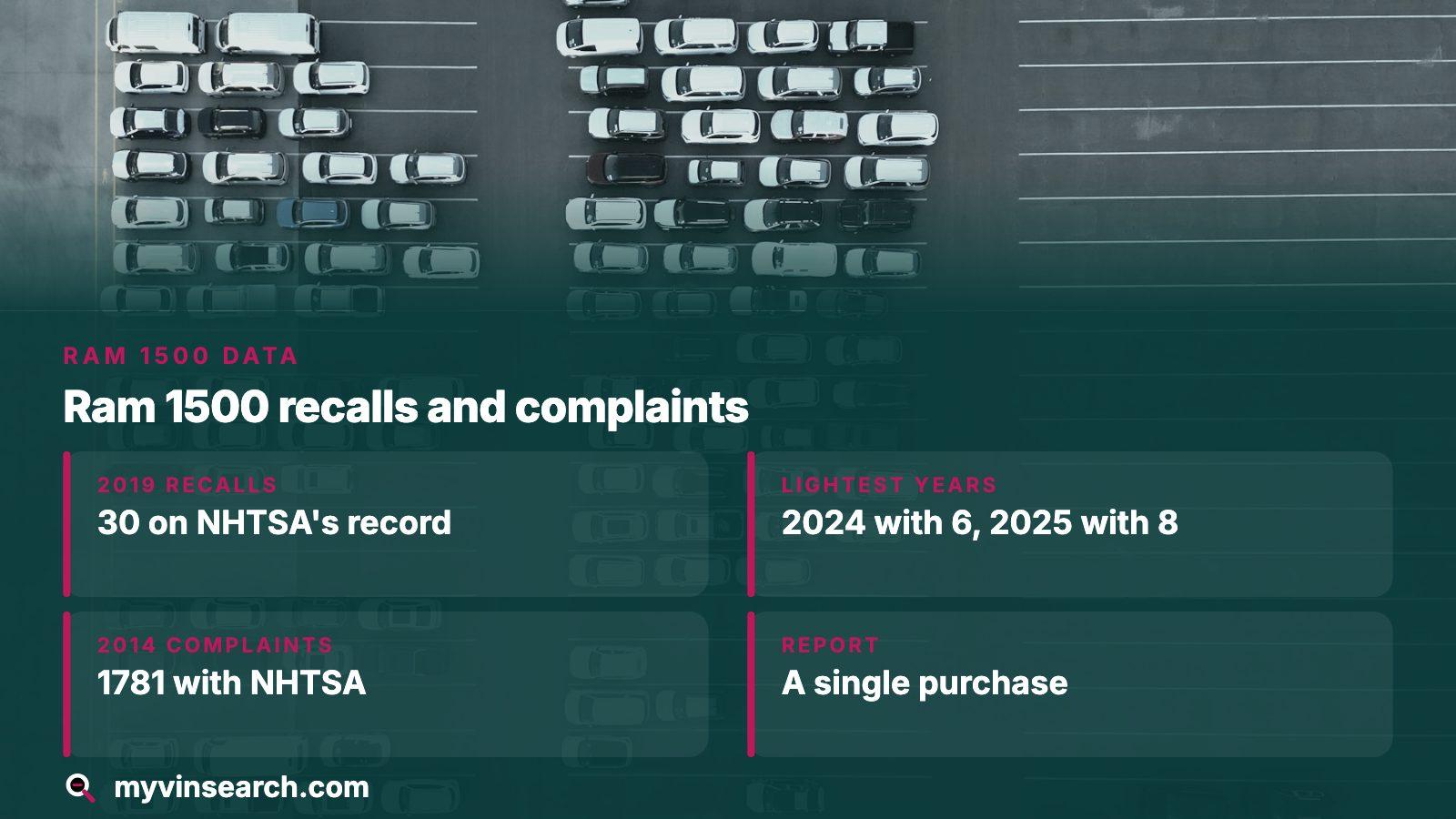
- Recall campaigns, 2019 Ram 1500
- 30 on NHTSA's record
- Lightest years pulled
- 2024 with 6, 2025 with 8
- Complaints, 2014 model year
- 1781 filed with NHTSA
- Preview
- Preview costs nothing; the report is a single purchase
What a model-specific check adds for a half-ton Ram
MyVINSearch organizes its checks by make and model, so the results you read are framed around a Ram pickup and not around cars in general. Half-ton trucks lead busy lives. They tow trailers, sit on work sites, change hands between tradespeople and show up at auctions after crashes, which is why a shiny crew cab can still carry a messy file.
- Brands on the title (salvage, rebuilt, flood) along with the state behind each one.
- Insurer total-loss entries and damage records, with auction photos if a wreck went through a sale.
- Mileage recorded at earlier titles and inspections, which should only move upward.
- Recalls that remain open, waiting on a repair at a Ram dealer.
- Lender claims, theft flags and an estimated worth for the year and trim.
None of that shows on a test drive. The number is the only thing a detailer cannot clean.
Four Ram strings, decoded
To see how much a VIN gives away, I fed invented strings to NHTSA's decoder. They are not real trucks, and the decoder complained that the ninth character failed its arithmetic, which is itself a lesson: a typo or a made-up number can still decode, so the check digit matters. The results show why an ad that says only Ram 1500 leaves gaps.
| VIN begins | Decoder says | Built in |
|---|---|---|
| 1C6RR7LT | SLT trim, model year 2013, four-wheel drive, 5.7 L gasoline V8 | Warren |
| 1C6SRFFT | Big Horn trim, model year 2019, four-wheel drive, gas engine of 5.7 L | Sterling Heights |
| 1C6RR7GT | SLT trim, model year 2019, also four-wheel drive and 5.7 L | Warren |
| 1C6SRFU9 | TRX performance trim, model year 2021, 6.2 L gasoline engine | Sterling Heights |
Notice the two 2019 trucks: same year, same engine size, different plants. A 2018 Ram 2500 string I tried showed a 6.7 liter diesel from Saltillo, Mexico, so the heavy-duty line really is a separate vehicle. If the decode disagrees with the ad on engine, trim or weight class, stop and ask the seller before spending more.
Recall counts by model year, and why a big number is not a verdict
NHTSA's recall data lists these campaign counts for the Ram 1500. A count tells you how many notices exist, not how many apply to a given truck, because each campaign names only certain builds.
| Model year | Campaigns on record |
|---|---|
| 2013 | 12 |
| 2014 | 17 |
| 2015 | 18 |
| 2016 | 17 |
| 2017 | 13 |
| 2018 | 15 |
| 2019 | 30 |
| 2020 | 14 |
| 2021 | 15 |
| 2022 | 16 |
| 2023 | 11 |
| 2024 | 6 |
| 2025 | 8 |
The 2019 row stands out partly because many campaigns span several years, so one notice can appear under a handful of model years. Its list runs from steering fasteners and a transfer case gear to a tailgate hinge, an anti-lock brake software fix and second-row belt anchorage. A single 2019 truck may fall under a few of them or none, and only its VIN settles that.
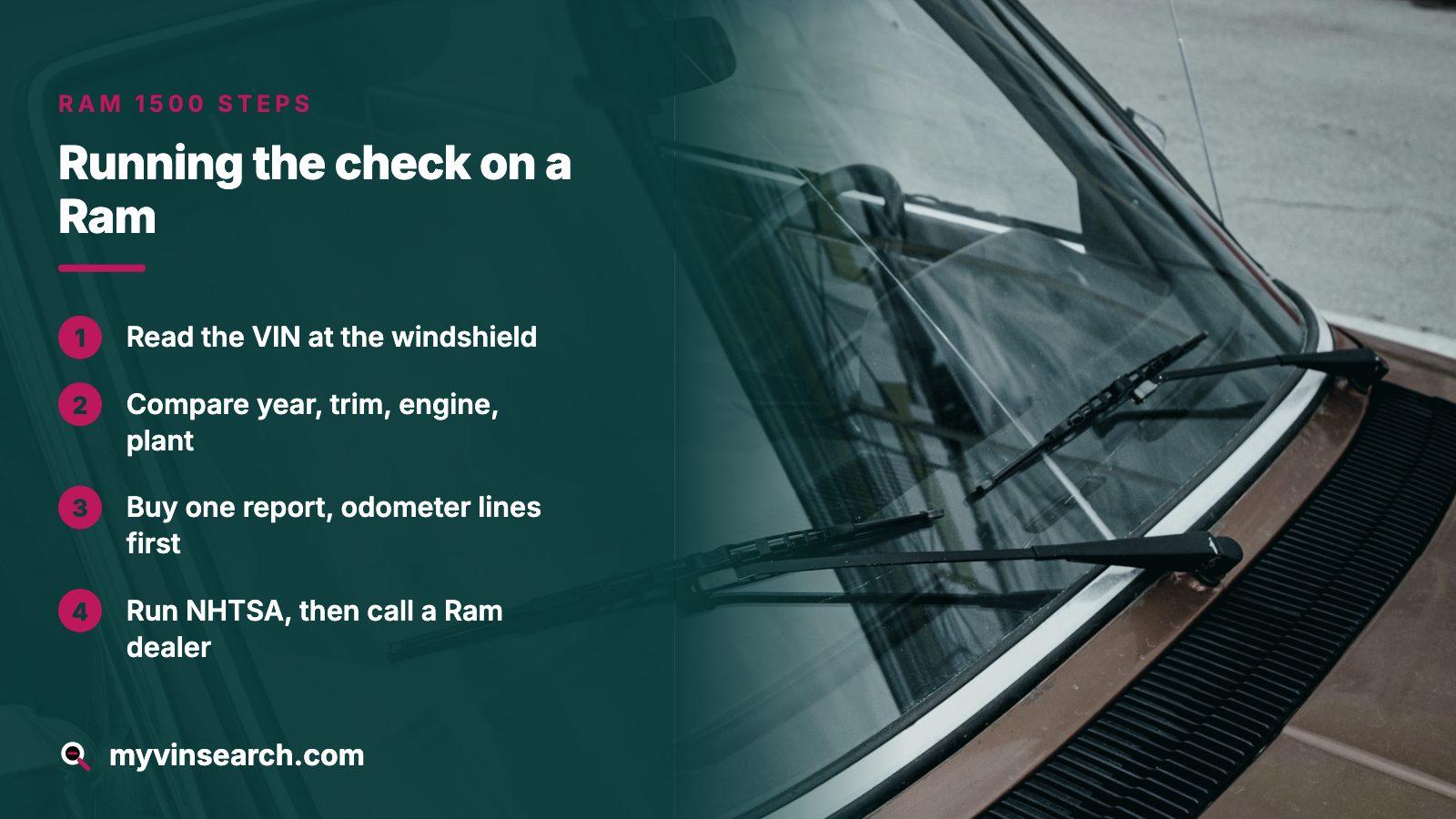
Running the check on a truck you are about to buy
- Find the number at the lower left of the windshield, on the truck itself, and compare it with the registration or title in the seller's hand.
- Enter it at MyVINSearch and read the preview: year, trim, engine, drive and plant should match the listing.
- Keep the truck as a candidate? Buy a single report and read the brands and odometer lines first.
- Run the same VIN through NHTSA's recall search for any repair still owed.
- Call a Ram dealer about any open recall and ask when the repair can be done.
Do the first step in person. A VIN pasted into an online ad may belong to another truck, and a mismatch costs you nothing to find.
When the mileage on the report disagrees with the dash
Owners can file complaints with NHTSA, and the database is public. Most describe mechanical trouble, but a few describe the very surprise a VIN check exists to catch.
From an NHTSA owner complaint
A 2013 Ram 1500 owner described buying the truck from a private seller showing 136,000 miles. While pulling a history report afterward, the owner found it listed 220,000. The complaint was filed under the heading odometer fraud, in 2025.
The takeaway: run the report before the handshake, not after. A gap that wide between dash and record justifies walking away or lowering the offer, and that is far easier before the title changes hands.
Reading the results: what each red flag asks of you
| Entry | What it may mean | Your move |
|---|---|---|
| Salvage, rebuilt or flood brand | The truck was declared a loss by an insurer, then fixed | Pay for a frame and body inspection, or pass |
| Mileage that drops between entries | Rollback or a data error | Ask for dealer service records |
| An open recall | The repair was never done | Book it at a Ram dealer, or have the seller do it first |
| A lien | The bank that financed it could still have rights | Ask for the lender's letter releasing it before any payment |
| Engine or trim differs from the ad | Another truck, or a mistyped VIN | Hold off until you hold the title |
A surprise a recall search will not warn you about
From an NHTSA owner complaint
One owner of a 2013 Ram 1500 bought it used at a Missouri dealer in 2016. When a recall notice arrived, the dealer refused the work because the truck had been built in Canada, something the owner says nobody mentioned at purchase.
That complaint was filed in 2019, and it matches the way NHTSA describes its own tool: the VIN search does not cover a recall involving an international vehicle. If the preview or the paperwork hints that a truck came from outside the United States, ask a Ram dealer in writing whether open campaigns will be repaired before you agree on a price.
What the government tools leave out
NHTSA's VIN search lists only recalls that remain unrepaired, so a finished repair vanishes from it. It can lag on brand-new campaigns while VINs are loaded, leaves out older campaigns past the 15-year mark, apart from makers who extend coverage, and says nothing about crashes. A message reading zero unrepaired recalls is not a clean history.
The federal title database, NMVTIS, tracks five things: the current title and its last date, brand history, the odometer figure, total-loss history and salvage history. It is meant to be short. Reading a fuller report next to it lets you test whether title, damage and mileage tell the same story.
A related trap is naming. NHTSA files Ram pickups under different make and model spellings across years, and a complaints lookup typed the wrong way can return zero for a truck with hundreds of reports. A model year 2010 pickup, for instance, sits under Dodge, with 488 complaints.
Cost and what to do after you read it
The preview costs nothing to view. A full report is bought once and never renews, and bundles are offered if you are weighing a few trucks. See the pricing page for the choices.
Then act on what you read. An open recall is a repair to schedule. A brand, a lien or a mileage conflict is a reason to renegotiate, ask for proof, or look at the next truck.
Where this information comes from
- NHTSA: Check for recalls — Where the VIN sits, and what the VIN search includes and omits.
- NHTSA recalls data: 2019 Ram 1500 — Campaign counts by year; other years use the same lookup.
- NHTSA vPIC VIN decoder — Decoding year, trim, engine and plant from a VIN.
- NMVTIS: understanding a vehicle history report — What the government title database records.
- NHTSA owner complaint 11664275 — owner experience, paraphrased
- NHTSA owner complaint 11192729 — owner experience, paraphrased
Sources and photos: Facts checked against the sources above in November 2026. Photos by NATHAN MULLET, Max Tokarev and Iain on Unsplash; diagrams by MyVINSearch.
Keep reading
- Ram VIN check by line: 1500, 2500, 3500 and ProMasterThe brand-level check covering every Ram line, including the heavy-duty trucks.
- Ram recall check by VIN: every Ram model line, plus the Uconnect radio campaignThe recall half of a Ram check, in more depth.
- Ford F-150 VIN check: how to read one truck's record before you buyThe same check for a rival half-ton, if you are cross-shopping.
- PricingHow single reports and packs are priced.
Frequently asked questions
Is a Ram 1500 VIN check free?
Parts of it. NHTSA's recall lookup carries no fee, and MyVINSearch shows a preview at no charge. The complete history report is bought once. Each free tool shows only a slice, so careful buyers combine several before paying a seller.
Where is the VIN printed on a Ram 1500?
Stand beside the driver's door and read the plate visible through the glass in the windshield's bottom corner. Registration paperwork repeats it, and some insurance cards do. Compare plate and paperwork before running anything.
Does a Ram 1500 VIN lookup show open recalls?
NHTSA's VIN search does, though only for unrepaired ones. A completed repair will not appear, and brand-new campaigns may lack VINs for a while. If a truck sits near a campaign's build range, ask a Ram dealer to confirm.
Will a Ram VIN report expose a rolled-back odometer?
It can reveal a conflict. Readings recorded at earlier titles and inspections should climb, so a lower number later is a warning. It cannot prove tampering, and a truck never inspected leaves nothing to compare. Ask for service records.
Is a Ram 2500 checked the same way as a 1500?
The steps are identical, but the decode differs. NHTSA reads the 2500 as its own line with a different weight class and engines, so check that the preview fits the advertised truck before buying.
Now check the car itself
The guide explains what to look for. The report shows what this VIN has on record.