THE SHORT ANSWER
Type the VIN into the preview and confirm that the year, model and engine it returns match the ad. If they do, buy the report once and read the mileage, title and recall lines first. The recall line needs care on a Cadillac: a May 2026 air bag filing names cars from model years 2015 and 2016, and the repair may not exist yet, so only the VIN shows whether one car is on the list.
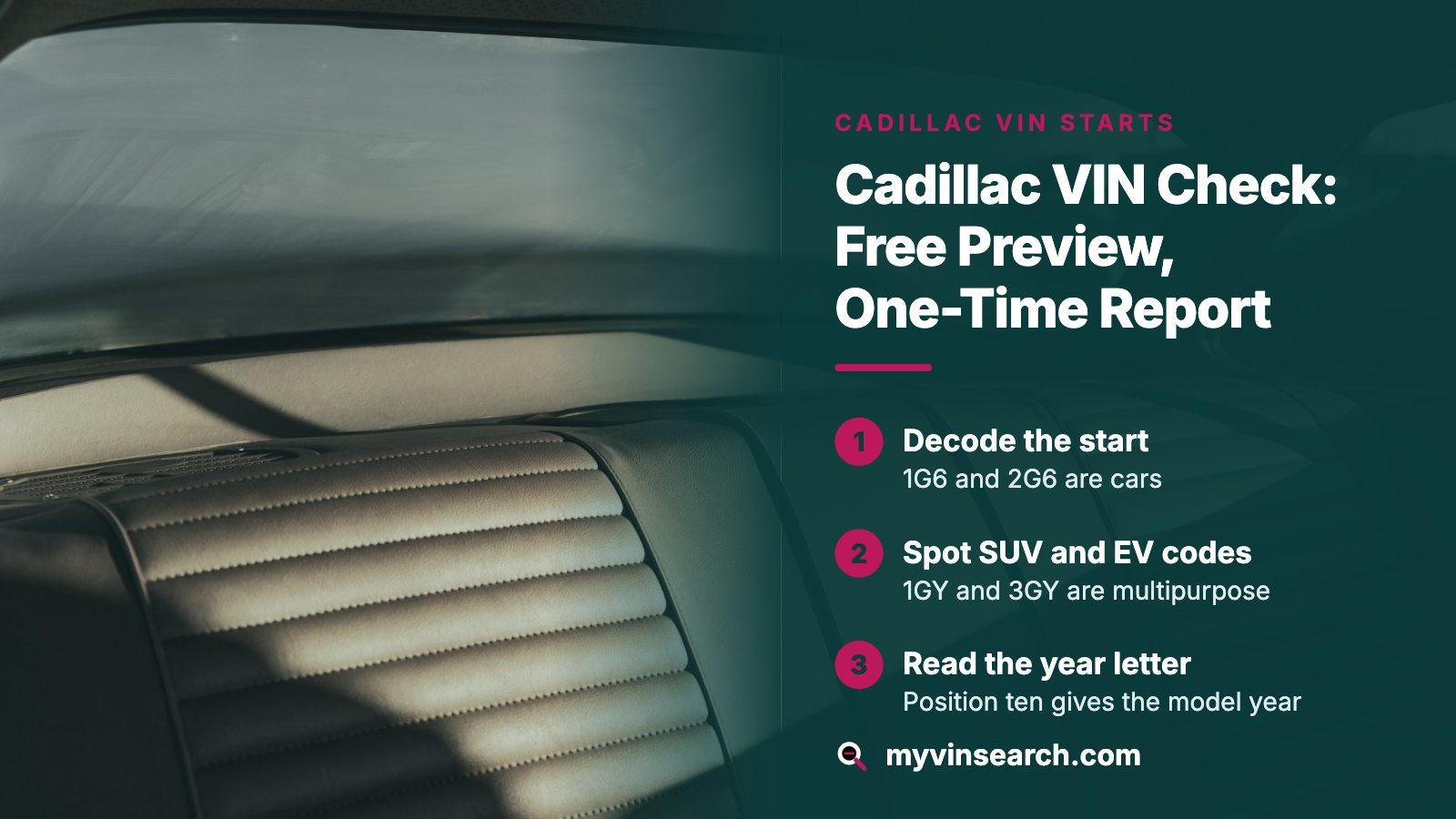
- Passenger car prefixes
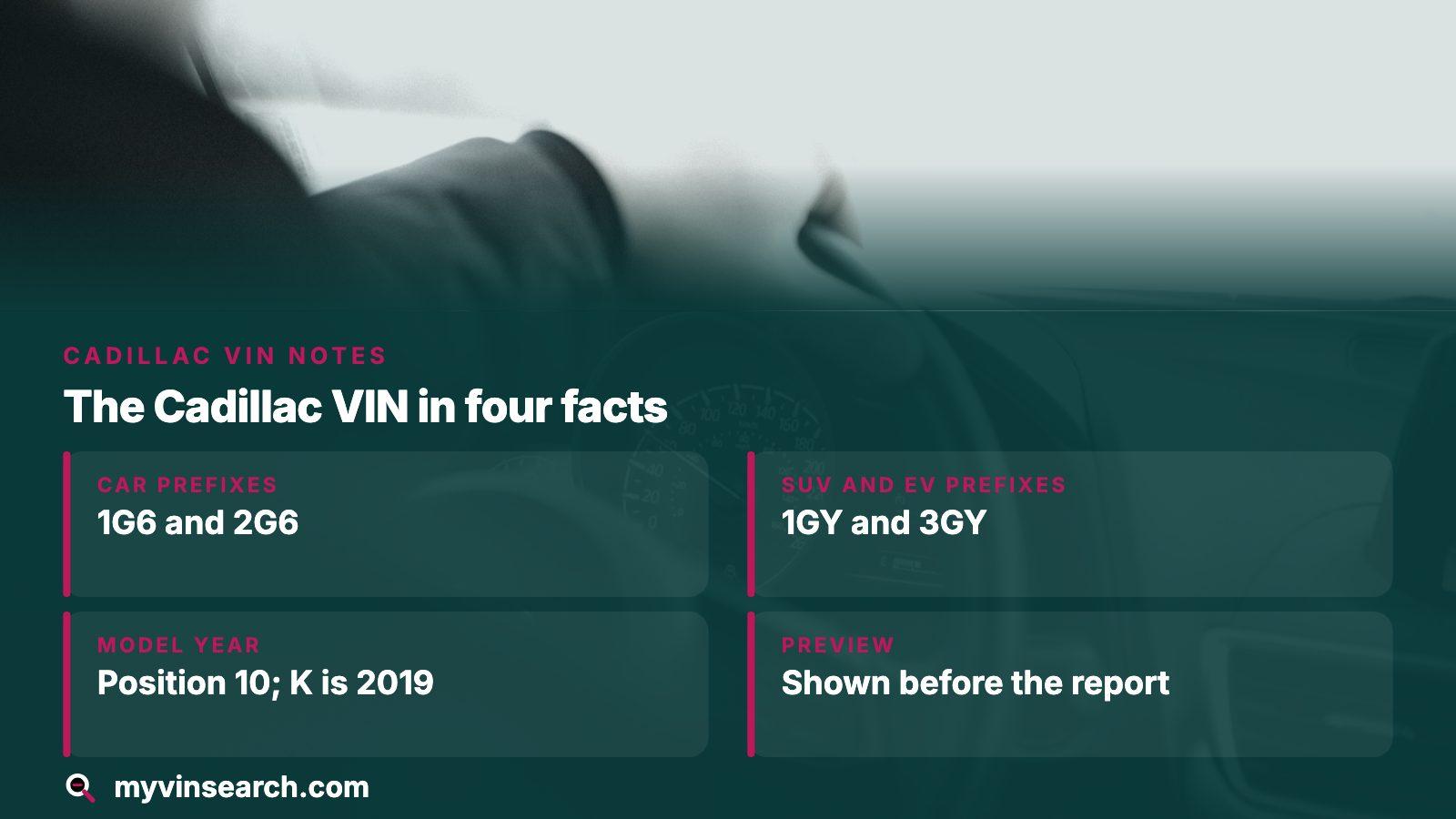
- 1G6 and 2G6 decode as Cadillac cars
- SUV and EV prefixes
- 1GY and 3GY decode as multipurpose vehicles
- Model year
- Position 10: E is 2014, K is 2019, P is 2023
- Preview
- Free; the report is one payment
What a Cadillac VIN check reads on one car
NHTSA lists 37 model names under Cadillac, from the old Cimarron and Seville to the Lyriq and Escalade IQ. The check ignores the badge on the trunk and reads the record tied to the VIN.
- Title: junk, salvage or flood labels that a state or an insurer put on file.
- Mileage: dated odometer readings, so a fall or a leap shows up.
- Damage: logged crashes, with auction photos if the car passed through a salvage sale.
- Recalls: open campaigns on this VIN where the repair is still undone.
- Use and money: liens, impound and theft entries, and fleet or livery use.
Cadillac VIN starts, decoded: seven real examples
NHTSA's decoder gives Cadillac five prefixes: 1G6 and 2G6 for passenger cars, 1GY and 3GY for multipurpose passenger vehicles, and 1GE for incomplete vehicles. Complaint files carry just 11 characters of each VIN and the decoder reads those too, so these starts are real.
| VIN start | Decodes as | Plant |
|---|---|---|
| 1GYS4CKJ9JR | 2018 Escalade, 4WD, 6.2-liter V8, engine L86 | Arlington, USA |
| 1GYS4BKLXMR | 2021 Escalade, 4WD, 6.2-liter V8, engine L87 | Arlington, USA |
| 1G6D15RW3M0 | 2021 CT5 sedan, AWD, 3.0-liter six | Lansing, USA |
| 2G61U5S34E9 | 2014 XTS, Livery trim, 3.6-liter six | Oshawa, Canada |
| 3GYFNAE3XGS | 2016 SRX, front-wheel drive, 3.6-liter six | Ramos Arizpe, Mexico |
| 1GYKNCRS5PZ | 2023 XT5, front-wheel drive, 3.6-liter six | Spring Hill, USA |
| 1GYKPMRK8PZ | 2023 Lyriq, rear-wheel drive, battery electric | Spring Hill, USA |
Both Escalades carry a 6.2-liter V8, yet the engine code changes between them, and the 2025 engine campaign names 2021 to 2024 only. The XTS comes back with Livery trim, a label that points to hired-car use and deserves a direct question to the seller.
How to run the check on a Cadillac
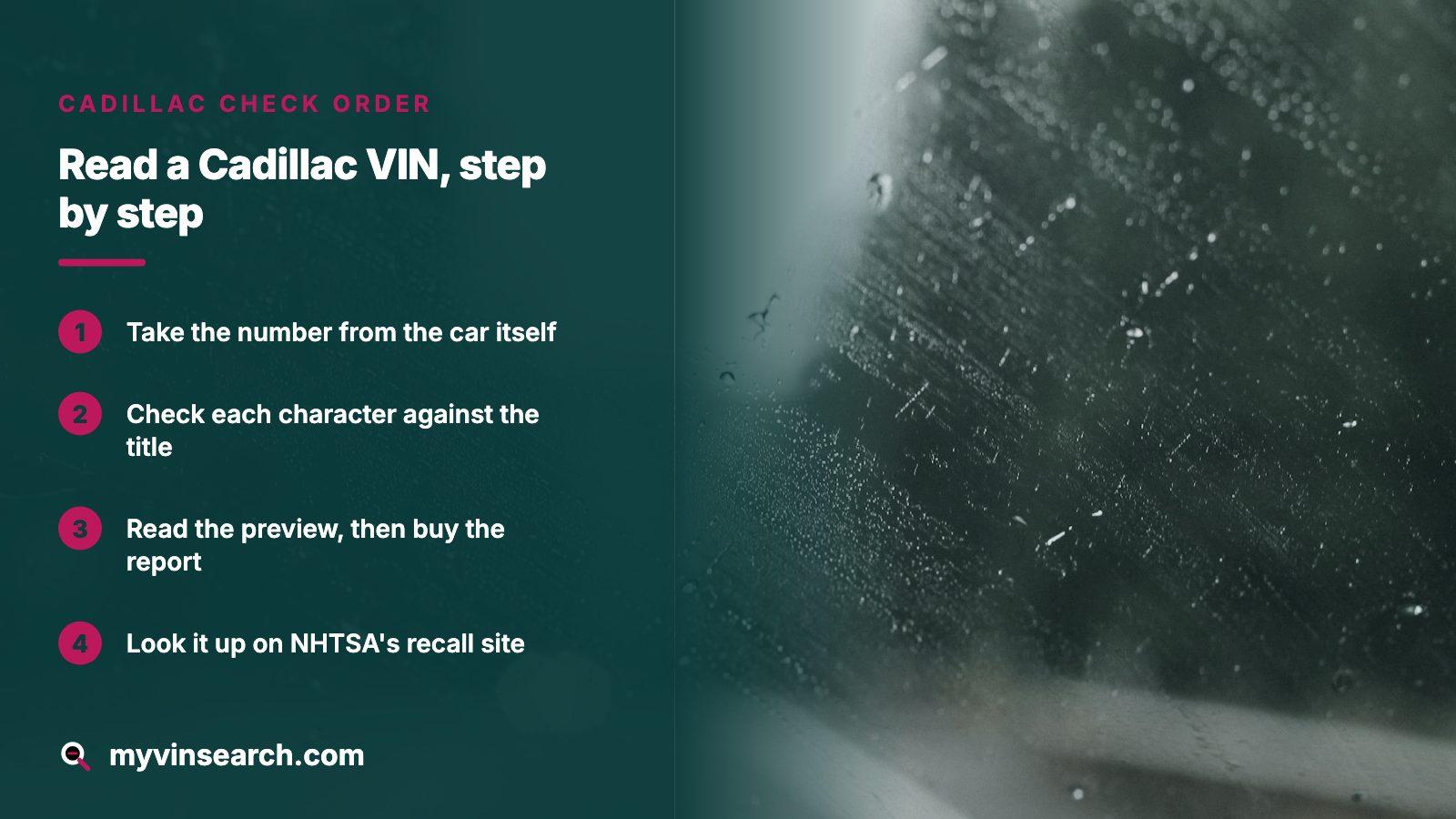
- Take the number from the car itself. Federal rules make it legible from outside, through the glass beside the left windshield pillar, with nothing moved.
- Check each character against the title and the ad. If your copy holds an I, an O or a Q, you misread it, since those three letters are not allowed in a VIN.
- Enter it in MyVINSearch. The free preview shows whether year, model and engine agree with the listing, and a mismatch is the moment to stop and ask.
- If the preview fits, pay once for the report and read mileage, title and recalls before anything else.
- Look the VIN up on NHTSA's recall site too, and note any campaign that names an engine, a transmission or a build date.
Cadillac recalls: which campaigns a VIN check can surface
General Motors files these campaigns, often beside Chevrolet or GMC models, and a recall binds a car only if its VIN is in the filing. Counts swing by model year: NHTSA returns none for a 2019 Escalade or a 2018 or 2019 XT5, but nine for a 2015 Escalade, five for a 2020 XT5 and seven for a 2023 Lyriq.
| Campaign | Cadillacs named | What fixes coverage | Fault |
|---|---|---|---|
| 26V329 | 2015 Escalade, Escalade ESV, XTS; 2015 to 2016 ATS, CTS, SRX | Model year, then the VIN list | Driver air bag inflator may rupture |
| 14V394 | 2003 to 2014 CTS; 2004 to 2006 SRX | Build dates per model | Ignition can leave run and shut the engine off |
| 21V473 | 2010 to 2016 SRX | Model years | Rear toe link can loosen and separate |
| 25V148 | CT6 from 2019 to 2020; CT4 and CT5 from 2020 to 2021 | 10-speed transmission | Internal damage can lock the wheels |
| 25V274 | 2021 to 2024 Escalade, Escalade ESV | 6.2-liter V8 gas engine | Rod or crankshaft defects can wreck the engine |
Each fix is free to the owner. The air bag filing shows how a new result can read: its VINs became searchable May 21, 2026, interim letters went out June 19, 2026, and more letters follow once a remedy exists.
When the VIN shows an open recall with no repair yet
From an NHTSA owner complaint
The owner of a 2019 CT6 received notice of campaign 25V148, then learned the repair part had not arrived. The car rolled back a foot or two after being parked, and on another day the shifter stuck in neutral at a drive-thru. Several dealers neither diagnosed nor fixed it, and the owner puts the failure at about 50,000 miles.
A buyer in that spot inherits the problem, not the fix. A check run before purchase lists the campaign as open, and this owner's own lookup confirmed parts were unavailable. Ask the seller whether notice letters arrived, ask a Cadillac dealer if the part is in, and price the car as if the repair date were unknown.
Mileage gaps: the complaint that repeats on used Cadillacs
Searching NHTSA's complaint records for fifteen Cadillac model names, model years 2006 to 2025, turns up eight that open with the words Odometer Fraud. All were filed between April 17, 2025 and April 28, 2026, cover model years 2011 to 2020, and three involve an Escalade or Escalade ESV. In each, the later figure beat the dash reading at purchase. These are owners' accounts, not findings.
From an NHTSA owner complaint
A buyer who picked up a 2019 Escalade ESV in November 2025 saw it fail the state inspection; the mechanic judged the needed repairs out of line with the low mileage. A history report then showed 237,000 miles in September 2025, against 65,800 at purchase. The owner contacted two state motor vehicle agencies, a police department and a district attorney, and the cases were dropped.
A report read before payment shows dated readings, so a leap stands out while walking away still costs nothing. One limit applies: the federal title database, NMVTIS, covers 87 percent of vehicles and more than half the states report to it, so a clean answer can be a false negative.
Reading the result: the flags and the next move
- Year, model or engine differs from the ad: the VIN belongs to another car, so stop until the seller explains.
- An open campaign: a free repair is owed on this VIN. Ask a Cadillac dealer whether the part is in before you settle on a price.
- Two dated readings that fall or leap: ask for service invoices and order the state title record.
- A title brand: a state filed salvage, junk or flood. Ask for repair papers and an independent inspection.
- Livery or fleet use: ask what the car did for a living, and have a mechanic judge the wear.
- Nothing flagged: nothing unrepaired is on file today. Run it again on signing day, and still hire a mechanic.
Paying for the report, and the steps after it
At no charge, the preview settles whether year, model and engine fit the listing. A report covers one VIN and is bought once; for a shortlist there are packs sized 3, 5 and 10, and nothing renews. Figures are on the pricing page.
- Ask a Cadillac dealer which campaigns are open on the VIN and whether parts are in stock.
- Order the state title record if the report shows a brand or the mileage does not add up.
- Book an independent mechanic and ask for a written estimate that carries the VIN. The FTC says a history report usually will not show mechanical problems.
Where this information comes from
- 49 CFR Part 565: Vehicle identification number requirements — Federal rules for VIN length, allowed characters, the model year code in position 10 and where the number must be readable.
- NHTSA vPIC: decode of a 2018 Escalade VIN start — The decoder call behind the table of VIN starts. The prefix lookups use the same service through its WMI call.
- NHTSA recalls data: Cadillac Escalade, model year 2021 — Campaign 25V274 and its engine scope. The other campaigns in the table come from the same service, filed by model and year.
- NMVTIS consumer information — What federal title records hold, where they come from, and why a clean result can still miss history.
- FTC: Buying a used car — Why a history report does not replace an independent mechanical inspection.
- NHTSA owner complaint 11722926 — owner experience, paraphrased
- NHTSA owner complaint 11665186 — owner experience, paraphrased
Sources and photos: Facts checked against the sources above in November 2026. Photos by Brandon Russell, Cole Keister and Miles Loewen on Unsplash; diagrams by MyVINSearch.
Keep reading
- Chevrolet VIN check: what the VIN shows on a Silverado, Equinox, Tahoe or BoltTahoe and Suburban are named beside the Escalade in several GM campaigns.
- GMC VIN check: what the VIN shows for a Sierra, Yukon, Acadia or TerrainThe Yukon appears in the same filings, and GMC gets the same model-by-model check.
- Sample reportLook through each section of a report before you decide to buy one.
- PricingWhat one report costs and how the packs of 3, 5 and 10 work.
Frequently asked questions
Can I run a Cadillac VIN check for free?
Only the preview costs nothing; it shows whether year, model and engine match the ad. The report is one payment per VIN, nothing recurring. For open recalls alone, NHTSA keeps free listings searchable by VIN, and the dealer repair costs the owner nothing.
Which VIN prefixes does Cadillac use?
NHTSA's decoder returns Cadillac for 1G6 and 2G6 on passenger cars, 1GY and 3GY on multipurpose vehicles such as the Escalade, XT5 and SRX, and 1GE on incomplete vehicles. A prefix names the maker and vehicle type, never the model.
Does the 2015 air bag recall cover my Cadillac?
Campaign 26V329 names the 2015 Escalade, Escalade ESV and XTS and the 2015 and 2016 ATS, CTS and SRX, but only VINs in the filing count. Look yours up; dealers will replace the driver air bag module at no charge once a remedy is available.
Is every 6.2-liter Escalade in the engine recall?
No. Campaign 25V274 names 2021 to 2024 Escalades and Escalade ESVs with that engine, and the 2018 start in the table, also a 6.2-liter V8, falls outside those years. Covered cars get an engine inspection, then a repair or replacement if needed, at no charge.
What if the report shows more miles than the dash?
Treat the dash as unproven until someone accounts for the difference. Request dated service invoices, order the state's own title record, and have a mechanic judge the wear. If nothing explains it, leave before you pay. The complaints above show gaps of twenty thousand to over a hundred thousand miles.
Now check the car itself
The guide explains what to look for. The report shows what this VIN has on record.