THE SHORT ANSWER
Put the Traverse's VIN in at MyVINSearch, then let the free preview tell you whether year, engine and drive fit the listing. If the SUV is still a contender, one paid report adds title brands, damage and odometer entries. Afterward, put the number into NHTSA's recall page as well, since Traverse campaigns vary a great deal from one model year to the next.
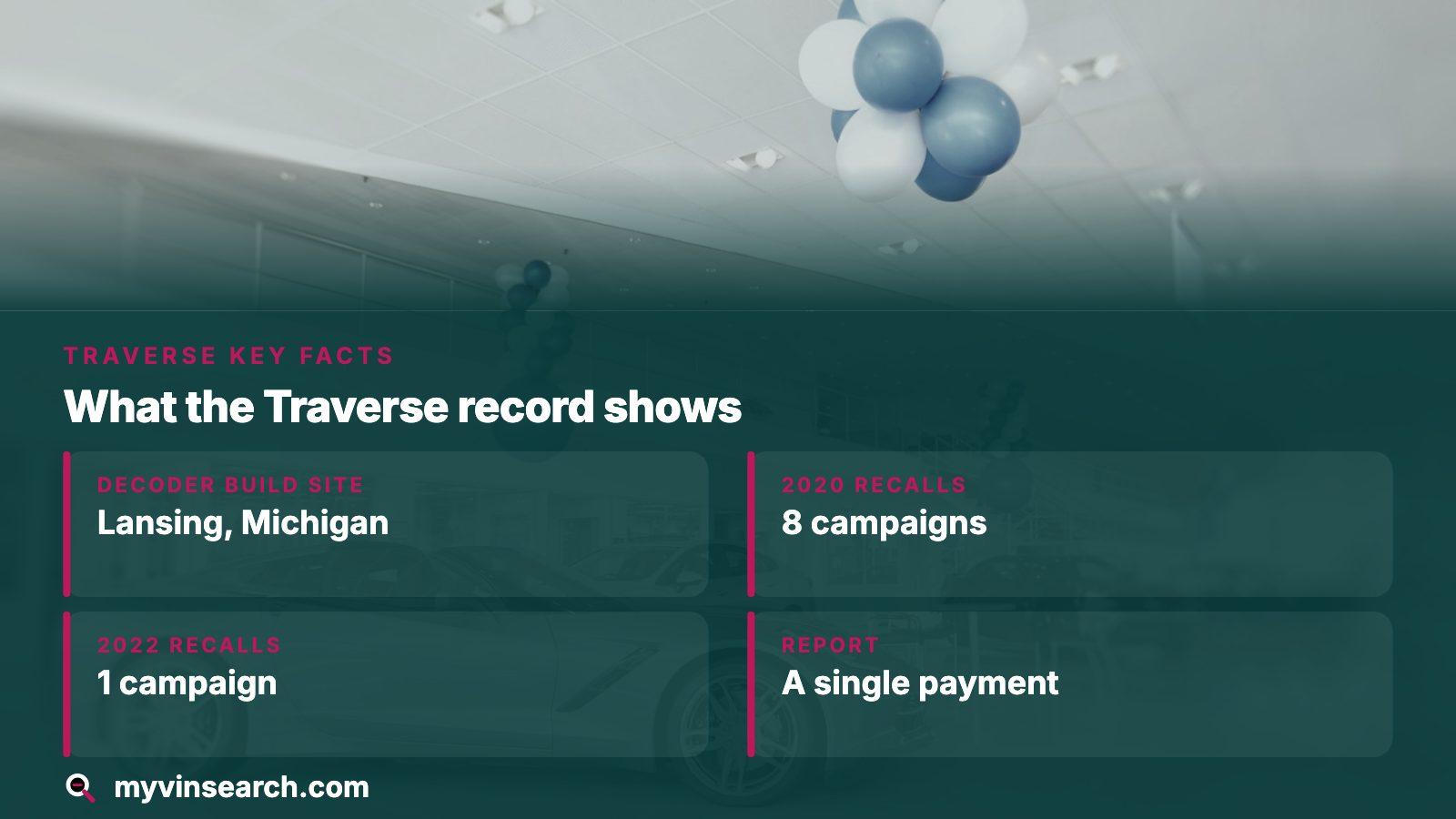
- Build site in decoder tests
- Lansing, Michigan
- Recall campaigns, 2020 model year
- 8
- Recall campaigns, 2022 model year
- 1
- Preview
- Free; report is a single payment
Why a Traverse deserves its own search
This site sorts its lookups by make and model, because a Traverse raises questions a small sedan never does. A big family hauler often leads a busy life with one household before it is traded, and the records worth reading are those that move your offer.
- Salvage, rebuilt or flood branding on the title, and which state applied it.
- Insurance total-loss entries and auction photos, if the SUV was once wrecked.
- Odometer readings from past titles and inspections, which should only climb.
- Safety repairs that Chevrolet still owes, known as open recalls.
- Theft flags and lender claims that a seller may not have mentioned.
Many of these entries trace back to NMVTIS, the national title system that the Justice Department's vehiclehistory.gov describes as a shield against title fraud, dangerous cars and resale of stolen ones.
Decode the number, then hold it against the listing
To see what a Traverse number gives away, I ran three invented ones through NHTSA's vPIC decoder. Each failed the check-digit test, as made-up numbers will, but the decoder still described a build.
| VIN begins | Decoder result | Built at |
|---|---|---|
| 1GNKVHKD5EJ | Model year 2014, 2LT trim, 3.6 liter gasoline six, driven through all four wheels | Lansing, Michigan |
| 1GNKRHKD1JJ | Model year 2018, LT trim, front drive; engine details left blank | Lansing, Michigan |
| 1GNERGKW5LJ | Model year 2020, LT trim, gasoline V6 of 3.6 liters, front-driven | Lansing, Michigan |
If an ad promises all-wheel drive and the number decodes as front-driven, the seller owes you an answer, and the same goes for a year that contradicts the title. Errors in several positions, as the 2018 sample showed, usually point to a misread digit, so recopy the number before concluding anything.
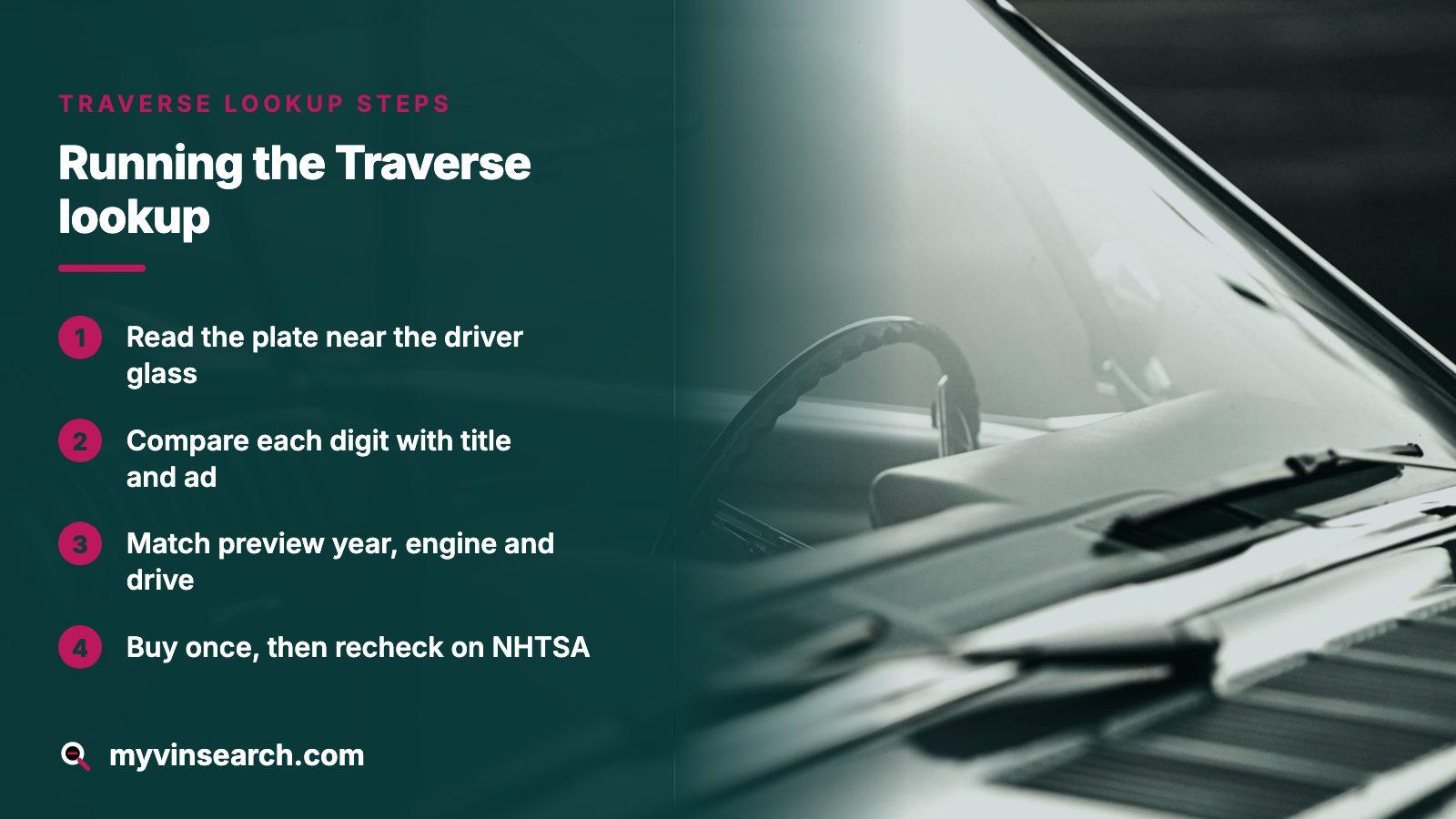
Running the lookup in five moves
- Go to the Traverse and read the number stamped on the small plate seen from outside, down where the dashboard meets the driver's side glass. NHTSA says the registration card repeats it, and an insurance card might as well.
- Line it up with the title and the ad, checking each digit.
- Enter it at MyVINSearch and compare the preview's year, engine and drive with the ad.
- If the Traverse still looks like the right one, buy a single report and start with the title brands, damage entries and odometer history.
- Check the number again on NHTSA's recall page and have a Chevrolet dealer book any open repair.
Copy it from the vehicle itself. A number pulled from an online photo can belong to a different SUV.
Recall counts swing by model year
NHTSA's recall data lists the campaigns below for the years I pulled. Each campaign names particular build dates or trims, so no single Traverse carries every item listed. Newer years show short lists largely because they have had less time to collect them.
| Model year | Campaigns | Owner complaints |
|---|---|---|
| 2009 | 8 | 448 |
| 2010 | 5 | 669 |
| 2012 | 5 | 354 |
| 2014 | 7 | 549 |
| 2016 | 5 | 292 |
| 2018 | 2 | 466 |
| 2020 | 8 | 235 |
| 2022 | 1 | 103 |
A longer list does not make a worse SUV on its own, because the maker pays for recall repairs. The real question is whether that repair was carried out on the vehicle you are looking at.
Campaigns worth asking a seller about
- Driver air bag inflator: campaigns 21V782000 (2013-2017) and 23V334000 (2014-2017) say the inflator may explode on deployment. Dealers replace the module at no charge.
- Side curtain air bags: 21V246000 covers 2010-2019 Traverses whose curtain bags may not be attached properly. Dealers realign or replace weld nuts.
- 2020 frame: 19V643000 concerns a possibly cracked right-side rail under the hood. The dealer inspects it and, where needed, replaces the vehicle.
- 2020 fuel pump: 20V639000 concerns a plastic burr that could starve the engine of fuel. The pump module is replaced.
- Seat belt pretensioner: 14V266000 applies to Traverses built from June 6, 2008 through May 14, 2014.
Request the repair invoice from the seller, then see whether NHTSA's page reports zero unrepaired items for that VIN.
What owners write that no history report can show
A VIN check reads records, not the engine. Older Traverses draw many mechanical complaints, and 2010 alone has 669 on file with NHTSA: 331 name steering and 178 name the engine. The 2014 year leans toward air bags, with 259 complaints, plus 128 electrical and 118 engine.
From an NHTSA owner complaint
One 2010 Traverse owner wrote that the motor began rattling on start-up, coming from the passenger side, with the odometer near 86 thousand. Their mechanic diagnosed a stretched timing chain, confirmed by a stored trouble code, and said the complete chain assembly needed replacing.
The lesson for a high-mileage 3.6 liter Traverse: hear the engine start cold, and ask to see maintenance paperwork. A VIN report supplies neither.
Red flags that justify walking away
- Year, engine or drive type that the decode contradicts.
- A salvage, rebuilt or flood brand lacking repair records.
- A mileage reading below one logged earlier.
- Theft or lender claims nobody disclosed.
- An unfinished air bag or frame campaign the seller brushes aside.
One flag by itself is a reason to press the seller for details. When two or three pile up, the sensible move is a different listing.
What NHTSA's free search leaves out
NHTSA's lookup costs nothing and suits any Traverse. A VIN search returns unrepaired recalls only, with a zero message when none apply. Left out: repairs already completed, fresh announcements whose affected VINs have not all been loaded yet, and campaigns older than 15 years that the maker has not extended.
Titles, wrecks and mileage fall outside its scope. Pair the two tools, since NHTSA shows what Chevrolet owes this Traverse while a history report covers its earlier life.
Paying for the report and what follows it
Nothing is charged for the preview on MyVINSearch. What you pay for the report goes out once, with nothing recurring, with the single option and the packs shown on the pricing page. Hold off on paying until the Traverse has survived your own walk-around.
A clean report with nothing open still deserves a pre-purchase inspection by a mechanic. If it shows a brand or an unfinished campaign, that becomes a bargaining point: a lower price, proof of repair, or a different car.
Where this information comes from
- NHTSA: Check for Recalls — where the VIN sits and what the search does and does not show
- NHTSA vPIC VIN decoder — decoder used for the sample builds
- NHTSA 2014 Chevrolet Traverse — recall and complaint record for that year
- NHTSA owner complaint 11466949 — owner experience, paraphrased
- NHTSA 2020 Chevrolet Traverse — frame rail and fuel pump campaigns
- VehicleHistory.gov — purpose of the federal title information system
Sources and photos: Facts checked against the sources above in November 2026. Photos by Nik, Dylan Michaud and Richard R on Unsplash; diagrams by MyVINSearch.
Keep reading
- Chevrolet VIN check: what the VIN shows on a Silverado, Equinox, Tahoe or BoltThe wider Chevrolet check, for shoppers still comparing models.
- Chevrolet recall check by VIN: find the model line, then the open campaignsLooking up open Chevrolet recalls by VIN.
- Chevrolet Equinox VIN check: read the record before you buy oneThe smaller sibling, for a buyer who finds the Traverse too large.
- PricingWhere the single report and the packs are priced.
Frequently asked questions
Is a Chevrolet Traverse VIN check free?
Viewing the MyVINSearch preview costs nothing and shows year, engine and drive for the number entered. Buying the complete history report is its own step, paid once. NHTSA's recall search is free as well and reveals any safety repair still owed.
Where is the VIN on a Traverse?
Bend down beside the driver's door and find the plate at the dash corner. NHTSA names the registration card as another place, and mentions the insurance card as a possibility. A mismatch between the ad and the SUV is a warning sign.
What is the difference between a Traverse VIN lookup and a VIN check?
Shoppers use both words for one act, which is entering the 17 characters to see what exists for that vehicle. Results depend on the database behind the box: a decoder gives the factory build, NHTSA gives open maker repairs, and a history report gives titles, damage and odometer entries.
Will a VIN check show a timing chain problem?
No. What a history report holds is records, with nothing about mechanical wear. NHTSA owner complaints describe stretched timing chains on older Traverses, so request maintenance records, hear a cold start, and pay a mechanic to look at the engine first.
Does an open recall mean I should skip the Traverse?
Not on its face, because the dealer does recall work for nothing. All the same, an unfinished air bag or frame item should be handled before everyday driving, and you can ask the seller to book it or cut the price.
Now check the car itself
The guide explains what to look for. The report shows what this VIN has on record.