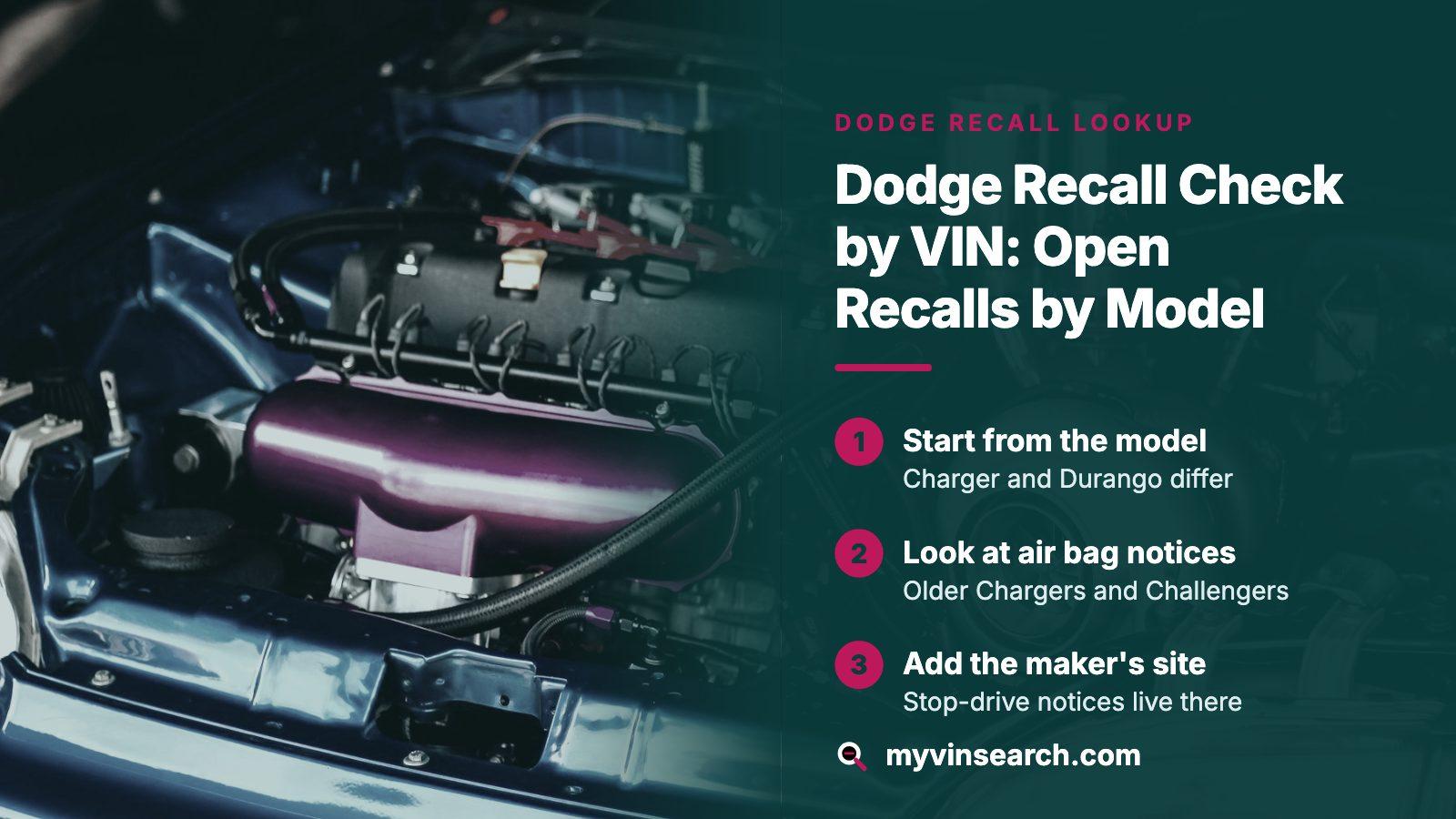
THE SHORT ANSWER
Read the VIN off the car, run it through the preview here, then repeat it on NHTSA's lookup and on Mopar, the maker's own site. Both are free. Any open recall is fixed by a dealer at no charge. An unrepaired air bag inflator recall on an older Dodge deserves a phone call to the maker the same day, because some carry a do-not-drive instruction.
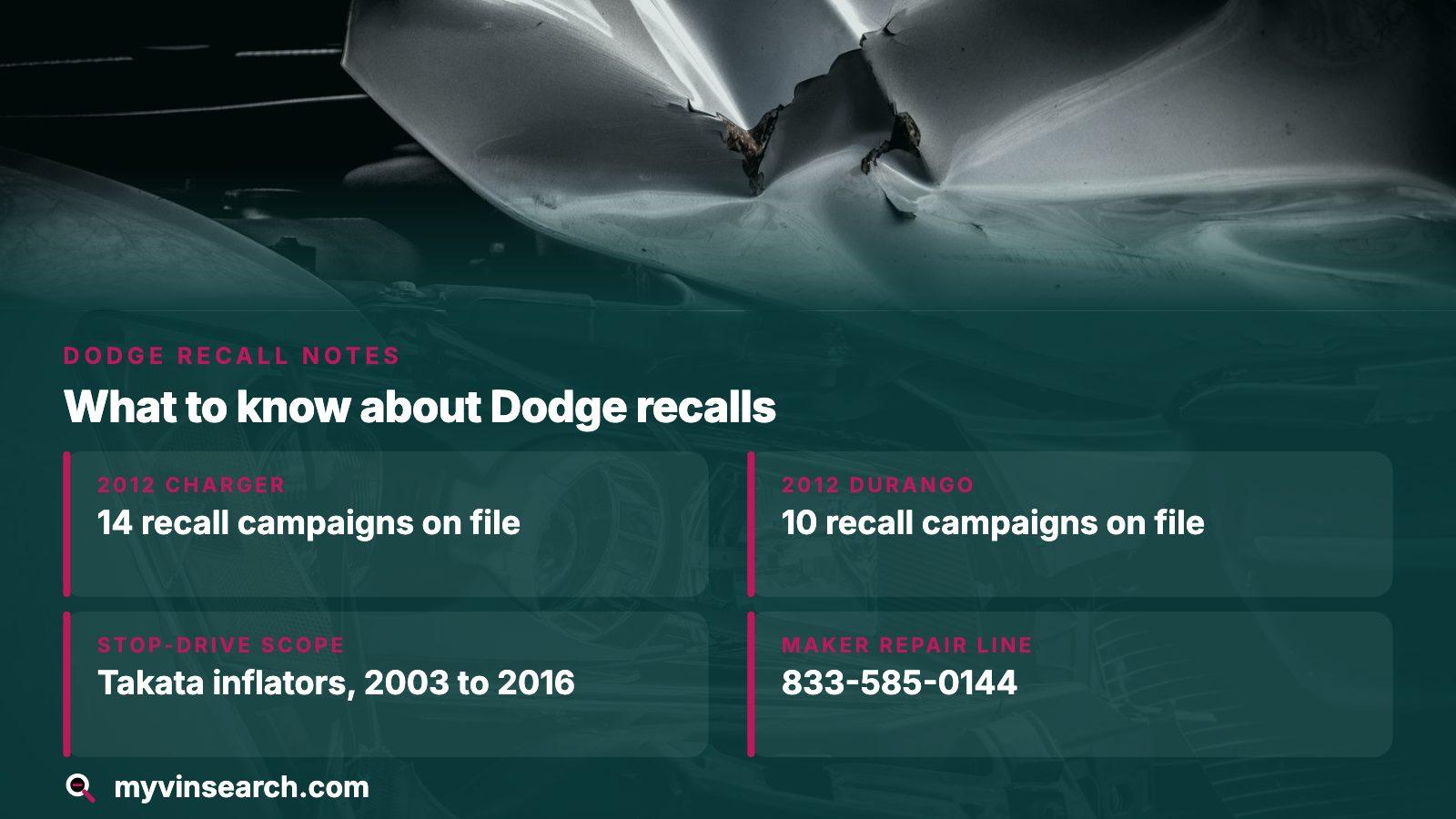
- 2012 Dodge Charger
- 14 recall campaigns on file
- 2012 Dodge Durango
- 10 recall campaigns on file
- Stop-drive scope
- Takata inflators, 2003 to 2016 builds
- Maker repair line
- 833-585-0144
Why a Dodge search starts with the model, not the badge
MyVINSearch sorts vehicles by make and model, and Dodge is a good reason why. Recalls are written against a model line and a build window. A sedan and a three-row SUV wearing the same badge can have almost nothing in common on paper, and NHTSA's data shows the spread for the 2012 model year.
| 2012 Dodge model | Campaigns on file |
|---|---|
| Charger | 14 |
| Durango | 10 |
| Challenger | 6 |
| Grand Caravan | 6 |
| Journey | 6 |
| Avenger | 3 |
Each total counts every filing against that model year, even build dates the car on your driveway may sit outside. Only the VIN narrows it to the campaigns that apply.
Running the lookup on a Dodge you are about to buy
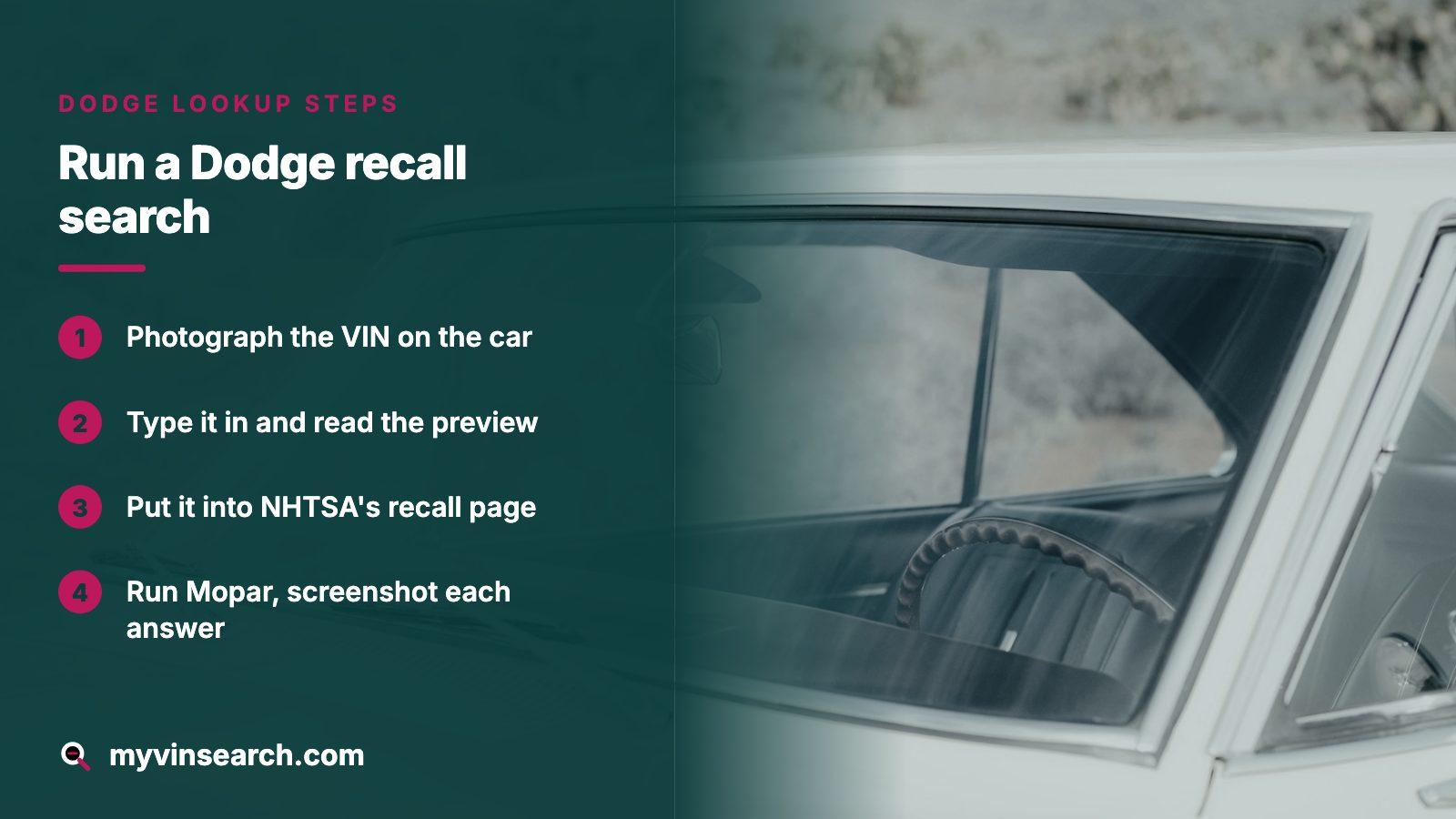
- Photograph the VIN on the car in person. Find the plate behind the windshield near the driver's door pillar, or read it from the registration paperwork. A number typed into a listing may hide a slip.
- Type it in here; the preview that comes back is free, and buying the report is a later choice.
- Put the same VIN into NHTSA's recall page. No account is needed, and a clean car gets a short zero-unrepaired message.
- Run it on Mopar too. That site also lists service campaigns, which NHTSA's tool leaves out, and says drivers can claim back some earlier recall-related costs.
- Screenshot each answer and note the date, because campaigns are added after you look.
A seller's claim that all recalls were done proves nothing. Fixed items leave the open list, and unfixed ones remain, so the lookup is the test.
Older Chargers and Challengers: the air bag campaigns to look for first
Three campaigns in the 2012 Charger and Challenger data carry a park-it flag. 16V352000 and 18V021000 concern passenger inflators that can degrade after years of humidity, and 18V021000 sorts cars by where they were sold or ever registered, from the hot Gulf and Pacific states down to the cooler northern ones. 19V018000 covers inflators that could burst under excess pressure. The remedy wording is blunt: do not drive until the repair is done, and the dealer replaces the inflator free.
NHTSA says the wider Takata problem involves about 67 million air bags and has caused injuries and deaths. A car moved from a northern state to Florida still counts, which is why the registration history matters as much as the badge.
From an NHTSA owner complaint
A 2010 Challenger owner wrote to NHTSA that close to twelve months had gone by since the passenger air bag notice. The dealership repeated that the part was out of stock and gave no estimate.
The lesson: a letter in the mail is not a repair. If the air bag item shows open, ask the seller for a dated repair order before committing, or walk away.
Other campaigns that turn up by model
Air bags are only part of the picture. These are examples from the same NHTSA data, each described there as repaired free of charge.
- Charger, Challenger and Durango, 2011 to 2014: 17V435000, an alternator that can fail suddenly, stall the engine without warning and, in some cases, short circuit.
- Charger, 2011 to 2016: 16V043000, a body sill that may buckle under the factory jack if the wheels are not blocked. The remedy is wheel chocks with instructions for using them.
- Durango, 2011 to 2013: 15V879000, sun visor lamp wiring that can short and start a fire, plus 19V813000, a pump relay fault that can stop the engine.
- Journey, 2011 to 2015: 17V432000, driver air bag wiring that can chafe inside the steering wheel and fire the bag unexpectedly, and 16V273000, a power steering hose that can rupture in the cold.
Some of these were re-issued after an earlier fix proved incomplete, so a dealer's note that the car was repaired once does not close the second filing.
The stop-drive notice and what the maker's site adds
Mopar, run by the maker FCA US, describes a stop-drive notice mailed to owners who had already had a Takata inflator letter. The notice applies to some Chrysler, Dodge, Jeep and Ram builds made from 2003 to 2016. Recipients are asked to ring 833-585-0144 or their dealer to arrange an immediate no-cost fix, and a contractor named MarketSource may come to the customer.
NHTSA groups Dodge and Ram in one entry of its Takata make list, then warns that the list cannot say whether a given car is included. Let the VIN decide, not the seller's recollection.
From an NHTSA owner complaint
A different 2010 Challenger owner brought a recall letter to a dealership and was refused, since the car had earlier been in a crash that set off the air bag. The owner asked NHTSA whether credit was available or the work would be paid out of pocket.
So an accident record is worth reading before you buy; it can trail the car into the service bay.
Reading the result and spotting the red flags
| What the lookup shows | What to do |
|---|---|
| Zero unrepaired recalls | Good sign for today only. Look at accident, title and odometer records next. |
| Open item with a do-not-drive line | Do not drive the car home. Ask for the repair first, or use the maker's phone line. |
| Open item, parts not yet available | Ask the seller for the dealer's written note, and price the wait into the deal. |
| Different make or model than the ad | Stop. The VIN may belong to another car, or the listing is wrong. |
A VIN can also show a recall that belongs to an equipment maker rather than Dodge. A wheelchair-van conversion, for instance, produced a 2025 filing that appears on Grand Caravan records.
What a recall lookup does not show
NHTSA is plain about the limits. Its VIN search omits repaired recalls, brand-new announcements where VINs are still being added, recalls past their fifteenth year unless the maker offers extra cover, and campaigns that are not about safety. It also skips recalls on international vehicles and small makers.
Older Ram pickups add a wrinkle. Before Ram became its own brand, NHTSA filed those trucks under Dodge, so a 2008 Ram returns 4 campaigns under that make. A clean recall result is silent on wrecks, salvage titles, odometer tampering and money owed on the car, which sit in separate records.
What the check costs and when the full report earns its place
Running the preview is free. The full report is one payment, not a subscription, and you can check the pricing page for the packs on offer. The repair itself, for any recall in the data above, costs the owner nothing.
For a used Charger, Challenger or Durango the report earns its place on what a recall lookup cannot give you: wreck records, branded titles, odometer history and open liens. Read those next to the recall result before you hand over money.
After the lookup: what to do with an open recall
- Phone a Dodge service desk, give them the VIN, and find out when the part arrives and when a bay is free.
- Ask the seller to complete the work before handover, or to lower the price while the car waits for parts.
- Sign up for NHTSA email alerts or the SaferCar app so a later campaign does not slip past you.
- Check again twice a year, which is NHTSA's own advice, and once more the day you pay.
Where this information comes from
- NHTSA: Check for recalls — What the federal VIN search shows and omits, where the VIN sits, and the alert options.
- NHTSA: Takata air bag recall spotlight — Why the inflators fail, the Do Not Drive warnings and the zone schedule.
- NHTSA recalls API: 2012 Dodge Charger — Campaign numbers, remedies and park-it flags for the Charger and Challenger.
- NHTSA recalls API: 2012 Dodge Durango — The Durango's campaign list, including the wiring and fuel pump items.
- Mopar: vehicle recalls and service campaigns — The maker's lookup, the stop-drive notice and the repair phone line.
- NHTSA owner complaint 10960345 — owner experience, paraphrased
- NHTSA owner complaint 11387216 — owner experience, paraphrased
Sources and photos: Facts checked against the sources above in November 2026. Photos by Willian Cittadin, Wesley Tingey and Clark Van Der Beken on Unsplash; diagrams by MyVINSearch.
Keep reading
- Dodge VIN check by model: Charger, Challenger, Durango, JourneyThe wider Dodge VIN check, beyond recalls.
- Chrysler VIN recall lookup: open recalls on the exact 300, 200 or PacificaChrysler shares platforms and air bag campaigns with Dodge.
- Ram recall check by VIN: every Ram model line, plus the Uconnect radio campaignRam pickups were Dodge trucks before the split.
- PricingHow single reports and packs are priced, with no subscription.
Frequently asked questions
How do I run a Dodge recall check by VIN?
Take the 17-character VIN from the windshield or registration card, enter it in the preview here, then repeat it on NHTSA and Mopar. Each lists recalls still unrepaired on that car. The two official tools are free and need no account.
Does the check show repairs that were already done?
No. NHTSA says its VIN search lists only unrepaired recalls, so a finished repair disappears from the result. To prove past work, ask the seller for dealer paperwork or look at the service entries in a history report.
Can I keep driving a Dodge with an open air bag recall?
Where the filing carries a do-not-drive instruction, the remedy text says to leave the car parked until the inflator is replaced. Call the maker's repair line or a dealer and ask about towing or a mobile visit.
Is the recall repair free on an older Dodge?
For the recalls read in NHTSA's data, yes, the remedy is free. Owners have told NHTSA of delays when parts ran short, and of a refusal after a prior crash. Ask the dealer to confirm before you book.
My Dodge shows no open recalls. Is it safe to buy?
It means nothing is outstanding against that VIN today. Wrecks, branded titles, odometer rollbacks and liens are held in other records, and a new campaign can be filed later. Run the VIN again on payment day and read a full report.
Now check the car itself
The guide explains what to look for. The report shows what this VIN has on record.