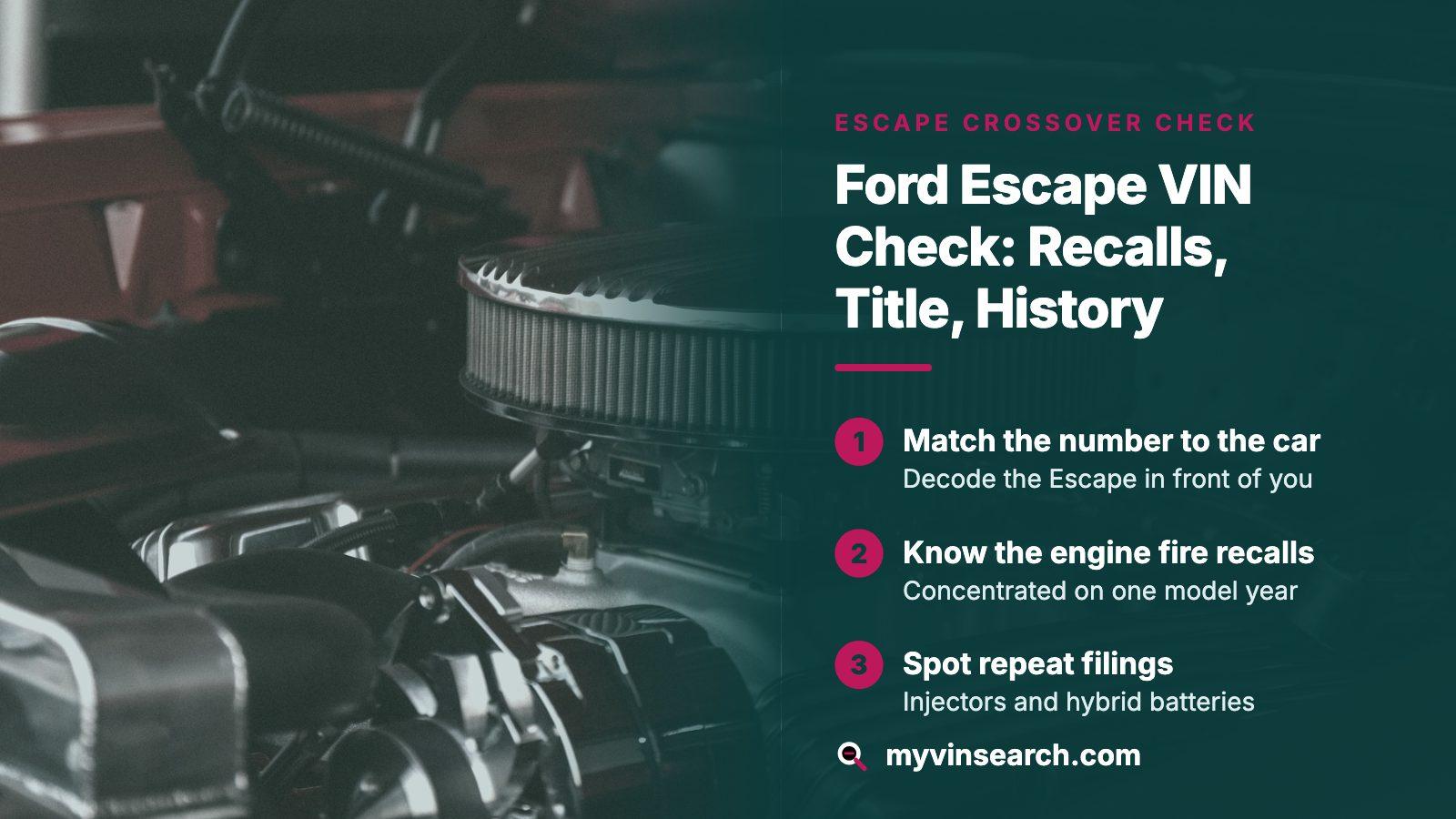
THE SHORT ANSWER
Type the Escape's VIN into MyVINSearch and use the free preview to check year, engine and drive against the listing. A match is your cue to pay once for the full report. Afterward, run the number through NHTSA's recall lookup too, because Escape campaigns often depend on engine and build date.
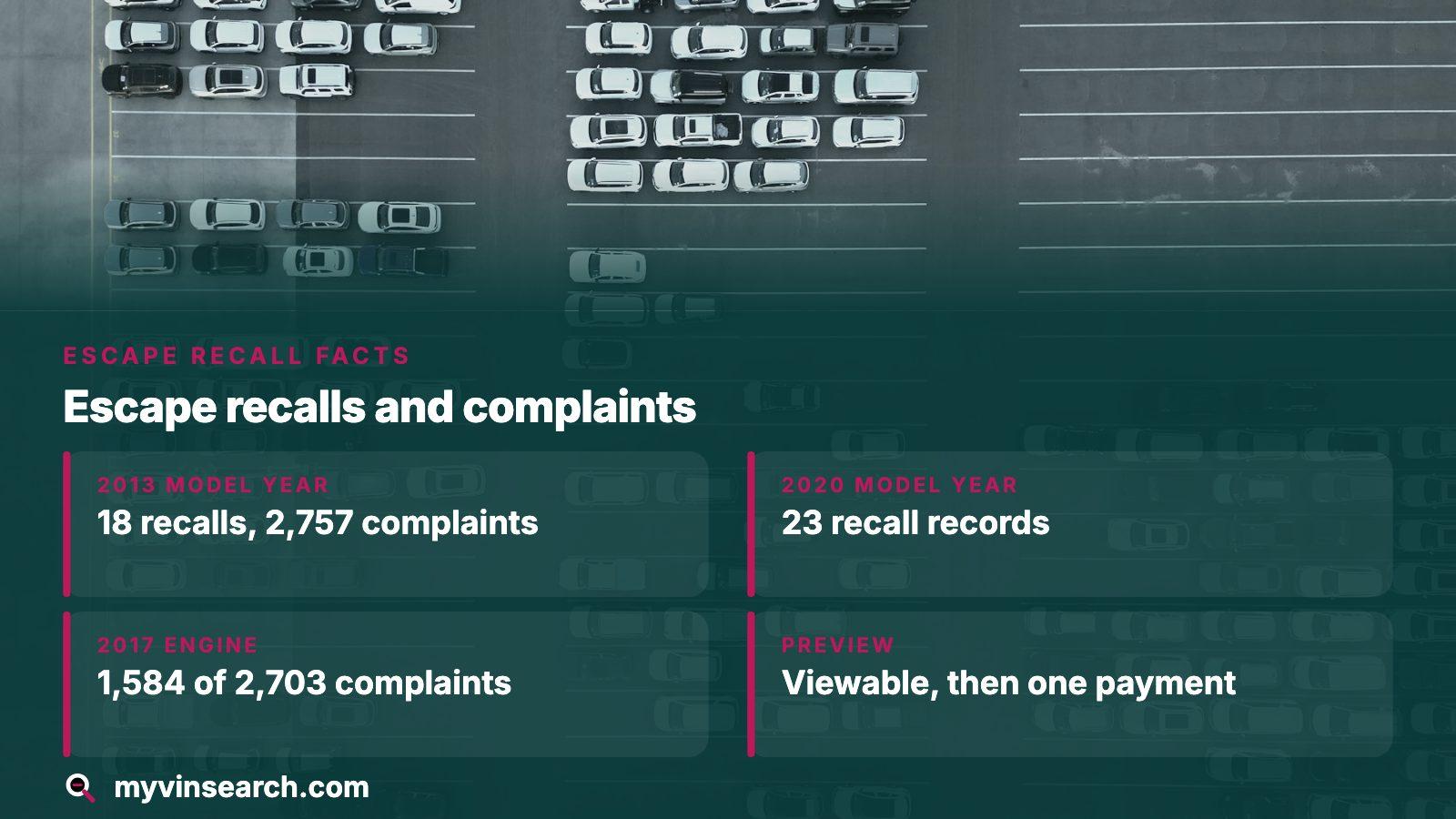
- 2013 model year
- 18 recall records, 2,757 owner complaints
- 2020 model year
- 23 recall records in NHTSA data
- 2017 model year
- Engine named in 1,584 of 2,703 complaints
- Preview
- Free to view; the report is one payment
What the lookup tells you about a used Escape
MyVINSearch organizes its pages by make and model, so an Escape gets read as the commuter and family crossover it usually is, one that has often had two or three owners. Paint and tires show in a walk-around. Earlier owners' history shows only in the record.
- Any salvage, flood, junk or rebuilt brand a state has put on the title.
- Accident and total-loss entries, with auction photos if the SUV was sold at one.
- Past odometer readings, which should rise in a steady line.
- Recalls that are still open on this specific VIN.
- Liens, theft records and the factory specs for the year and trim.
It does not replace a mechanic. It tells the mechanic where to look.
Confirm the number describes the Escape in front of you
Start with the number stamped on the Escape, and compare it to the title and the ad copy. Then let the federal decoder weigh in. I ran three invented patterns through NHTSA's vPIC tool to see what an Escape answer looks like. None is a real vehicle, so the tool objected to each check digit.
| Sample pattern | Decoder result | Plant |
|---|---|---|
| 1FMCU9G98HUA00001 | 2017 SE, 2.0-liter four-cylinder, four-wheel drive | Louisville |
| 1FMCU0GD5KUA00001 | 2019 SE, 1.5-liter four-cylinder, two-wheel drive | Louisville |
| 1FMCU9H9XMUA00001 | 2021 SEL, 2.0-liter four-cylinder, four-wheel drive | Louisville |
The engine matters on an Escape because recalls are split by engine. A seller who says 2.0 while the number points to a 1.5, or a listing a year off from the tenth character, needs to explain before you pay for anything else.
Recalls and complaints, model year by model year
I pulled NHTSA's recall and complaint records for nine Escape years. Read the recall column loosely: a record can be a campaign shared with other Ford models, and a few concern aftermarket parts.
| Model year | Recall records | Owner complaints | Most-named component |
|---|---|---|---|
| 2008 | 5 | 2,417 | Steering (1,237) |
| 2010 | 5 | 2,130 | Speed control (566) |
| 2013 | 18 | 2,757 | Engine (1,269) |
| 2015 | 9 | 1,138 | Power train (286) |
| 2017 | 4 | 2,703 | Engine (1,584) |
| 2018 | 4 | 1,825 | Engine (1,173) |
| 2020 | 23 | 1,550 | Structure (606) |
| 2022 | 19 | 238 | Fuel system (63) |
| 2024 | 8 | 78 | Electrical (28) |
Few recalls do not make a year safe. Late models show thin complaint counts mostly because their owners are newer and have filed less.
The 2013 Escape and its 1.6-liter fire recalls
Two campaigns matter most on a 2013. Number 12V431000 covers a cylinder head plug that can pop out and drain coolant, which Ford said could ignite on a hot engine. Number 13V583000 covers a cylinder head that can overheat and crack, letting oil reach a hot surface. Both apply only to 1.6-liter cars from the first production run, and the fix in each case is done by a dealer at no charge.
A different filing, 14V495000, hits 2013-2014 cars with the 2.0-liter: crimped splices in the wiring to a pressure sensor can cause hesitation or a stall. Because the engine decides which campaign applies, an engine-size mismatch in the paperwork is worth chasing.
From an NHTSA owner complaint
An owner of a 2013 Escape reported in early 2026 that the SUV lost power on a highway, smoked, and then burned, with flames spreading from the engine bay until the whole front and the cabin were on fire. The owner said the recall came up only after the purchase, when they went looking.
Takeaway: look up the recall status before you hand over money, not after, and ask for the dealer paperwork showing the work was done.
The 2020 redesign: injectors, hybrid batteries and repeat filings
Newer Escapes carry a different set of worries. Campaign 22V191000 dealt with a cracking oil separator housing on 1.5-liter engines. Its successor, 22V859000, covers a fuel injector that can crack and leak inside the engine bay, and Ford said cars repaired under the first campaign needed the new fix as well. Two later filings, 25V165000 and 25V467000, returned to the same injector issue.
Hybrid and plug-in owners should read 24V954000. A cell defect in the high-voltage battery can short internally, and owners were told not to charge until the repair was done.
For a buyer, the point is that an old repair order settles little. A fix completed in 2022 may not be the fix required today, so the VIN has to be checked against the current list.
Older Escapes: steering assist and the shifter bushing
On 2008 through 2011 cars, campaign 14V284000 addresses a steering torque sensor that may fail to read the driver's input, which can remove power assist and make low-speed steering heavy. It matches the steering lead in the 2008 complaint numbers.
From 2013 to 2019, campaign 22V413000 covers a shifter cable bushing that can wear or come loose, so the car may not select the gear you chose and may roll away once you think it is parked. Dealers swap the bushing and fit a protective cap.
How to run the check
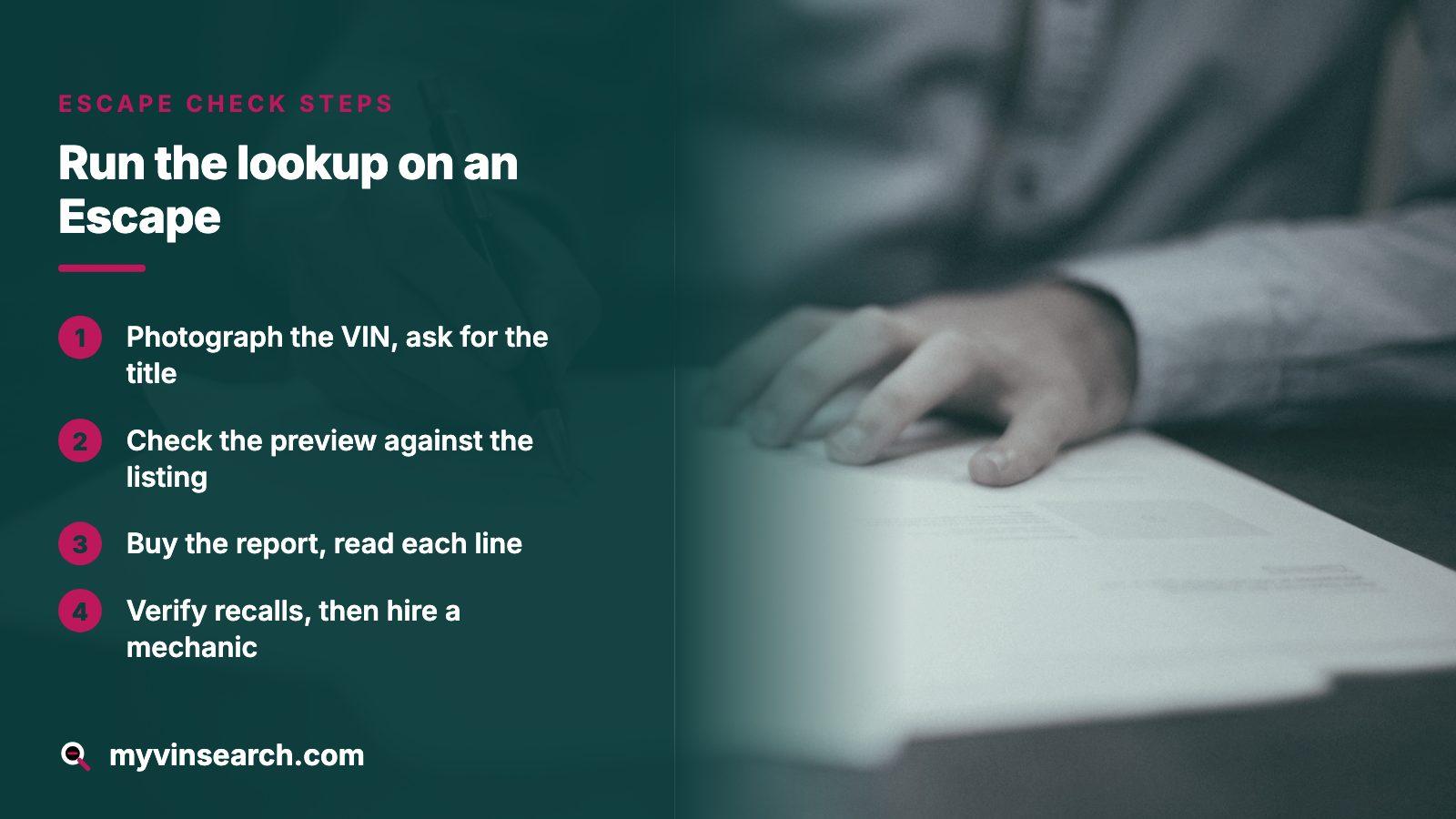
- Photograph the VIN where it sits on the Escape and request a copy of the title from the seller.
- Type it into MyVINSearch. The free preview confirms year, engine and drive.
- When the preview agrees with the listing, buy the report and go through the title, damage and mileage lines one by one.
- Look the VIN up in NHTSA's recall tool as well, and have a Ford dealer confirm whatever is open.
- Hire an independent mechanic, with the engine bay and underbody on the checklist.
Finish all of it before putting down a deposit. Hurry is what makes people skip steps.
Red flags in an Escape's record
| What you see | Your move |
|---|---|
| Salvage, rebuilt or flood brand | Order a body and electrical inspection. The federal title program says saltwater leaves wiring and air bag sensors more likely to fail. |
| Mileage entry below an earlier one | Treat the rest of the file as suspect. |
| Open recall with no completed repair | Ask for the dealer's note and bargain on price. |
| 1.6-liter engine in a 2013 | Ask to see proof the cylinder head campaigns were done. |
| Lien still on record | The seller may not hold clear ownership. |
| Decoder result differs from the ad | Settle which is wrong before paying. |
A cloned VIN, lifted from a different Ford that shares the model and year, is less common. Paperwork that does not agree usually gives it away.
Paying for the report and what comes next
You can view the preview without paying. Buying the full report means one charge and no recurring billing, and the pricing page shows the current options. Comparing three Escapes in one weekend? A pack puts their records next to each other.
Even a clean record leaves the mechanic's inspection on the list. A messy one gives you grounds to haggle or walk, and a saved copy helps if a dispute follows.
Where this information comes from
- NHTSA recalls data: 2013 Ford Escape — Engine, wiring and shifter campaigns for the 2013 model year.
- NHTSA recalls data: 2020 Ford Escape — Injector, oil separator and battery campaigns for the redesign.
- NHTSA vPIC VIN decoder — What a typed VIN returns for year, engine and plant.
- NMVTIS consumer page — The federal title database and what a brand label means.
- NHTSA owner complaint 11713232 — owner experience, paraphrased
Sources and photos: Facts checked against the sources above in November 2026. Photos by Victor Hughes, Scott Graham and Iain on Unsplash; diagrams by MyVINSearch.
Keep reading
- Ford VIN check: read the prefix, then match your model to its recordThe brand-level version, covering Ford VINs across models.
- Ford recalls by VIN: start at the model line, finish with the open campaignsThe recall half of a Ford check, line by line.
- Sample reportSee a finished report before you pay for one.
- PricingHow one report and the packs are priced, with no subscription.
Frequently asked questions
Is a Ford Escape VIN check free?
In part. NHTSA's decoder and recall lookup are free, and MyVINSearch lets you view a preview without paying. The full history report is one purchase. Every free tool covers a slice of the record, so most careful buyers use several before deciding on the report.
What does a Ford Escape VIN lookup show?
It matches the number to title brands, damage and total-loss entries, earlier mileage, liens, theft flags, open recalls and factory specs. Unreported repairs and driving habits stay invisible, which is why a mechanic's inspection stays on the list.
Which Escape years have the most recalls?
In NHTSA's data, 2020 has 23 recall records, 2021 and 2022 have 19 each, and 2013 has 18. Some are shared across Ford models, so check campaigns against the VIN rather than the year alone.
Does a clean Escape report mean no open recalls?
No. Recalls are tracked apart from title and damage history, and the list grows whenever Ford files a campaign. Look up the VIN with NHTSA on the day you buy and have a dealer confirm. A spotless title tells you nothing about a part awaiting repair.
Can a VIN tell me which engine an Escape has?
Often, yes. The decoder returns engine size for most patterns, though one 2013 sample I tried returned none. Since recalls differ between the 1.6, 2.0 and 1.5-liter engines, confirm the engine under the hood matches the decoded result.
Now check the car itself
The guide explains what to look for. The report shows what this VIN has on record.