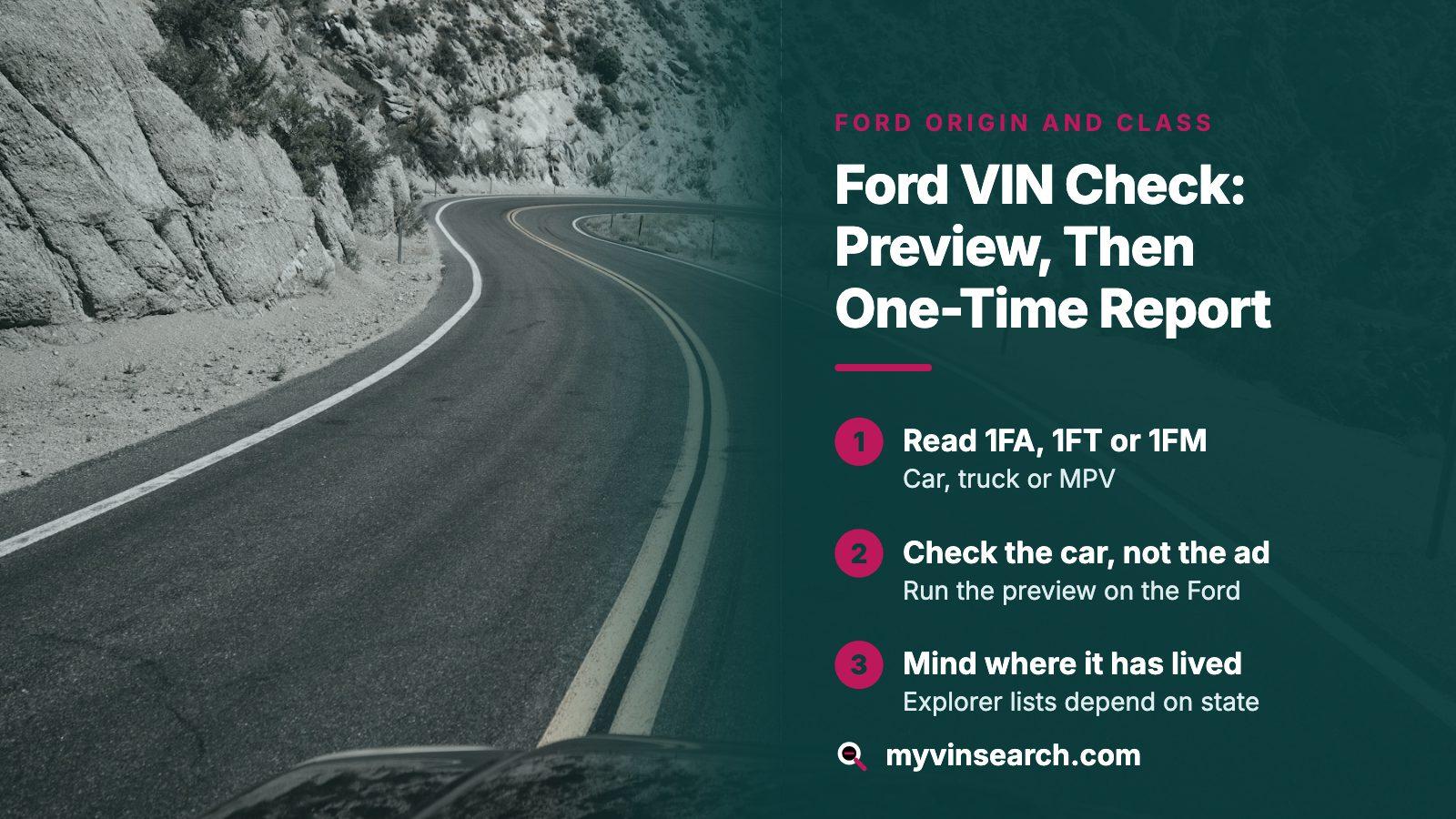
THE SHORT ANSWER
Read the VIN off the Ford, run the preview, and buy the one-time report once the preview matches the vehicle. The report adds title, damage, mileage, salvage and open-recall entries for that number. Ford files notices by engine, build date and sometimes by state, so the VIN decides which ones reach your truck or SUV. Previewing carries no charge; a report is one purchase, priced on the pricing page.
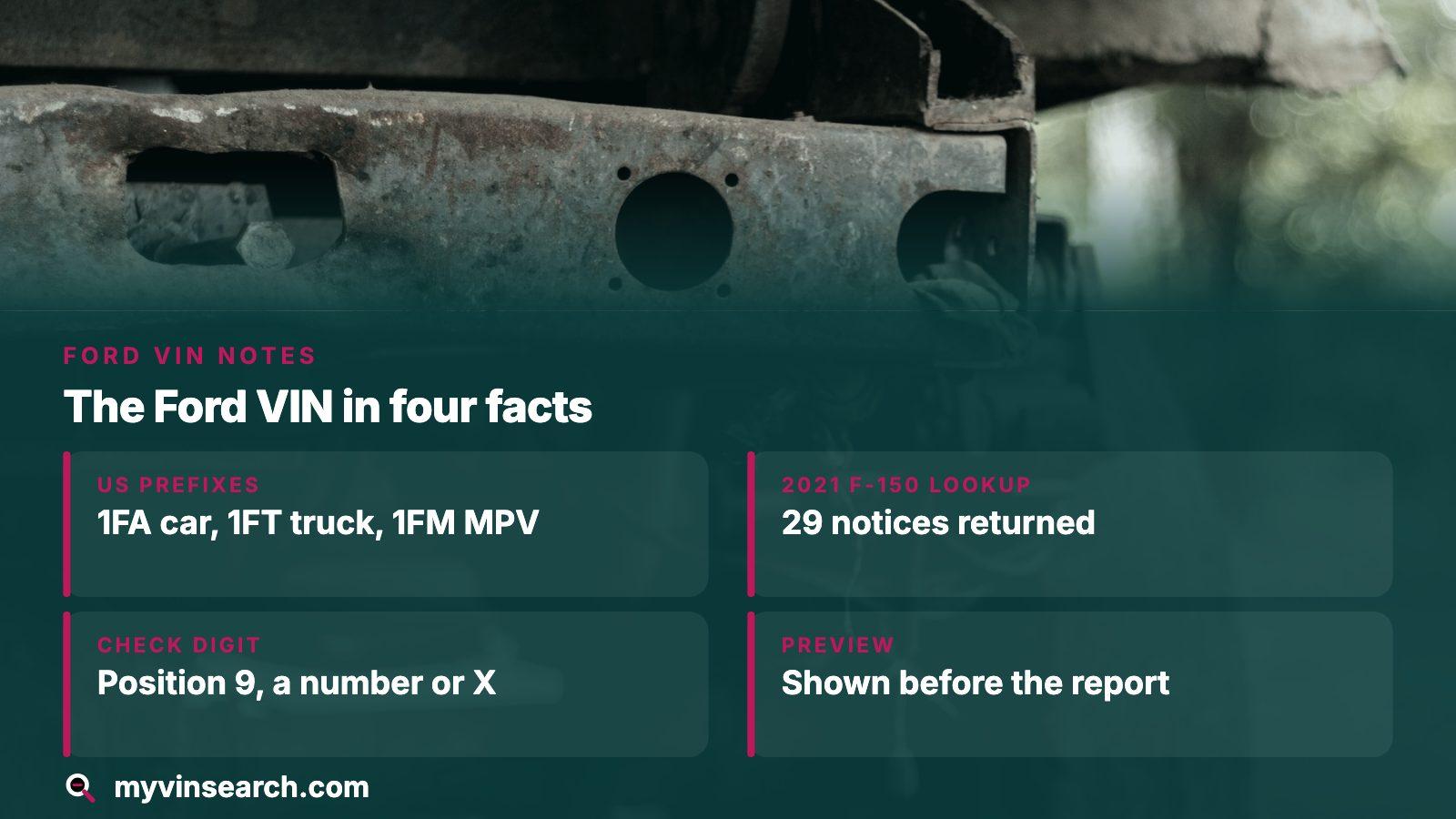
- US-built prefixes
- 1FA car, 1FT truck, 1FM MPV
- Notices on one 2021 F-150 lookup
- 29
- Check digit
- Position 9, a number or X
- Preview
- Free; the report is one payment
What a Ford VIN check turns up before money changes hands
A badge and a model year say little about a vehicle's past. Entries are filed under the VIN, so two Fords off the same line can read very differently.
- Title brands: junk, salvage or flood, as a state or an insurer recorded them.
- Accidents and damage, with auction photos when the vehicle went through a salvage sale.
- Odometer readings over the years, so a figure that moves backward stands out.
- Liens, impounds, theft and insurance entries, which show whether someone else has a claim.
- Open safety recalls for that exact VIN, plus market value and factory specs.
The FTC advises an independent inspection even when a history report looks clean, so make the check step one and a mechanic step two.
The first three characters: where your Ford was built and what class it is
NHTSA's maker list holds more than 50 identifiers under Ford company names. Nine of them follow; MPV stands for multipurpose passenger vehicle.
| Starts with | Built in | Class filed |
|---|---|---|
| 1FA | United States | Passenger car |
| 1FT | United States | Truck |
| 1FM | United States | MPV |
| 2FM | Canada | MPV |
| 3FA | Mexico | Passenger car |
| 3FT | Mexico | Truck |
| 3FM | Mexico | MPV |
| WF0 | Germany | Passenger car |
| NM0 | Turkey | Truck |
A prefix names the maker, the country and the class, never the model. On a truck, positions 4 to 8 describe the line, cab type, engine, brake system and weight rating; on a car, the line, body type, engine and restraint devices. Position 10 is the year (G is 2016, K is 2019, M is 2021), position 11 the plant, and position 9 a check digit that lets you test a transcription.
Run the check on the Ford itself, not on the listing
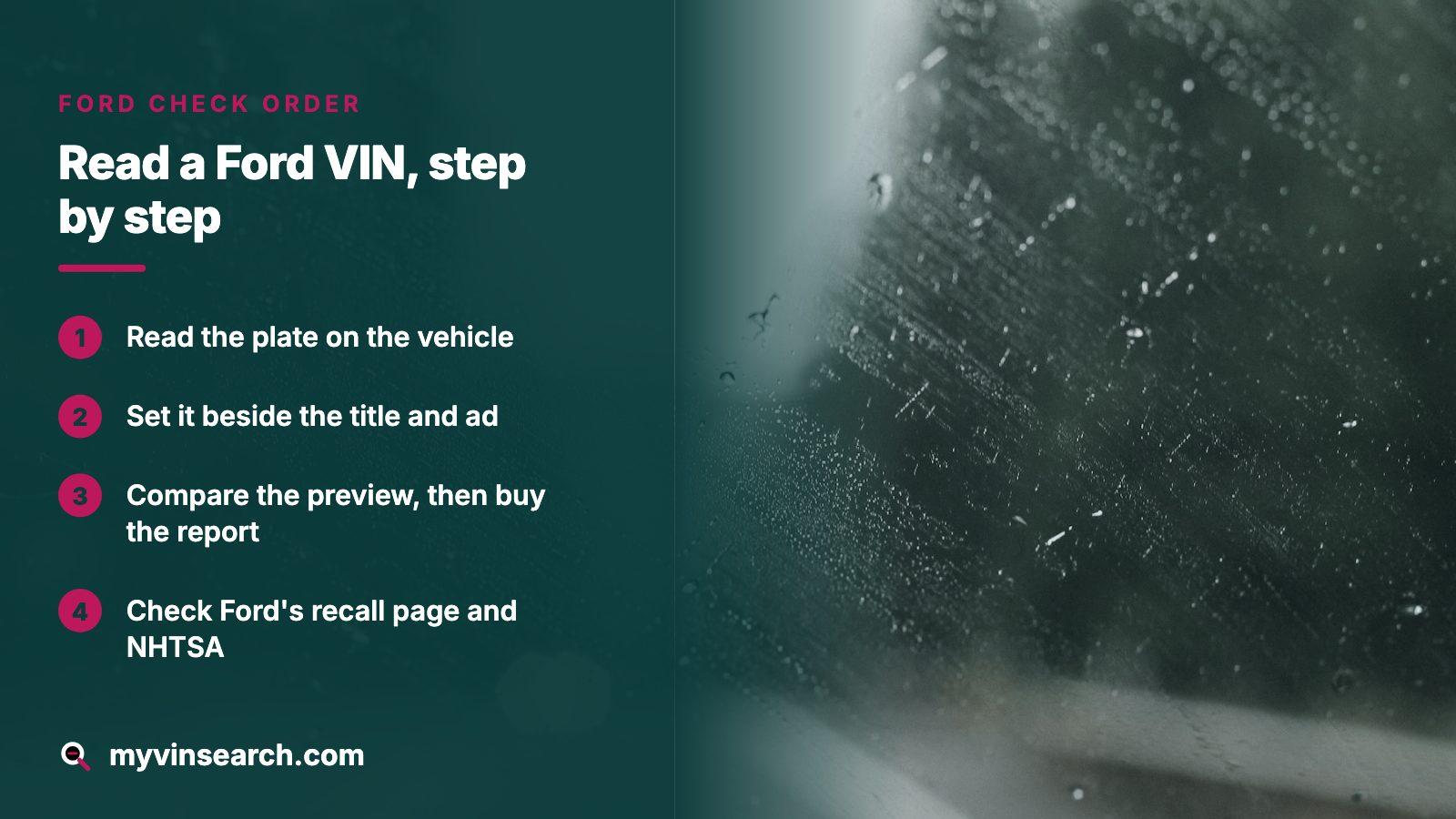
- Work from the vehicle, never the listing: read the plate seen through the windshield, then open the driver's door and compare the label there. A photo beats copying by hand.
- Set it beside the title and the ad. Real VINs never contain I, O or Q, so one in your entry is a misread.
- Run the preview and compare the model, year and engine it reports with the listing. A mismatch ends the talk until the seller explains it.
- If the preview fits, buy the report once and read title, damage and mileage before the recalls.
- Put the same VIN into Ford's own recall page and NHTSA's lookup, then ask for the invoice behind any repair the seller calls finished.
Why a 2016 Explorer's recall list depends on where it has lived
The rear toe link on the 2016 Explorer has three notices on NHTSA's list. The 2019 notice covered toe links that may fracture and suddenly change the handling. A 2020 notice sent repaired trucks back for a ball joint knuckle inspection. The 2021 expansion blamed road salt for corroding that joint and reaches Explorers first sold, or registered at any point, in 22 states and the District of Columbia.
That wording matters on a used car. An Explorer that spent its winters in Ohio falls inside the notice; one that always lived in Arizona does not, and California is not listed. A block heater notice on the same model names only 2.3L engines built between October 20, 2014 and January 28, 2016, so build dates split lists too. Ask where the vehicle has spent its life, and test the answer against the title entries.
Two Explorer buyers who learned about open recalls after the sale
From an NHTSA owner complaint
Someone who bought a 2016 Explorer from a police department learned of the toe link recall only while booking other service in October 2024. The dealer set the repair for the 17th. Before then, turning left at about 30 mph on a country road, the SUV became uncontrollable; the rear toe link on the driver's side had snapped at the weld.
That notice dated from 2019; a VIN run before paying would have shown it.
From an NHTSA owner complaint
One owner says a 2016 Explorer bought from a dealer in January 2026 had three safety recalls open and unrepaired at the sale: the toe link notice, the road salt expansion and a B-pillar trim notice. The papers listed them, with a lookup printout dated the day before. The owner also says the odometer read 70,929 miles at purchase when the true figure was about 123,779.
A disclosed recall is still a repair you inherit, so make the seller finish it or price it in. The mileage claim is the owner's own, but it shows why earlier odometer readings belong beside the dash figure.
Same maker, different lists: five model years side by side
Counts are what NHTSA's recall data returned on November 3, 2026, one model year each, and they rise as notices are filed.
| Model year | Notices | What the list leans toward |
|---|---|---|
| 2019 Ranger | 11 | Rear light connectors, blower motor, shifter faults, seat belt routing |
| 2018 Expedition | 14 | Seat belt pretensioners, second-row seats, fuel pump, transmission parts |
| 2016 Explorer | 15 | Rear toe links, roof rail covers, seat bolts, trim, block heaters |
| 2020 Escape | 23 | Engine notices split by 1.5L and hybrid, battery, air bag, brake pads |
| 2021 F-150 | 29 | Windshield, driveshaft, steering gear, brake booster, wipers, trailer brake software |
The Escape shows why the engine behind the VIN matters: oil separator and injector notices name only 1.5L engines, while the hybrid battery weld notice and the engine-failure notices name 2.5L hybrid powertrains only. Several lists also hold a second notice for vehicles repaired wrongly the first time, and the Expedition's seat belt pretensioner has drawn three, in 2024, 2025 and 2026.
Reading a Ford result: red flags and what to do about each
| You see | It means | Do this |
|---|---|---|
| Model, year or engine differs from the ad | The VIN fits another vehicle, or the ad is wrong | Settle it before talking price |
| A junk, salvage or flood brand | Severe damage or a total loss was recorded | Ask for repair papers; book an inspection |
| Mileage that drops between entries | The odometer may have been altered or misread | Ask the seller to explain each reading |
| An open recall | Ford owes a safety repair on this VIN | Have a Ford dealer book it, or adjust the price |
| Nothing found | No record on file, which is not a clean bill | Check again on payment day and inspect |
An empty title record is weak evidence. NMVTIS, the federal title database, draws on more than half of the states, and states differ on what they brand salvage, so a gap can hide a problem. The FTC also points buyers to NICB's VINCheck, which looks for flood damage, unrecovered theft and salvage declarations.
What it costs and what to do once the report is open
The preview is free to run. Reports are sold one at a time or in larger bundles. Nothing auto-renews, and prices are laid out on the pricing page. Once you hold one:
- Save the report so the VIN, the date and the entries stay together.
- Book any open recall at a Ford dealer. The Explorer notices described above all call the repair free of charge.
- Ask for the invoice showing the campaign number behind any recall the seller says was done.
- Arrange the independent inspection before you sign.
Where this information comes from
- 49 CFR Part 565: VIN requirements (eCFR) — The federal rule behind the 17 characters, the check digit, the year code and where a VIN must be readable.
- NHTSA vPIC: manufacturer identifiers for Ford — Where the prefix table comes from: each identifier with its country and vehicle class.
- NHTSA recalls data: 2016 Ford Explorer — The toe link and block heater notices described here; the other model years use the same lookup by model.
- NMVTIS consumer information (Bureau of Justice Assistance) — What the federal title database holds and where its gaps lie.
- FTC: Used cars — Advice to get a history report, check recalls and still have the car inspected.
- NHTSA owner complaint 11619311 — owner experience, paraphrased
- NHTSA owner complaint 11738362 — owner experience, paraphrased
Sources and photos: Facts checked against the sources above in November 2026. Photos by Will Truettner, Cole Keister and Zoshua Colah on Unsplash; diagrams by MyVINSearch.
Keep reading
- Ford recalls by VIN: start at the model line, finish with the open campaignsThe recall half of a Ford check, followed model line by model line.
- Lincoln VIN check: what a VIN shows on a Navigator, Aviator, Corsair or MKZSeveral Ford notices name Lincoln models too, so read this if the car wears that badge.
- Sample reportSee what a finished report holds before you pay for one.
- PricingHow single reports and packs are priced, with no subscription.
Frequently asked questions
Where is the VIN on a Ford?
On the Ford itself, look low in the windshield on the driver's side from outside, then at the label along the driver's door edge. Paperwork such as the title repeats it. Photograph both and check every character against those papers.
Does a Ford VIN check show recalls?
It lists the open ones for that VIN. NHTSA's lookup costs nothing, and Ford's own page searches by VIN too. Neither shows how a repair was done, so ask for the invoice behind anything the seller calls finished.
Is the VIN preview really free?
Yes. Previewing carries no charge, and the answer shows whether this VIN fits the model, year and engine in the ad. Title, damage, mileage, salvage and recall entries sit in the one-time report, bought separately with no subscription.
Can a VIN show whether a Ford was built in Mexico or Canada?
Yes, from the first characters: on the prefixes in the table, 1 is the United States, 2 Canada and 3 Mexico, while WF0 and NM0 point to Germany and Turkey. Build country alone does not settle recalls, which follow model, engine, build window and sometimes state.
Is a clean result enough to buy a used Ford?
No. A history report shows only what was recorded, and the FTC says it does not replace an independent inspection. Not every state sends title data to the federal database, so an empty record is not a clean one. Add a mechanic's inspection.
Now check the car itself
The guide explains what to look for. The report shows what this VIN has on record.