THE SHORT ANSWER
Copy the VIN off the Explorer, enter it at MyVINSearch and read the free preview to confirm year, engine and drive type. If they match the ad, one payment opens the full record. Afterward, enter that VIN in NHTSA's recall lookup too, because several Explorer campaigns apply only to certain build dates or states.
- 2020 model year
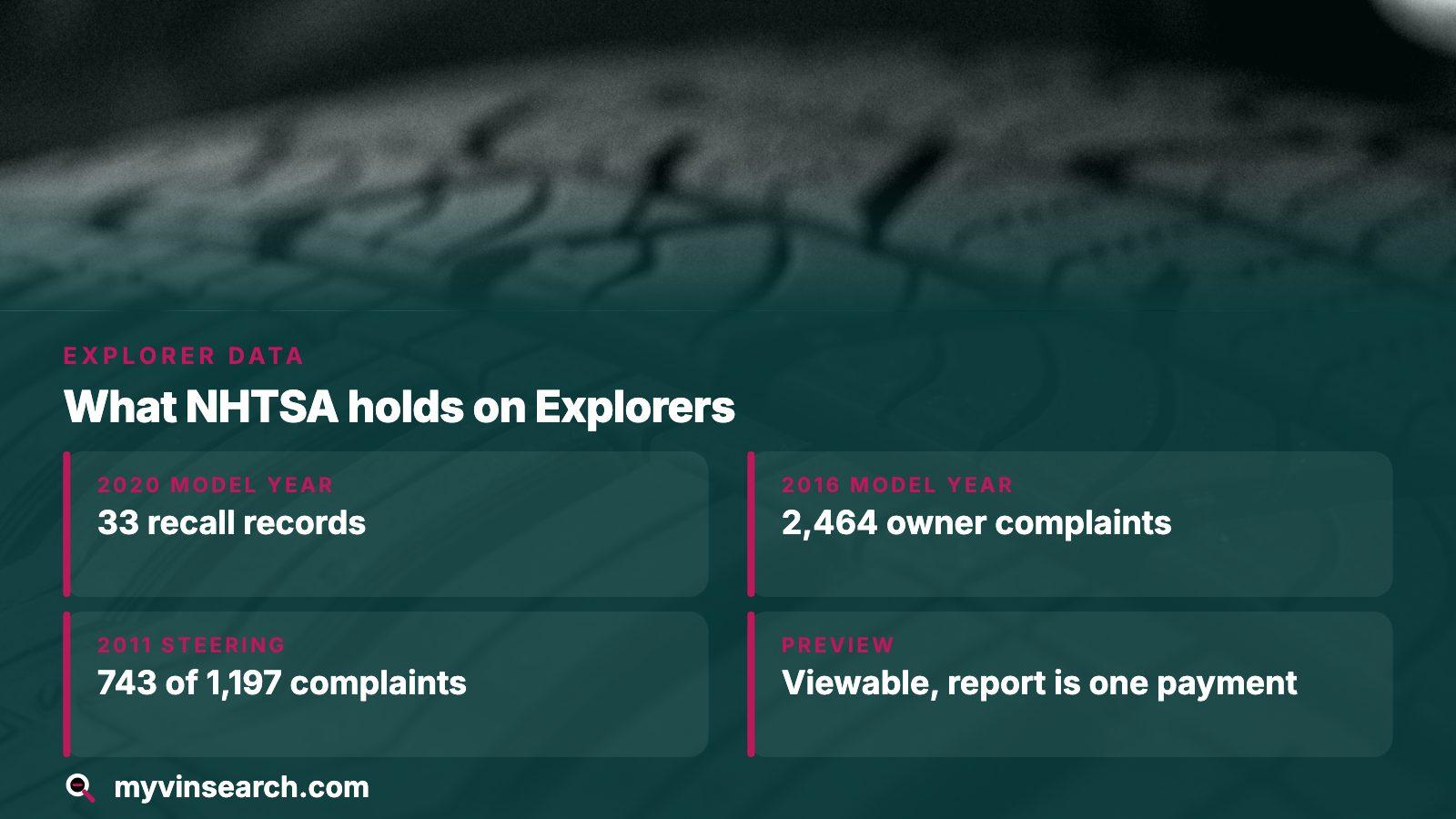
- 33 recall records in NHTSA data
- 2016 model year
- 2,464 owner complaints filed
- 2011 model year
- Steering named in 743 of 1,197 complaints
- Preview
- Free to view; the report is one payment
What a VIN lookup tells you about an Explorer
MyVINSearch reads VINs by make and model, so an Explorer result is judged as a three-row family SUV that is often driven hard, towed with and loaded with kids. The record answers the questions a walk-around cannot.
- Whether any state stamped the title salvage, flood, junk or rebuilt.
- Total-loss and accident entries, with auction photos where the vehicle went through a sale.
- Odometer readings from earlier title events, which should climb steadily.
- Open safety recalls attached to this VIN, repaired at a Ford dealer without charge.
- Liens, theft flags and the factory specification for the year and trim.
None of this replaces a test drive. It tells you which questions to ask while you are on one.
Find the number, then check it describes this Explorer
Two places carry the number on an Explorer: a stamped plate on the dash that you read from outside the SUV, and a sticker inside the driver's door opening. Compare each with the paperwork. Then see what the federal decoder says about it. I fed NHTSA's vPIC decoder four made-up patterns to see how an Explorer should look. They are patterns, not real vehicles, which is why the decoder grumbled about each check digit.
| Sample pattern | Decoder result | Plant |
|---|---|---|
| 1FMHK8D81BGA00001 | 2011 XLT, 3.5-liter six-cylinder, four-wheel drive | Chicago |
| 1FM5K8D83FGA00001 | 2015 XLT, 3.5-liter six-cylinder, four-wheel drive | Chicago |
| 1FMSK8DH5LGA00001 | 2020 XLT, 2.3-liter four-cylinder, four-wheel drive | Chicago |
| 1FMSK8FH0NGA00001 | 2022 Limited, 2.3-liter four-cylinder, four-wheel drive | Chicago |
If a seller advertises a V6 and the number decodes to a four-cylinder, or the model year in the ad is two years off the tenth character, stop and ask why before going further.
How the recall and complaint load shifts by model year
I pulled NHTSA's recall and complaint records for twelve Explorer model years. Read the recall column as a rough guide only. Some records are campaigns shared across several Ford models, and a few cover parts sold separately.
| Model year | Recall records | Owner complaints | Most-named component |
|---|---|---|---|
| 2002 | 10 | 3,622 | Power train (1,577) |
| 2006 | 4 | 635 | Power train (301) |
| 2011 | 8 | 1,197 | Steering (743) |
| 2013 | 12 | 2,238 | Steering (836) |
| 2015 | 9 | 1,816 | Structure (411) |
| 2016 | 15 | 2,464 | Structure (592) |
| 2018 | 7 | 734 | Structure (288) |
| 2019 | 6 | 303 | Structure (151) |
| 2020 | 33 | 1,250 | Power train (505) |
| 2022 | 24 | 274 | Power train (61) |
| 2024 | 10 | 21 | Unknown or other (4) |
| 2025 | 20 | 109 | Electrical (24) |
Young model years show few complaints because their owners have not lived with them long yet. A low count on a 2024 says little.
Older Explorers: the rear toe link campaigns
For 2011 through 2017, the item to confirm is the rear suspension. Campaign 19V435000 covers toe links that may fracture, which Ford said changes handling without warning. The fix replaces the links, checks both ball joints and swaps the wheel knuckle where needed.
A separate filing, 21V746000, applies to 2011-2013 Explorers sold or registered in a list of cold-weather states that run from Connecticut to Wisconsin. It targets a replacement ball joint that can seize and break the outer toe link, with a risk of lost steering control. So an Explorer that spent winters in a salted state, or was repaired with a part-store joint, deserves a closer read of its repair history.
Steering also drives the older complaint numbers. Campaign 14V286000 reflashes the control module of the electric power steering on 2011-2013 cars built between May 2010 and February 2012.
Newer Explorers: axle bolts, fuel lines and software
The 2020 redesign brought the heaviest recall load of any year in my pull. Campaigns reach the fuel system (19V859000 for a chafing vapor line, 20V730000 for a tank valve), the driveshaft (20V693000) and the rear lower control arm bolts (21V154000). Later ones cover a plug-in hybrid battery cell defect (23V626000) and a power train control reset that can affect the park system (23V069000).
The one I would read first is 23V675000, for 2020-2022 cars. Its rear axle bolt can snap, and the driveshaft may then come loose. Ford's repair swaps the subframe bushing and the bolt.
From an NHTSA owner complaint
The owner of a 2020 Explorer wrote that a dealer handled the axle bolt recall in early 2024 but, in the owner's view, only inspected it. About eighteen months later the bolt broke and the differential dropped away. The owner said Ford declined to reopen the recall.
Takeaway: hearing from a seller that the recall is finished is a claim, not a record. Ask for the dealer repair order and compare it with what the VIN shows.
How to run the check
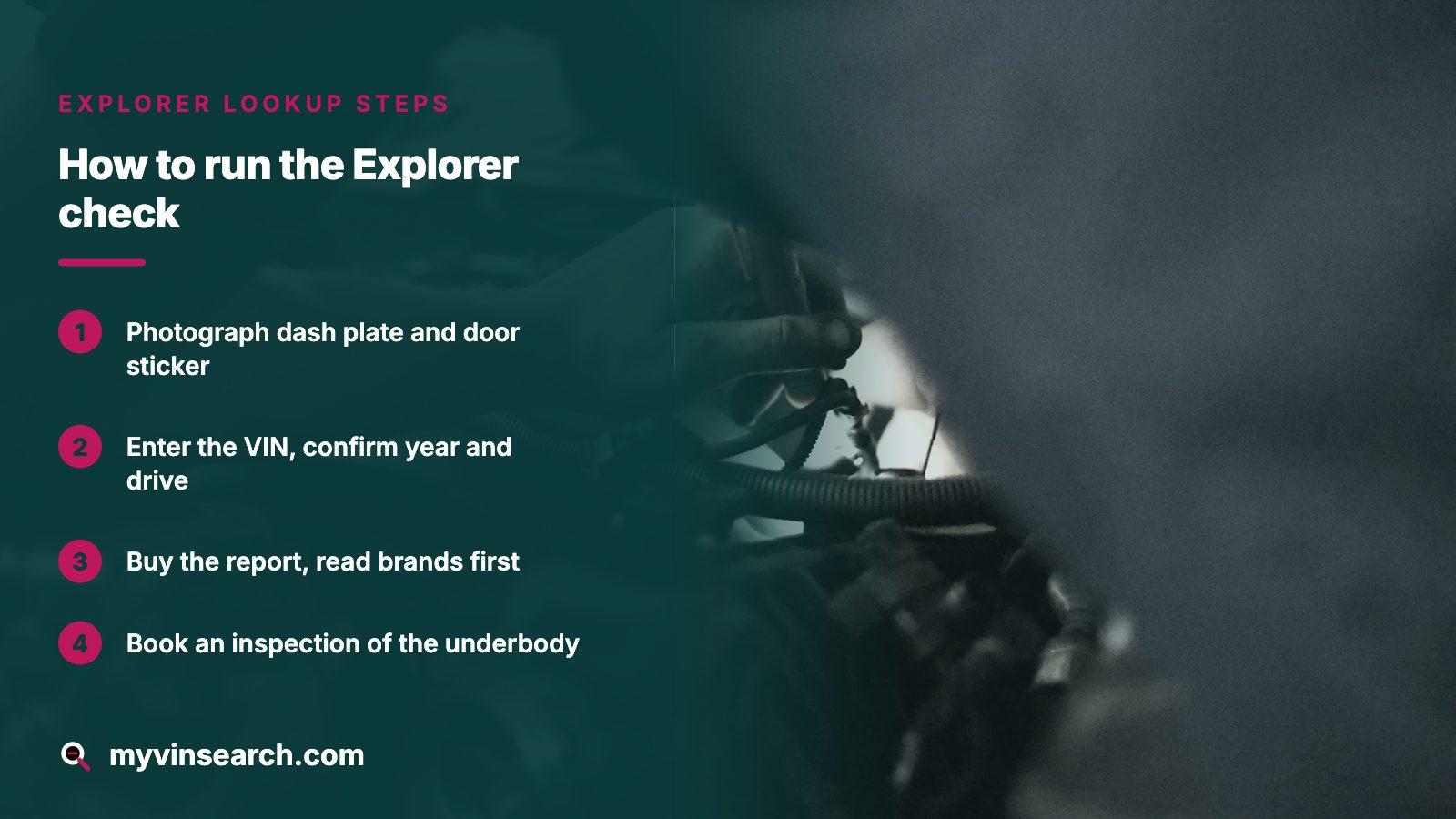
- Photograph the plate on the dash and the sticker in the door opening, then ask the seller for the title.
- Enter it at MyVINSearch. The preview is free and shows year, engine and drive so you can confirm the right Explorer.
- Buy the report if it matches, then read each brand, damage and mileage line in order.
- Put the same VIN into NHTSA's recall lookup and have a Ford dealer confirm anything open.
- Book an independent inspection that includes the rear suspension and underbody.
Do this before a deposit. Hurry is how steps get skipped.
Red flags in an Explorer's record
| What you see | Your move |
|---|---|
| Salvage, rebuilt or flood brand | Get a body-shop and electrical inspection. The federal title program warns that a saltwater soak leaves wiring and air bag sensors likelier to fail. |
| Odometer entry lower than an earlier one | Distrust every other number in the file. |
| Former fleet or police-interceptor use | Expect heavy wear and ask for service records. |
| Open recall with no completed repair | Ask for the dealer's note and a lower price. |
| Lien still listed | The seller may not hold clear ownership. |
| Decoder disagrees with the ad | Ask which is wrong before you pay for anything. |
A cloned VIN, copied from another vehicle of the same make, model and year, is a rarer trap that mismatched paperwork can reveal.
Paying for the report and what comes after
Looking at the preview is free. Buying the report is one payment, never a recurring charge, and the pricing page has the current options. Shopping three Explorers at once? A pack lets you line the records up against each other.
If the record is clean, finish by paying a mechanic who knows Explorers to inspect it before purchase. If it is not, negotiate or walk away on the facts, and save the report in case of a dispute later.
Where this information comes from
- NHTSA recalls data: 2011 Ford Explorer — Toe link, steering and door handle campaigns for the first years of the generation.
- NHTSA recalls data: 2020 Ford Explorer — Fuel, driveshaft, axle bolt and battery campaigns for the redesign.
- NHTSA vPIC VIN decoder — What a typed VIN returns for model, engine and plant.
- NMVTIS: vehiclehistory.gov — The federal title database and what a brand label means.
- NHTSA owner complaint 11669680 — owner experience, paraphrased
Sources and photos: Facts checked against the sources above in November 2026. Photos by Will Truettner, Mustafa Sheikhmouss and Yvette S on Unsplash; diagrams by MyVINSearch.
Keep reading
- Ford VIN check: read the prefix, then match your model to its recordThe brand-level version, covering Ford VIN prefixes and other models.
- Ford recalls by VIN: start at the model line, finish with the open campaignsThe recall half of a Ford check, model line by model line.
- Sample reportSee a finished report before you pay for one.
- PricingHow one report and the packs are priced, with no subscription.
Frequently asked questions
Is a Ford Explorer VIN check free?
In part. NHTSA's decoder and recall lookup cost nothing, and MyVINSearch shows a preview at no charge. The full history report costs one payment. Each free tool covers only a slice, so careful buyers combine them before deciding whether the report is worth buying.
What does a Ford Explorer VIN lookup show?
It ties the number to title brands, damage and total-loss entries, earlier odometer readings, lien and theft flags, open recalls and the factory specification. It cannot show an unreported repair or how the SUV was driven, so a mechanic's inspection still belongs on the checklist.
Where is the VIN on an Explorer?
There are two spots: a plate on top of the dash and a sticker inside the driver's door opening. Each should read exactly like the title. Characters that differ, or a sticker that looks glued over, are a reason to walk away until the seller explains in writing.
Does a clean Explorer report mean no open recalls?
No. Recall status is separate from title and damage history, and it changes whenever Ford files a new campaign. Check NHTSA's lookup on the day you buy, then ask a Ford dealer to confirm. A spotless title says nothing about a part waiting for a fix.
Which Explorer years have the most recalls?
In NHTSA's data the 2020 model year has 33 recall records, the most among the years I pulled, followed by 2022 with 24 and 2025 with 20. Some are shared across Ford models, so check campaigns against your own VIN rather than the year alone.
Now check the car itself
The guide explains what to look for. The report shows what this VIN has on record.