THE SHORT ANSWER
Type the VIN into the free preview and confirm that the year, model and engine match the ad. If they do, buy the report once and read mileage, title and recalls first. Lincoln adds a twist on recalls: the filings belong to Ford, so a model-year list mixes in other Ford trucks, and only the VIN shows whether a campaign reaches your car.
- Lincoln prefixes
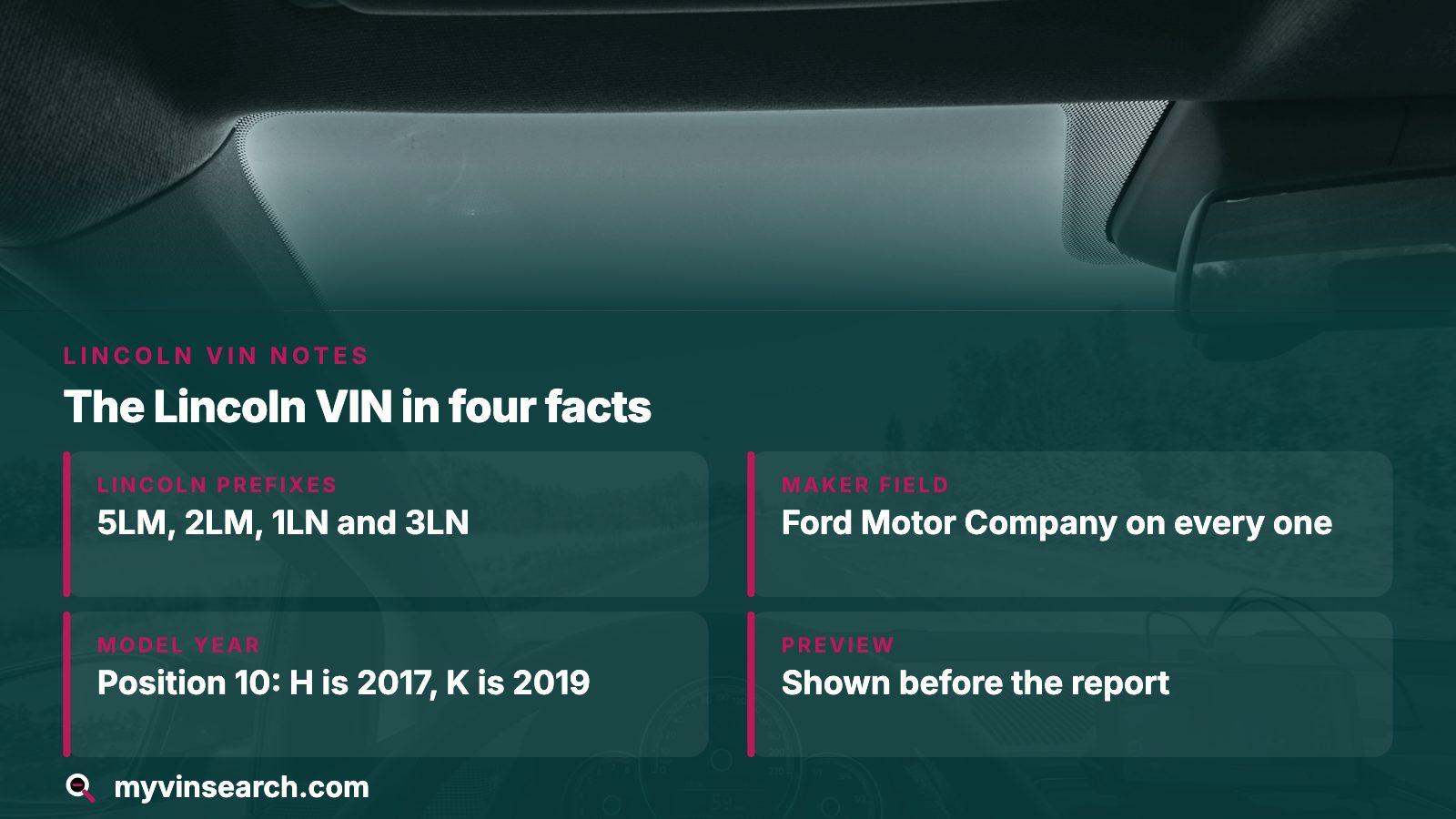
- 5LM, 2LM, 1LN and 3LN decode as Lincoln
- Maker field
- Ford Motor Company on every one
- Model year
- Position 10: H is 2017, K is 2019, M is 2021
- Preview
- Free; the report is one payment
What a Lincoln VIN check reads on one car
NHTSA lists 17 Lincoln model names, from the Town Car and Zephyr to the Corsair. The check ignores the badge on the liftgate and reads what has been filed against the VIN.
- Title brands: junk, salvage or flood, as a state or an insurer recorded them.
- Odometer history: dated readings, so a fall or a leap shows.
- Damage: recorded crashes, plus auction photos if the car sold at a salvage sale.
- Open recalls: campaigns that name this VIN where the repair is still owed.
- Liens, impound and theft entries, and any rental or fleet use.
Lincoln VIN starts, decoded model by model
NHTSA's decoder returns Lincoln for four prefixes: 5LM and 2LM on SUVs, 1LN and 3LN on cars. All four name Ford Motor Company as maker, with its Canadian and Mexican units shown for 2LM and 3LN. The starts below come from owner complaints, which publish only 11 characters of a VIN.
| VIN start | Decodes as | Plant |
|---|---|---|
| 5LMJJ3LT8JE | 2018 Navigator L, 4WD, turbo 3.5-liter six | Jefferson County, Kentucky |
| 5LMJJ2LT6KE | 2019 Navigator, 4WD, turbo 3.5-liter six | Jefferson County, Kentucky |
| 5LM5J7XC2MG | 2021 Aviator, AWD, turbo 3.0-liter six | Chicago, Illinois |
| 2LMPJ8L9XKB | 2019 Nautilus, AWD, turbo 2.0-liter four | Oakville |
| 5LMTJ5DZ7MU | 2021 Corsair, plug-in hybrid, 2.5-liter | Louisville, Kentucky |
| 5LMCJ2D92HU | 2017 MKC, 4WD, 2.0-liter four | Louisville, Kentucky |
| 3LN6L5FC4HR | 2017 MKZ, AWD, 3.0-liter six | Hermosillo, Mexico |
In the five Navigator starts decoded for this page, the sixth character is 3 on each long Navigator L and 2 on each standard one. And a 2017 MKC and a 2021 Corsair (5LMCJ1D92MU) open with the same five characters, so the year letter in position 10 is the clearest tell between them.
How to run the check on a Lincoln
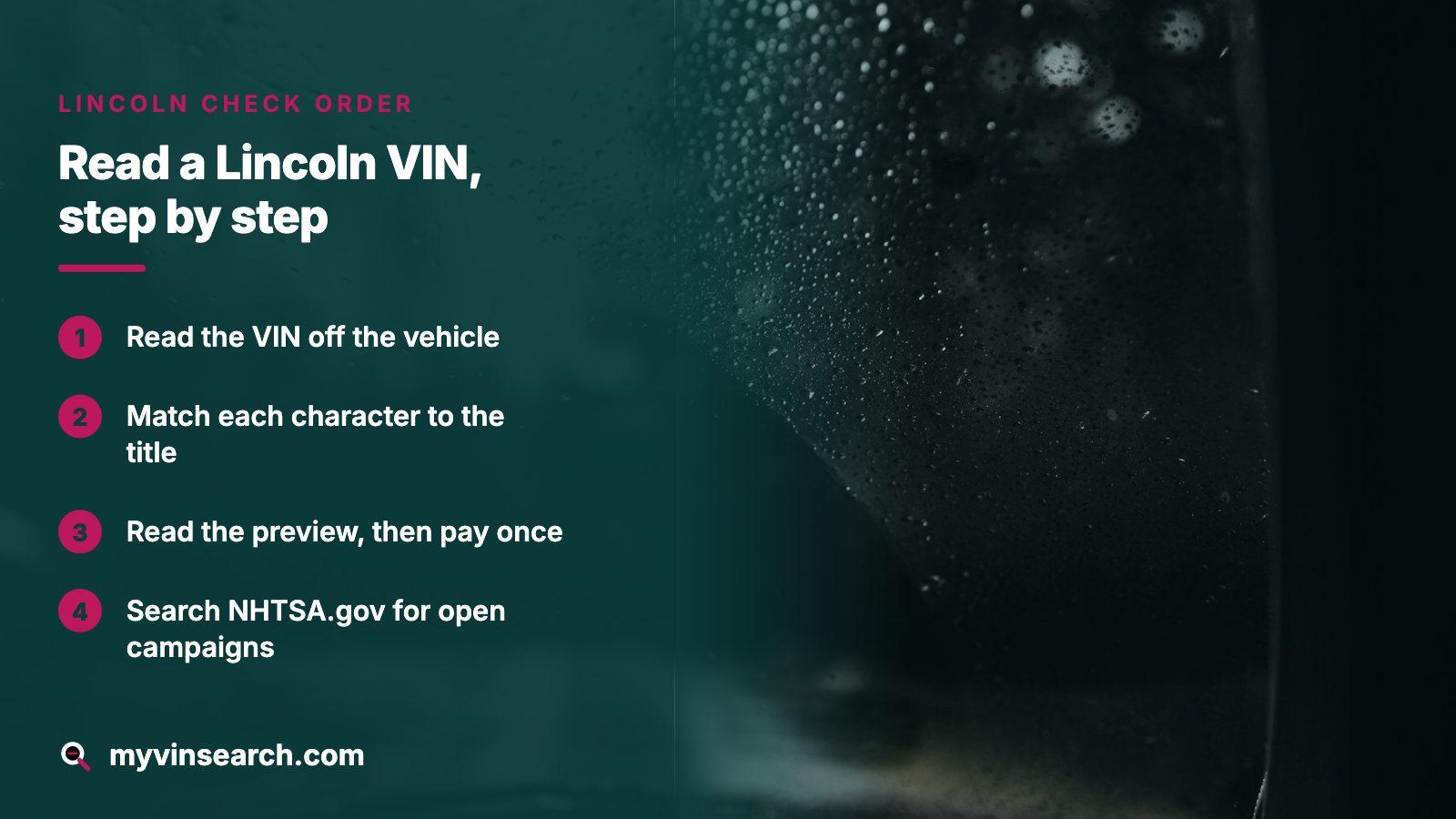
- Read the VIN off the vehicle, not the listing. Federal rules make it visible through the windshield from outside the driver's side in daylight, in capitals at least 4 mm tall.
- Match each character against the title paperwork and the ad. The letters I, O and Q are banned from VINs, so spotting one means a misread.
- Enter it in MyVINSearch. The free preview shows whether year, model and engine agree with the listing; a mismatch means stop and ask.
- If the preview fits, pay once for the report and read mileage, title and recalls first.
- Search the VIN on NHTSA.gov too, and note any campaign whose remedy date lies ahead.
Lincoln recalls: Ford filings, searched by VIN
Ford Motor Company filed every campaign in these lookups, and NHTSA tags the records as Lincoln even when the summary names an Expedition or an F-150. A model-year search returns every filing naming that model, so counts run high.
| Model year | Campaigns returned | Examples in the list |
|---|---|---|
| 2018 Navigator | 12 | Seat belt retractors, park pawl, brake master cylinder |
| 2020 Aviator | 30 | Rearview camera, hybrid battery cells, wiper motor |
| 2021 Corsair | 22 | Hybrid battery and engine fires, camera, wiper motor |
| 2014 MKZ | 14 | Door latches, steering bolts, restraint module |
| 2021 Nautilus | 2 | Intake valves that can break, camera software |
A count is not a verdict on one car. A filing appears in a model-year list when it names that model and year, but the repair applies only if the VIN or build date is inside it. One MKZ filing names cars built between November 14, 2012 and July 31, 2014; another, April 25, 2012 to September 30, 2013.
An open recall with no repair ready yet
Campaign 26V402 covers park pawls that can engage while the vehicle is moving, on 2018 to 2021 Navigators and certain Expeditions, Explorers, Aviators and a 2021 F-150. VINs became searchable June 26, 2026, and Ford anticipates the final remedy in April 2027.
From an NHTSA owner complaint
A 2018 Navigator owner held notices for two campaigns, but the powertrain repair had no parts available. At 60 mph on the freeway the steering wheel shuddered and the pedal stopped responding; the truck then stalled at a signal and would not restart. One independent shop replaced the transmission and the fault returned three weeks later. A second replaced spark plugs and fixed a transmission part without a cure; a third said the transmission needed replacing. The owner lists about 72,000 miles.
A buyer in that spot inherits the problem, not the cure. Campaign 26V344, filed May 28, 2026 for 2018 to 2022 Navigators and Expeditions, replaces two earlier seat belt campaigns, and cars already repaired under them need the new fix. A VIN that read closed last year can read open today.
When the report's mileage and the dash disagree
From an NHTSA owner complaint
A dealer sold a 2019 Navigator to a buyer who later found the mileage did not add up. The dash showed 81,183 at purchase; a warranty company flagged the gap, and a history report put the reading near 97,000. The owner filed it under the label Odometer Fraud and does not say how it ended.
A gap of nearly sixteen thousand miles is what dated readings expose before you pay and a clean dash hides after. The federal title system covers 87 percent of vehicles, and more than half the states report to it, so a quiet result can still be a false negative. If two readings clash, ask for service invoices and order the state title record.
Buybacks, brands and what a title record can miss
From an NHTSA owner complaint
A used 2017 MKZ came with the story that it was a manufacturer buyback with every fault fixed. An oil leak later called for a new oil pan, valve covers and gaskets under a service bulletin, a job priced near four times a plain pan gasket. The owner asks why the updated parts were not fitted at buyback.
Get a buyback story in writing before you pay. Brand standards vary by state, and the federal system warns that a car treated as salvage in practice might lack the brand on record. Whether a buyback appears as a label is a question for that state's title record, not something to assume.
Reading the result: flags and the next move
- Year, model or engine differs from the ad: wrong vehicle or wrong listing. Stop until the seller explains.
- An open campaign: the dealer repair costs the owner nothing. Ask if the part is in and whether a remedy date is posted.
- A campaign Ford refiled after a bad earlier repair: a closed status may not hold. Ask for the repair order.
- Two dated readings that fall or leap: request service invoices and the state title record.
- A title brand or a buyback story: collect repair papers and pay an independent mechanic to inspect it.
- Nothing flagged: nothing unrepaired is on file today. Run it again on signing day.
The price question and the steps after it
The preview costs nothing and settles whether year, model and engine fit the listing. The report is one purchase per VIN, with no renewal; for a shortlist of cars there are packs sized 3, 5 and 10. Rates sit on the pricing page.
- Phone a Lincoln dealer with the VIN and ask which campaigns are open and whether parts are in stock.
- Order the state title record if the report shows a brand or the mileage fails to add up.
- Hire an independent mechanic and ask for a written estimate that carries the VIN.
Where this information comes from
- 49 CFR Part 565: Vehicle identification number requirements — Federal rules for where the VIN must be readable, which characters are allowed, and the year code in position 10.
- NHTSA vPIC: decode of a 2018 Navigator L VIN start — The decoder call behind the table of VIN starts. The prefix lookups run on the same service through its WMI call.
- NHTSA recalls data: Lincoln Navigator, model year 2018 — Campaigns 26V402 and 26V344 with their dates. The Aviator, Corsair, MKZ and Nautilus counts come from the same service.
- NMVTIS consumer information — What federal title records hold, where they come from, and why a clean result can still miss history.
- NHTSA owner complaint 11699035 — owner experience, paraphrased
- NHTSA owner complaint 11733564 — owner experience, paraphrased
- NHTSA owner complaint 11579245 — owner experience, paraphrased
Sources and photos: Facts checked against the sources above in November 2026. Photos by Nik, Justin Cron and Sander Jeurissen on Unsplash; diagrams by MyVINSearch.
Keep reading
- Ford VIN check: read the prefix, then match your model to its recordLincoln recalls are Ford filings, and the Expedition, Explorer and F-150 appear in the same campaigns.
- Ford recalls by VIN: start at the model line, finish with the open campaignsSee how the same Ford filings read when you search by VIN instead of by model.
- Sample reportLook through each section of a report before you decide to buy one.
- PricingWhat one report costs and how the packs of 3, 5 and 10 work.
Frequently asked questions
Can I run a Lincoln VIN check for free?
Only the preview is free; it shows whether year, model and engine match the listing. One payment buys the report for one vehicle and nothing recurs. Open recalls can also be searched by VIN on NHTSA.gov, and the dealer repair costs the owner nothing.
Why does my Lincoln VIN decode to Ford?
The decoder names the manufacturer, and Ford Motor Company is filed for the 5LM, 1LN, 2LM and 3LN prefixes, with the Canadian and Mexican Ford units shown on 2LM and 3LN. The make field still reads Lincoln, so nothing is wrong with the decode.
What does the tenth character of a Lincoln VIN mean?
It is the model year code. Reading up from H for 2017, the letters J, K, L and M stand for 2018 through 2021. Compare it with the ad: a start with M in position 10 cannot be a 2017 MKC, whatever the listing claims.
What if the report shows more miles than the dash?
Treat the dash as unproven until someone accounts for the gap. Ask for dated service invoices, order the state title record, and have a mechanic judge the wear. If nothing explains it, walk away.
Will a Lincoln VIN check show a buyback?
Do not assume so. Brand rules differ by state, and the federal title database admits gaps that can produce a clean answer. Ask the seller in writing, pull the state title record, and read the report's title and mileage lines closely.
Now check the car itself
The guide explains what to look for. The report shows what this VIN has on record.