
THE SHORT ANSWER
Copy the Accord's VIN into MyVINSearch and use the free preview to confirm that year, trim and engine match what the ad says. After that, a one-time report opens the title, damage, odometer and recall lines for that car. Run the same number through NHTSA's recall tool as a second opinion before you agree on a price.
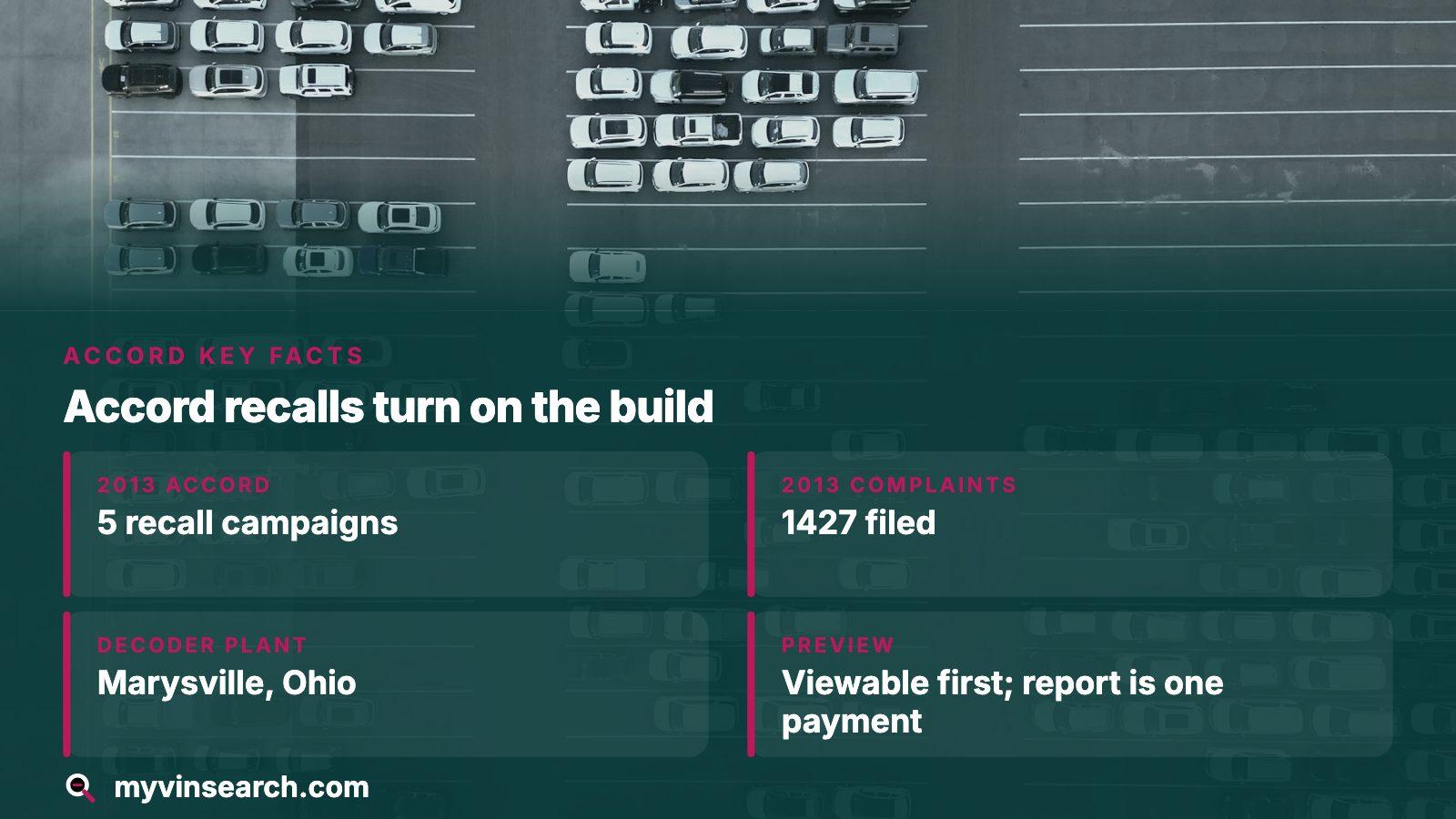
- Recall campaigns on a 2013 Accord
- 5 in NHTSA's recall data
- Owner complaints, 2013 model year
- 1427 filed with NHTSA
- Plant in the decoder samples
- Marysville, Ohio
- Preview
- Free to view; the report is a single payment
What a VIN lookup tells you about an Accord that the listing will not
The Accord is the sedan people buy when they want no drama, which means a lot of them have been through several owners, a few insurance claims and at least one auction lane. None of that is visible on a lot. MyVINSearch organizes its checks by model, so the answer is read against an Accord rather than a generic car.
- Any salvage, junk or flood label a state stamped on the title, with the state named.
- Crash and total-loss entries, plus auction photos if an insurer sold it off.
- Past odometer readings, which ought to rise steadily between titles.
- Unrepaired safety campaigns tied to this number.
- Liens, theft flags and a market value for that year and trim.
Viewing the preview costs nothing and confirms the basics. The report itself is bought once and never renews.
Reading the build details in an Accord's number
Characters one through three identify the maker and the region of assembly. NHTSA's decoder holds 45 Honda prefixes. For an American-market Accord the one you will usually meet is 1HG, and every sample Accord pattern I ran through the decoder came back built in Marysville, Ohio. A JHM prefix, by contrast, decoded to Sayama, Japan.
| Tenth character | Model year | Sample decoded |
|---|---|---|
| D | 2013 | LX with a 2.4L engine |
| J | 2018 | Sport with a 1.5L engine |
| K | 2019 | Sedan with a 1.5L engine |
| L | 2020 | Hybrid Touring with a 2.0L engine |
Use this as a quick sanity test. If the ad says 2018 and the tenth character is a D, someone has mixed up listings or the number on the dash does not belong to the car. The engine size in the preview should match too: a 1.5L car sold as a 2.0L is worth a direct question to the seller.
Why Accord recalls turn on build dates and states
Honda rarely recalls a whole model year. Campaign 13V297000 targeted 2013 Accords assembled from mid-January to early April, over a fuel tank neck that could stop the pump sealing. Campaign 15V121000 named three days in late July 2014 and a stretch from mid-August 2014 into January 2015, because connecting rod bolts may have been tightened wrongly. Neighbors on the same street can be on different sides of those lines.
| Campaign | Accords named | Problem in brief |
|---|---|---|
| 17V418000 | 2013 to 2016 | Battery sensor case admits water; short circuit and fire risk |
| 20V769000 | 2013 to 2015, 4-cylinder CVT, salt-belt registrations | Driveshaft coating weakened; shaft can break |
| 20V771000 | 2018 to 2020 sedan and Hybrid | Body control module software; wipers, camera, lights can drop out |
| 23V858000 | 2013 to 2023, also applied to a long list of other Honda and Acura cars | Fuel pump inside the tank can quit, stalling the engine |
Counting what NHTSA lists, a 2013 Accord has 5 campaigns, a 2015 has 5, a 2018 has 6, a 2020 has 5 and a 2022 has 4. Some of those also cover other Honda and Acura cars, so the summaries matter more than the tally.
The driveshaft campaign and where the car has lived
Campaign 20V769000 is the one that depends on geography. It reached Accords from 2013 to 2015 with a four-cylinder motor and CVT gearbox, provided the car was originally sold or at any time registered in one of 23 named jurisdictions, an alphabetical run from Connecticut to Wisconsin. The concern was a lubricant that weakened the shaft's protective coating, leaving it open to damage from road salt. If a shaft snaps the car loses drive suddenly, and it can roll off if parked without the handbrake. Campaign 25V422000, filed in June 2025, extended that repair for 2013 cars.
Why this matters when you read a report
The recall turns on registration history, not only on the VIN. An Accord now sitting in a dry state may still have spent winters in Ohio or New York. The title and registration trail in a history report shows where it was titled, so you can tell whether that campaign could apply.
The fix is an inspection and, where needed, new shafts on both sides, free to the owner.
What owners report when a recall list comes up empty
The 2013 model year has drawn 1427 complaints at NHTSA, and the 2018 year 1899. Complaints are not recalls: they are unverified accounts, and a clean recall check does not mean a clean car. Two filed this year on 2013 Accords show how a problem can live outside the recall list.
From an NHTSA owner complaint
One owner reported a failed VSA module, said many other 2013 Accords share the fault, and put the repair above 4,000 dollars. They noted Honda had done a recall abroad and asked NHTSA to force one here. A second owner wrote of electric power steering cutting out entirely at speed, a lit warning lamp and a dealer-read code of 34-05.
Take from this that the recall result and the history report answer different questions. Neither replaces a test drive with the steering and brake warning lights watched, or a pre-purchase inspection by a mechanic.
How to run the check on an Accord you are considering
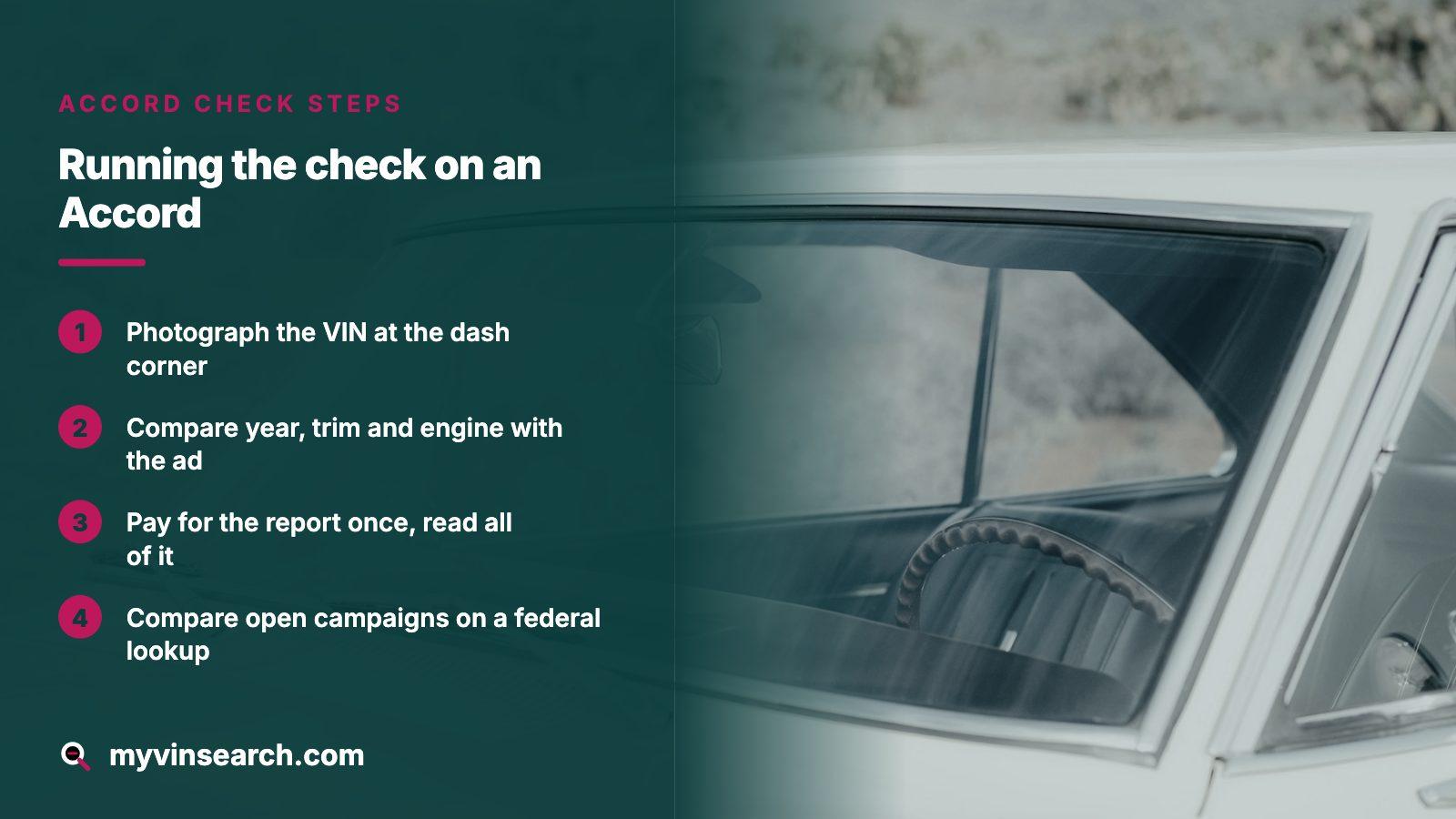
- Take a photo of the VIN at the dash corner, visible from outside, then compare it with the digits on the title or registration.
- Enter every character in the search field on this site and open the preview.
- Compare the year, trim and engine shown there with what the listing claims.
- If those basics agree, pay for the report once and read all of it.
- Run the same VIN through NHTSA's free recall lookup and compare the open campaigns.
A single mistyped character usually returns nothing at all, and an empty result looks exactly like a good one. Re-enter the number slowly before you trust it.
Red flags worth walking away from on an Accord
The federal title database takes reports from state titling offices, recyclers, salvage yards and insurance carriers. It carries a state's brand, the latest odometer figure and, sometimes, theft. After big floods, soaked cars were trucked into states with no flood brand and resold, and their wiring and airbag sensors were likelier to fail. A shared national record makes that dodge harder.
- A flood, salvage or junk brand on any past title.
- Mileage that drops between two entries.
- A recent title transfer from a state far from where the seller lives.
- A number on the car that disagrees with the paperwork; cloned cars wear VINs copied from matching vehicles.
- An open recall the seller says was done but cannot document.
Price, and where to go once you have the report
Current figures sit on the pricing page, so none are quoted here. A single report is one charge; bundles of 3, 5 or 10 exist for comparing several Accords. The preview costs nothing, so you can drop a car before spending anything when the year or engine fails to match.
If the report is clean, ask for service records on the steering, brakes and battery, then book an independent inspection. If it shows a brand, a mileage drop or an unrepaired campaign, use that to renegotiate or move to the next car. A model-specific report does not replace the mechanic. It tells you which questions to ask him.
Where this information comes from
- NHTSA recalls API: 2013 Honda Accord — Campaign numbers, dates, build windows and remedies quoted for the recall table.
- NHTSA vPIC: decode a Honda Accord VIN — Plant city, model year and engine returned for sample Accord numbers.
- NHTSA vPIC: Honda manufacturer identifiers — The list of Honda prefixes and vehicle classes.
- NMVTIS for consumers (U.S. Department of Justice) — What federal title data holds, who reports it and why brand washing is harder.
- NHTSA owner complaint 11769786 — owner experience, paraphrased
- NHTSA owner complaint 11745479 — owner experience, paraphrased
Sources and photos: Facts checked against the sources above in November 2026. Photos by Scott Graham, Wesley Tingey and Iain on Unsplash; diagrams by MyVINSearch.
Keep reading
- Honda recall check by VIN: open recalls for your exact modelThe wider Honda recall picture, beyond the Accord.
- Honda Civic VIN check: what the number tells you about one specific CivicThe same check for the other Honda sedan on many shortlists.
- Sample reportSee each section of a report before you pay for one.
- PricingHow single reports and multi-car sets are priced.
Frequently asked questions
Is a Honda Accord VIN lookup free?
Opening the preview at MyVINSearch costs nothing and confirms the year, trim and engine. The full report, which holds title, damage, odometer and recall entries, is a one-time payment. NHTSA's lookup is a separate free tool, and it covers safety campaigns only.
Where do I find the VIN on an Accord?
Look at the small plate at the dash corner nearest the driver, and at the label on the door pillar. Match either against the title or registration. If the seller offers only a photo, ask to see the car and read the number yourself.
Does a clean recall check mean the Accord is fine?
A clean lookup only says that no unrepaired campaign matches the VIN today. Owners have filed complaints about problems such as steering assist and the VSA module that sit outside the recall list, so pair the check with a test drive and an inspection.
Which Accord years have the most recalls?
In NHTSA's data the 2018 Accord leads with 6 campaigns, the 2013, 2015 and 2020 years carry 5 each, and the 2022 has 4. Counts overlap because some campaigns span many years, so read the actual summary for the VIN you are buying.
Can the check tell me where an Accord was built?
In part. The opening characters point to the maker and region, and the Accord samples decoded to Marysville, Ohio. A prefix that decodes to Japan on a car sold as American-built is a reason to ask the seller to explain.
Now check the car itself
The guide explains what to look for. The report shows what this VIN has on record.