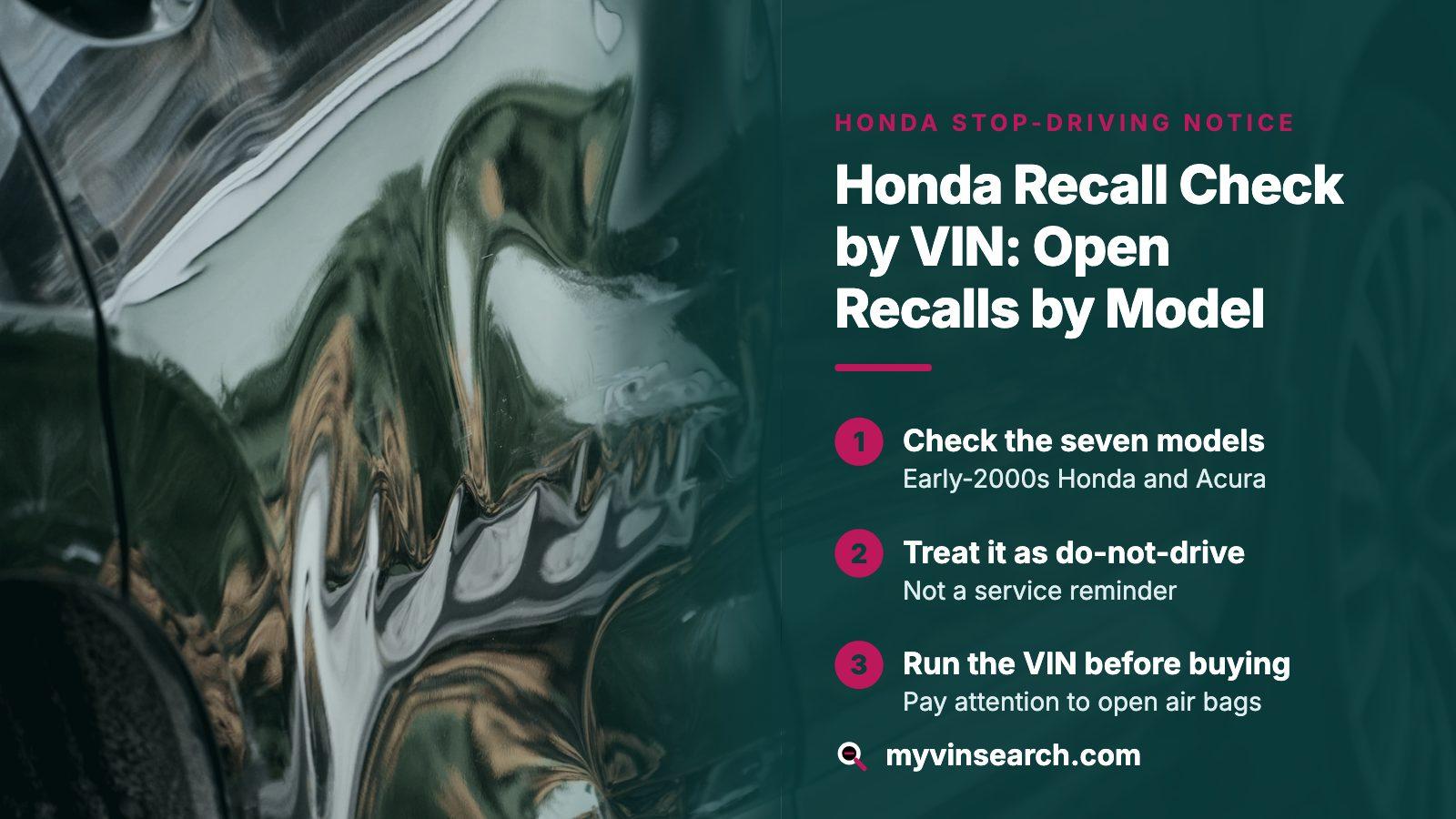
THE SHORT ANSWER
Take the 17-character VIN straight from the car, run the recall check, and compare it with NHTSA's lookup and Honda's own recall site. Any open safety recall is repaired at no charge. Pay attention if the car is one of the Honda or Acura models from 2001 to 2003 on the Takata Alpha list: NHTSA says an unrepaired inflator ruptures about half the time in a crash.
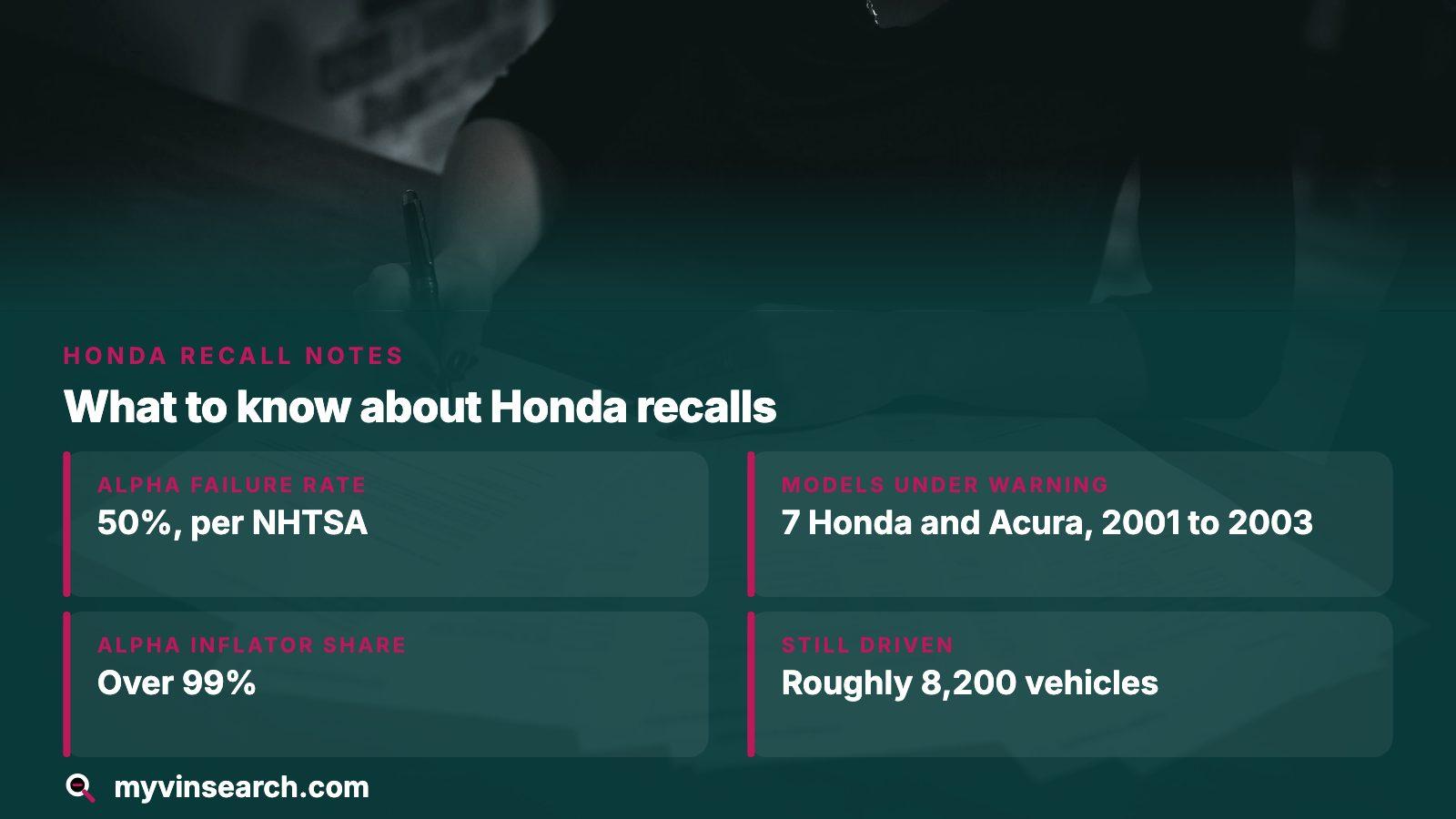
- Alpha inflator failure rate
- 50%, per NHTSA
- Models under the warning
- 7 Honda and Acura models, 2001 to 2003
- Alpha inflators accounted for
- Over 99%
- Still driven
- Roughly 8,200 vehicles
Start with the model line: what the VIN says about your Honda
Recalls are filed against model lines and years, never against the Honda name as a whole. An Accord, a Civic, a CR-V and a Pilot can share a lot and carry entirely different exposure. MyVINSearch is organized around that fact: pin down the make and model first, then read the campaigns that apply.
| VIN position | Role in a Honda recall match |
|---|---|
| 1 to 3 | Manufacturer, which separates a Honda from an Acura |
| 4 to 8 | Model line, plus engine and body details |
| 9 | Check digit, a sanity test on the other characters |
| 10 | Model year, which decides whether a campaign reaches the car |
If the ad says Pilot and the VIN decodes to something else, settle that first. The campaign list belongs to the model the number describes, whatever the listing says.
Running a Honda recall check on a car you might buy
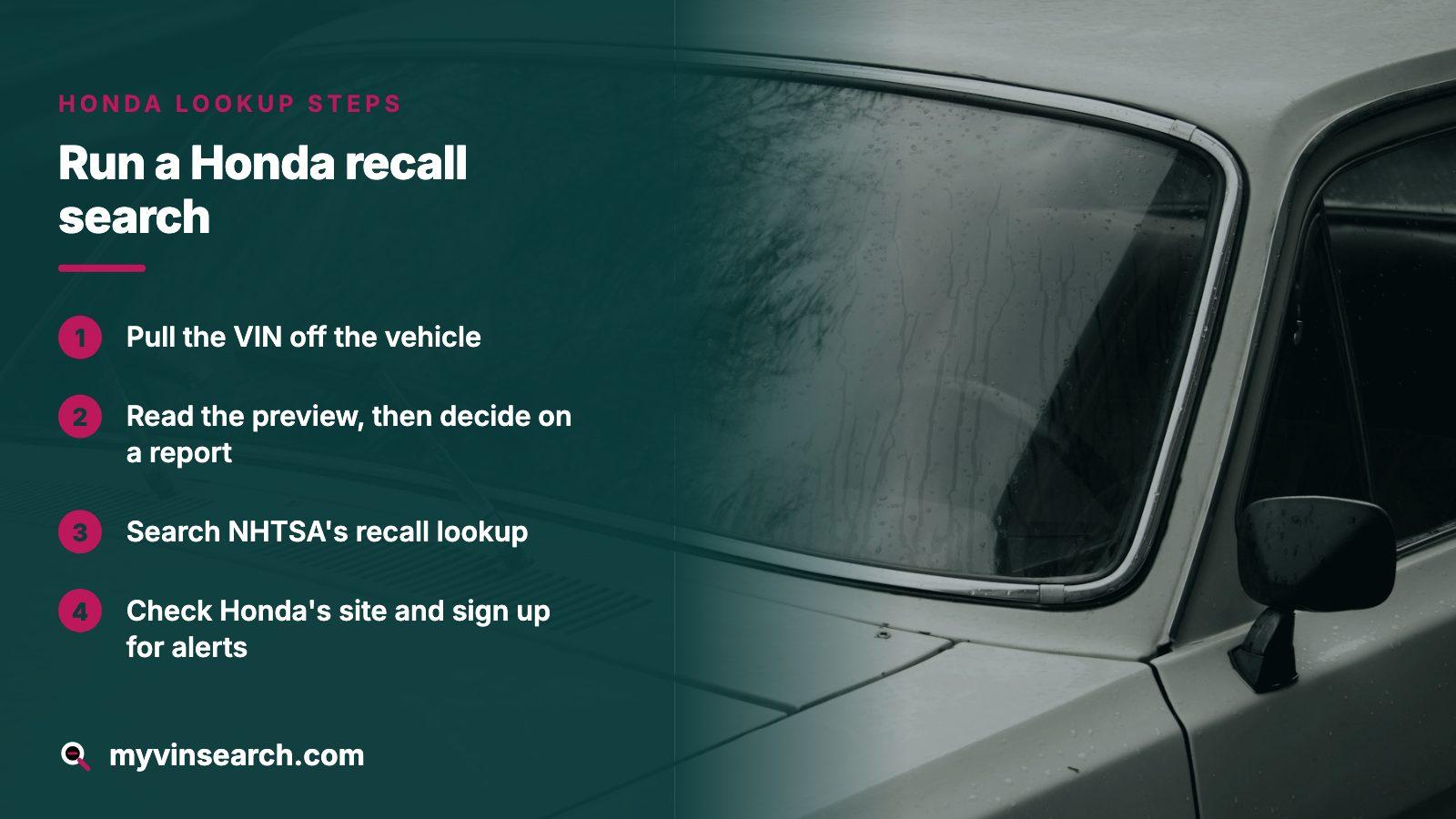
- Pull the VIN off the vehicle itself. Honda stamps it on a plate at the dashboard end of the windshield and prints it again on the door-frame sticker. Anything typed into a listing may carry a slip.
- Enter it on MyVINSearch and read the free preview first, then decide whether the full report is worth buying.
- Put the VIN into NHTSA's recall lookup as well. It covers every manufacturer selling in the U.S. and costs nothing.
- Check Honda's own recall site too. It carries product updates and service campaigns outside the federal recall system, which NHTSA's database never lists.
- Sign up for alerts. NHTSA's email notices and SaferCar app tell you when a campaign is filed against the car later.
Seven early-2000s models carry the do-not-drive warning
The Takata air bag recall is huge, and its campaigns are not equally serious. NHTSA singles out the oldest recalled driver-side inflators and calls them Alpha. The warning names seven models, and it matters only for cars whose Takata repair was never done.
| Model | Model years |
|---|---|
| Acura 3.2 TL | 2002 to 2003 |
| Acura 3.2CL | 2003 |
| Honda Pilot | 2003 |
| Honda Odyssey | 2002 |
| Honda CR-V | 2002 |
| Honda Civic | 2001 to 2002 |
| Honda Accord | 2001 to 2002 |
Being on this list does not make a particular car dangerous today. Many were fixed long ago. The model name raises the question and only the VIN answers it.
Why this is a stop-driving notice, not a service reminder
NHTSA states that Alpha inflators fail about half the time. A failed unit can burst its metal housing and throw fragments toward the driver. Honda has told owners of unrepaired cars not to drive them until the work is done.
Age works against these parts. The propellant degrades over the years and then burns faster and harder than designed, so more years means a more degraded inflator, not a safer one.
Honda says over 99% of these inflators are replaced or accounted for. Even so, NHTSA counted roughly 8,200 vehicles still on the road with the most dangerous air bags.
From an NHTSA owner complaint
A buyer of a 2001 Accord told NHTSA the original owner had passed along a copy of the air bag recall notice. The dealer had no part yet and, citing the do-not-drive warning, held the car until the buyer signed a release. The driver's air bag was switched off and the warning light stayed on.
An open Alpha recall can leave you with a car you cannot use and no part on the shelf. On a car you are about to buy, do not drive it home: have the seller arrange the repair first, or book the tow yourself.
What Honda pays for, and why the repair stays free
Because the advice is to leave the car parked, the remedy reaches beyond the repair itself. According to NHTSA, an owner of an affected vehicle can get:
- The recall repair at no charge, parts and labor included
- Towing to the dealer, so the car never has to be driven
- Mobile repair, where a technician comes to the vehicle
- A loaner or rental car where one is needed
Honda and Acura customer service takes calls on 888-234-2138.
The entitlement stays with the car, so a used Honda carries the claim. Its one boundary is a 15-year rule: the car must have been first sold fewer than 15 years before the manufacturer determined the defect existed. Takata campaigns for these cars fall inside that window.
Reading the result: what each outcome means for a Honda
| What the check shows | What it means | What to do |
|---|---|---|
| Open Takata campaign on a listed model | Possibly an Alpha car under the stop-driving warning | Call Honda customer service and arrange a tow |
| Open Takata campaign on any other Honda | An air bag is under recall, but not automatically an Alpha car | Book the dealer repair, which costs nothing |
| Open campaign on another system | A safety defect is still unrepaired | Ask whether parts are in stock before the sale closes |
| No open campaigns | Nothing unrepaired is recorded today | Run the VIN again right before payment |
One open recall seldom justifies walking from a deal, since the repair costs the buyer nothing. Settle it before the sale closes; later is how these cars reached two decades without the fix.
From an NHTSA owner complaint
A 2001 Civic owner, trying to sell the car, told NHTSA that the dealer never called back to schedule the air bag recall, and that an attempt years earlier went the same way. The owner warned it could become the next owner's safety problem.
A seller's promise to book the repair is only as good as the dealer's calendar. Ask for the work to be finished before you pay.
Honda and Acura: why a VIN search covers both badges
Acura is Honda's premium brand, and the two share engineering, suppliers and many components. When a shared part is defective, the campaign can appear under both names. That is why the 3.2 TL and 3.2CL appear on the Alpha list next to the Accord and Civic.
Federal campaigns are filed per brand, so a search by the Honda name alone will not show Acura entries. A VIN search avoids the gap because the number belongs to the vehicle, not to the badge on the trunk.
What a recall check cannot tell you, and what the report adds
A recall lookup answers one question: is a safety repair outstanding on this VIN today. Crash history, title brands, odometer accuracy and loans against the car sit in other record systems.
From an NHTSA owner complaint
A buyer of a 2002 Civic told NHTSA the air bag warning light had been on since the day of purchase. The dealer's paperwork said it did not know the system's status and accepted no liability. A history report later showed a head-on collision in 2018, and a VIN lookup showed an open air bag recall only on the day of the complaint.
That buyer got the recall answer and the history answer after the sale. Get both before you sign.
The free preview comes before any payment. One report covers one VIN and is paid once; packs of 3, 5 and 10 suit a shortlist, nothing renews, and the pricing page has the amounts. Beyond open recalls, the report holds:
- Title brands, plus salvage and auction history with photos
- Accident and damage records alongside odometer readings
- Liens, impounds, theft and insurance records
Where this information comes from
- NHTSA: Honda upgrades Takata Alpha recall to do-not-drive — Supports the failure rate, the count of vehicles still driven and the seven-model list.
- NHTSA: Takata air bag recall spotlight — Background on the wider Takata population and how the tiers differ.
- NHTSA: Recalls lookup — The federal VIN search that shows unrepaired safety campaigns on a specific car.
- NHTSA owner complaint 11670848 — owner experience, paraphrased
- NHTSA owner complaint 11394669 — owner experience, paraphrased
- NHTSA owner complaint 11407968 — owner experience, paraphrased
Sources and photos: Facts checked against the sources above in November 2026. Photos by Maxim Tolchinskiy, Tigran Shishmanyan and Dimitri Karastelev on Unsplash; diagrams by MyVINSearch.
Keep reading
- Sample reportSee what a full report holds beyond open recalls before you buy.
- PricingHow single reports and packs are priced, with no subscription.
- Toyota recalls by VIN: find the model line, then the campaigns still open on itThe same VIN-first recall check for another Japanese make.
- Hyundai recall check by VIN: open campaigns for your exact modelAnother make whose recalls span two marques, checked the same way.
Frequently asked questions
How do I run a Honda recall check by VIN?
Take the VIN from the car, enter it on MyVINSearch, then repeat the search on NHTSA's lookup and Honda's recall site. Each reports any safety recall still waiting for a repair on that vehicle. The two official tools need no account and cost nothing.
Which Honda models carry the stop-driving warning?
Seven models, all built between 2001 and 2003: the Accord and Civic (2001 to 2002), the CR-V and Odyssey (2002), the Pilot (2003), plus the Acura 3.2 TL (2002 to 2003) and 3.2CL (2003). It counts only when the Takata repair was never completed on that VIN.
Is a Honda recall repair still free on an old car?
Usually yes. The right to a free remedy passes to later owners, provided the car's first sale came within 15 years of the manufacturer's defect finding. These Takata campaigns fall inside that window.
Does a Honda recall check also cover Acura models?
A VIN search does, because the number identifies the vehicle itself. A search by brand name does not, since federal campaigns are filed per marque, and a shared defect can appear under both names with separate campaign numbers.
My Honda shows no open recalls. Is it safe to buy?
It means nothing is outstanding against that VIN today. It cannot show crash damage, title brands, odometer tampering or liens, which live in separate databases. Pair it with a full history report and run the VIN again at purchase.
Now check the car itself
The guide explains what to look for. The report shows what this VIN has on record.