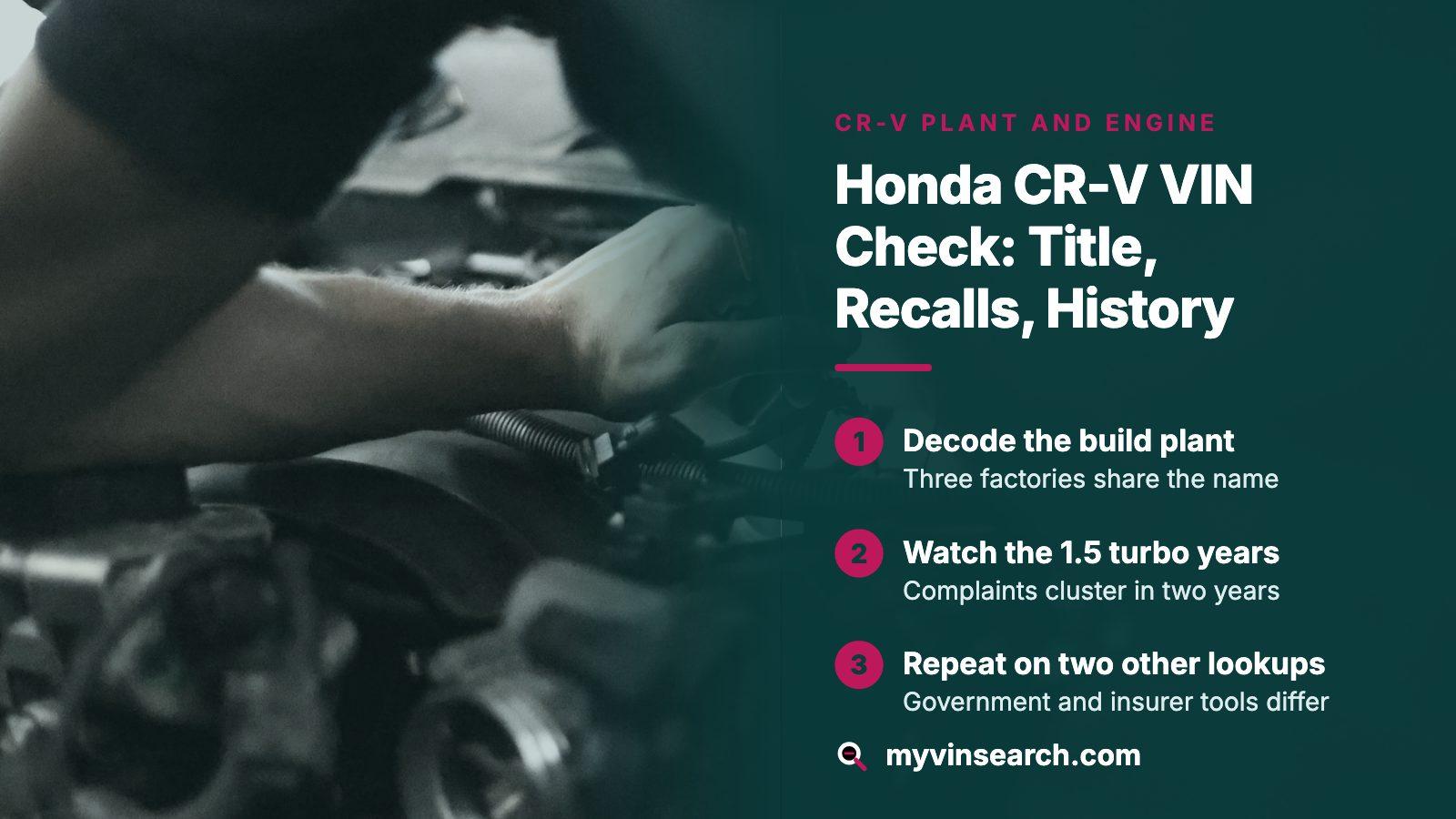
THE SHORT ANSWER
Copy the VIN off the CR-V and enter it at MyVINSearch. The free preview lets you confirm the year, engine and build plant against the ad. A one-time report then adds title, damage, mileage and recall entries. Afterward, repeat the lookup on two free services, NHTSA and NICB, as a cross-check.
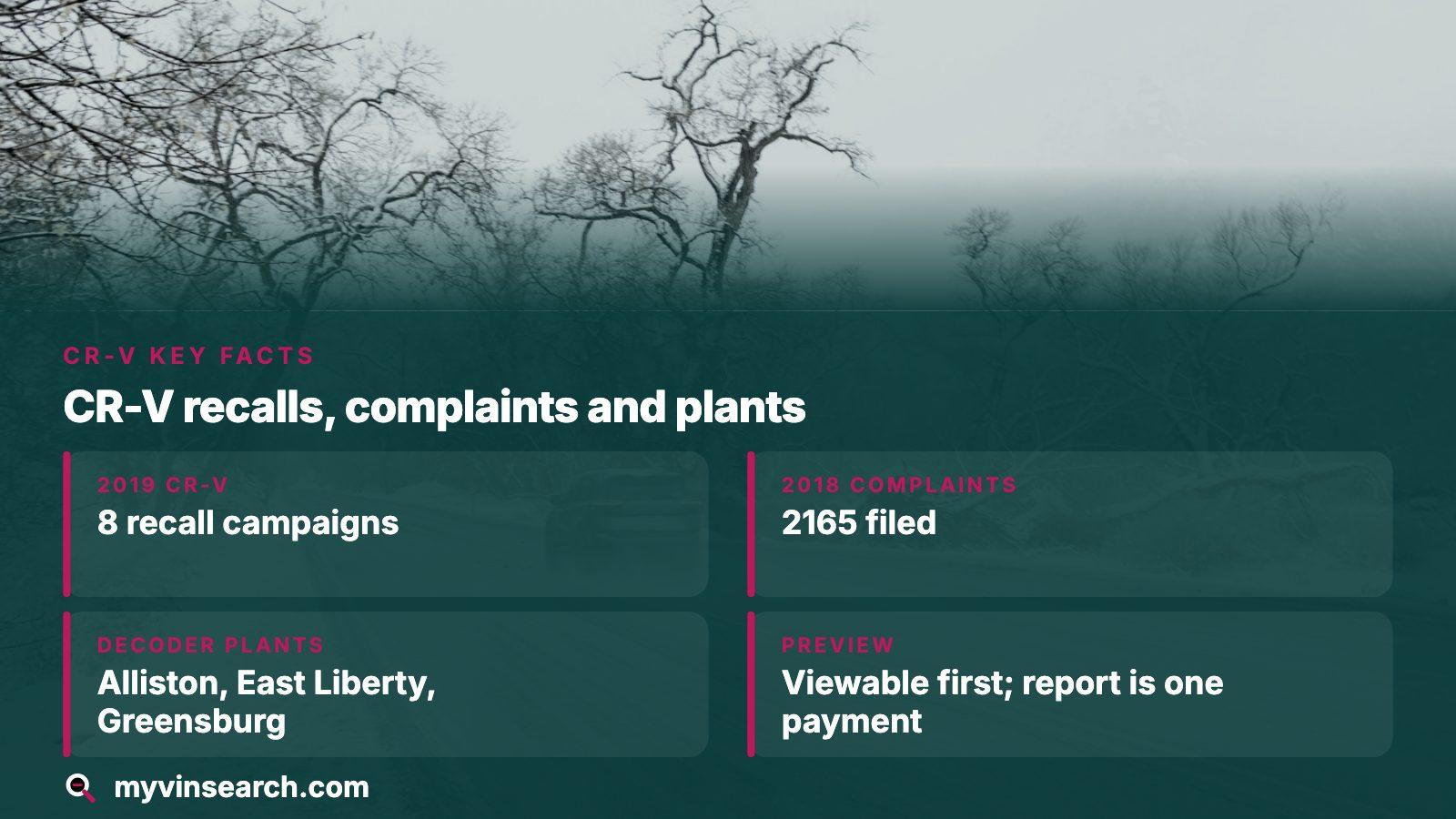
- Recalls on file, 2019 CR-V
- 8 campaigns in NHTSA's recall data
- Owner complaints, 2018 CR-V
- 2165 filed with NHTSA
- Plants seen in the decoder
- Alliston, East Liberty and Greensburg
- Preview
- Free to view; the report is a single payment
What a CR-V history check turns up
MyVINSearch builds its checks around the make and model, so a CR-V result is read as a CR-V, not as a generic used car. Compact SUVs get driven hard by families, commuters and rental fleets, and each of those lives leaves its own trail in the records.
- Salvage, flood or rebuilt title brands, and the state that issued them.
- Crash and total-loss entries, with auction photos where an insurer sold the SUV as a loss.
- Earlier odometer readings, which should climb steadily between titles.
- Open recall campaigns tied to this VIN, repaired by a Honda dealer at no charge.
- Liens, theft entries and a market value for the year and trim.
None of this shows up on a test drive. A CR-V that was totaled in one state and retitled in another can feel perfectly normal on a ten-minute loop.
Three factories, one nameplate: decode the VIN first
Characters one through three encode who made the vehicle and where. I ran partial 2017 CR-V patterns through NHTSA's vPIC decoder, and each one came back as a 1.5 liter EX built at a different place.
| VIN begins | Decoder answer | Engine returned |
|---|---|---|
| 2HK | Alliston, Ontario, Canada | 1.5 L |
| 5J6 | East Liberty, Ohio, USA | 1.5 L |
| 7FA | Greensburg, Indiana, USA | 1.5 L |
If the ad says one thing and the VIN prefix says another, treat it as a prompt to ask questions. It is usually a copied listing, but it can also point to a swapped plate on the dash. The 10th character gives the model year, and the decoder returned H for 2017 and L for 2020.
Recalls change a lot between CR-V model years
NHTSA's recall data lists 3 campaigns against a 2015 or 2016 CR-V, 7 against 2017, 5 against 2018, 8 against 2019, 7 against 2020 and 4 against 2021. Some are shared with other Honda models, so a bigger number does not automatically mean a worse SUV. What matters is whether your VIN was repaired.
| Campaign | CR-V years | Problem in brief |
|---|---|---|
| 17V442000 | 2017 2WD and AWD | Fuel supply pipe may disconnect and leak; engine can stall |
| 18V663000 | 2017-2018, shared with Civic | Steering sensor magnet may loosen; assist can reverse on full lock |
| 19V569000 | 2019 | Weld on the fuel tank vapor line may fail and leak |
| 19V865000 | 2019-2020 | Rear subframe bolts may loosen; subframe could separate |
| 23V158000 | 2017-2020, with other models | Front belt buckle may not latch |
Remedies in every case above are performed by a dealer free of charge, according to the recall notices.
The 1.5 turbo complaints behind the 2017 and 2018 numbers
Owners filed 1781 complaints on the 2017 CR-V and 2165 on the 2018, against 395 for 2016 and 360 for 2020. Engine was the most common component on both years, with 533 and 530 mentions, and fuel or propulsion followed. A single complaint can list several components, so treat these as a rough guide.
From an NHTSA owner complaint
The owner of a 2017 CR-V with about 20,000 miles told NHTSA that gasoline kept mixing with the engine oil. After a dealer suggested an early oil change, the level was again above the dipstick marks two weeks later. Honda offered extended coverage of six years with unlimited mileage, but the owner wanted the cause fixed before it damaged the engine. A later 2017 owner reported a software update under a service bulletin that did not cure the same fuel dilution.
What to take from it: complaints are one-sided and unverified, and no recall covers this issue in the data I pulled. Shopping for a 2017 or 2018 with the 1.5 turbo means asking to see the oil service history, then letting a mechanic inspect the dipstick for a high level or a fuel odor.
How to run the check on a CR-V you are considering
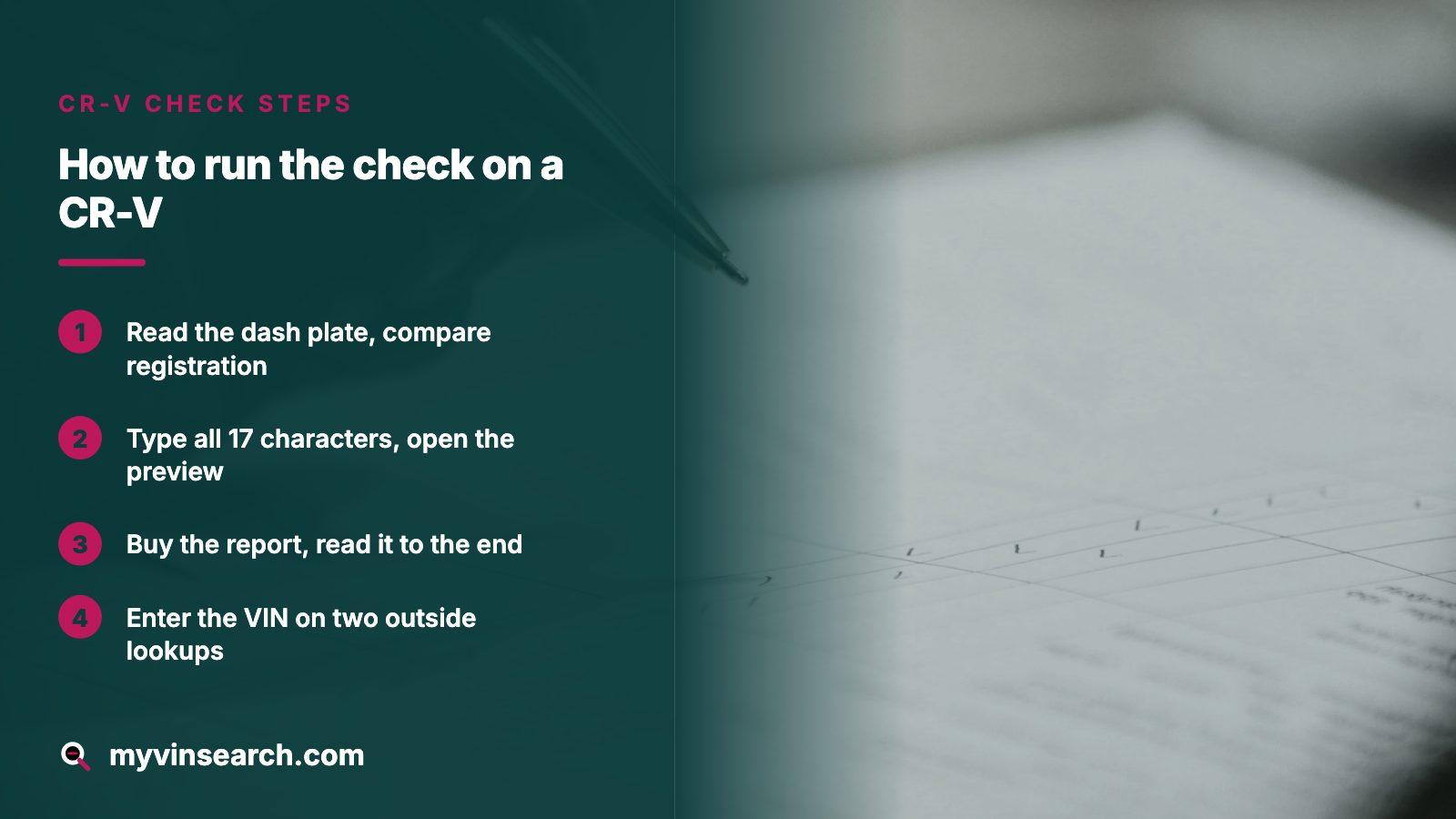
- Look through the glass at the plate on the dash corner nearest the driver, then compare what you read with the registration card. The insurance card sometimes carries it too, per NHTSA.
- Type all 17 characters into MyVINSearch and open the preview.
- Check that model year, engine and trim in the preview match the listing.
- Buy the report if those basics line up, and read it through to the end.
- Finish by entering the VIN on NHTSA's recall page and again at NICB's VINCheck.
One mistyped character can return nothing, and nothing looks the same as clean. NICB warns that a wrong VIN may fail to match a record.
What the free government and insurer tools leave out
NHTSA's VIN search shows unrepaired recalls and, for a car with none, says so in a short line of text. It does not show repaired recalls, brand-new ones whose VIN lists are incomplete, or recalls past the 15-year mark. You can search up to 100 VINs at once, which helps when you are comparing several CR-Vs.
NICB's VINCheck is free and tells you whether member insurers reported the VIN as theft not yet recovered, salvage, or water damage. Each IP address gets 5 lookups per day. NICB says plainly that the tool is a starting point only. Neither tool lists odometer readings, past owners or liens, and that is where a full report earns its fee.
Red flags worth walking away from
- A salvage or flood brand, particularly with a sale price that ignores it.
- Odometer readings that fall, or sit flat for years and then jump.
- An open recall on the fuel system, steering or rear subframe that the seller waves off.
- A VIN prefix, year character or engine that disagrees with the ad.
- A crash entry with no repair paperwork to go with it.
A single flag supports haggling over price. Two or more is a reason to look at another CR-V.
Cost, and what to do once you hold the report
You pay nothing to see the preview. After that comes a single payment for the report, multi-report packs appear on the pricing page, and no subscription starts.
Match the inspection to what the report found: brakes and steering for a recall flag, bodywork and frame for a crash entry. If a recall is still open, ask the seller for proof of repair or have a Honda dealer do it before you pay. Honda's recall notices also give a customer service line for questions.
Where this information comes from
- NHTSA: Check for recalls — what the VIN recall search shows and omits
- NHTSA recalls API: 2017 Honda CR-V — campaign numbers, dates and remedies
- NHTSA vPIC VIN decoder — plant and engine returned for CR-V VIN patterns
- NHTSA owner complaint 11318952 — owner experience, paraphrased
- NICB: VINCheck — free theft, salvage and flood lookup and its limits
- VehicleHistory.gov: NMVTIS — federal title history system for buyers
Sources and photos: Facts checked against the sources above in November 2026. Photos by Mustafa Sheikhmouss, Masjid MABA and Zoshua Colah on Unsplash; diagrams by MyVINSearch.
Keep reading
- Honda VIN check: pick the model, then read what the VIN has on fileSee the whole Honda lineup by VIN prefix before narrowing to the CR-V.
- Honda recall check by VIN: open recalls for your exact modelLearn how Honda recall lookups work across every model.
- Toyota RAV4 VIN check: what one number shows before you buyCompare against the RAV4, the CR-V's closest rival.
- Sample reportLook at a finished report before you pay for one.
Frequently asked questions
Is there a free Honda CR-V VIN check?
Partly. NHTSA shows unrepaired recalls by VIN and NICB's VINCheck covers insurer reports of theft, salvage and flood loss. Neither covers odometer history, ownership or liens. MyVINSearch gives a free preview, and the rest of the history comes in a report you buy once.
Can the VIN tell me where my CR-V was built?
Yes. The first three characters identify maker and country. In NHTSA's decoder, a 2017 CR-V starting 2HK came from Alliston in Canada, 5J6 from East Liberty in Ohio and 7FA from Greensburg in Indiana. The full 17 characters decode the remaining details.
My CR-V shows no open recalls. Is it problem-free?
No. A clean NHTSA result means no unrepaired recall is attached to that VIN right now. Owners have reported issues, such as fuel in the oil on 2017 models, that the recall data I pulled does not cover. Ask for service records and have the SUV inspected.
Does a clean VIN report mean the CR-V was never in a crash?
Not strictly. A report reflects what states, insurers and auctions recorded. A repair paid for privately may leave no entry. Add a mechanic's inspection to the report, and look for mismatched paint and uneven gaps between panels.
Which CR-V model years draw the most owner complaints?
Among the years I pulled from NHTSA, 2018 leads with 2165, then 2017 with 1781 and 2019 with 1108. Counts drop to 360 for 2020. Numbers also reflect sales volume and how long owners have had to file, so they are a guide, not a ranking of quality.
Now check the car itself
The guide explains what to look for. The report shows what this VIN has on record.