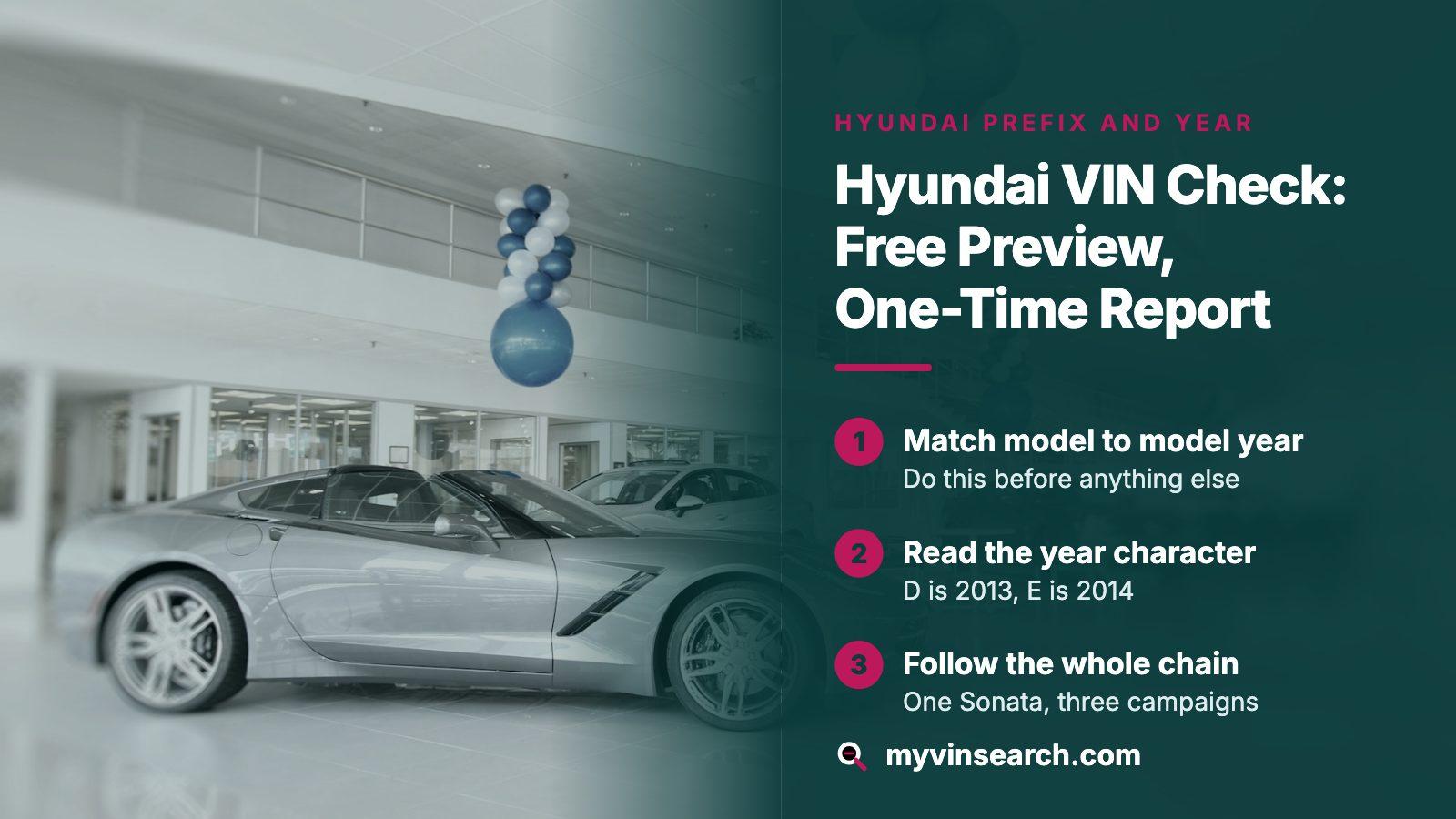
THE SHORT ANSWER
Read the 17-character VIN off the Hyundai and enter it for the free preview. If the model and year match the advert, buy one report for that car and read its title, odometer, damage and recall entries. Hyundai recalls follow build windows, so only the VIN shows whether a given Sonata or Palisade is on a campaign list.
- Hyundai prefixes
- 15 in NHTSA's list
- Built in
- South Korea and the United States
- Year character
- Position 10: D is 2013, E is 2014
- Preview
- Free; the report is a single payment
What a Hyundai VIN check shows that the badge does not
An advert says Sonata and gives a year. A VIN check says what has happened to that particular Sonata. It reads the record filed under one number, so two cars with the same name and year can come back with very different files.
- Whether any state has branded the title salvage, flood or rebuilt.
- Mileage recorded on different dates, so a rollback or a typo stands out.
- Crash and damage records, with auction photos when an insurer wrote the car off.
- Recall campaigns filed against this exact VIN and not yet repaired.
Reading the number: Hyundai prefixes and the year character
NHTSA lists 15 Hyundai prefixes, though several of them cover trucks and trailers. The first three characters name the builder, not the model.
| VIN begins | NHTSA lists it as |
|---|---|
| KMH | Hyundai Motor Co, South Korea, passenger cars |
| KM8 | Hyundai Motor Co, South Korea, multipurpose vehicles |
| 5NP | Hyundai-Kia America Technical Center, United States, passenger cars |
| 5NM | Hyundai Motor Manufacturing Alabama, multipurpose vehicles |
| 7YA | Hyundai Motor Group Metaplant America, multipurpose vehicles |
Position 10 holds the model year, and neighboring years sit one letter apart: D is 2013, E is 2014, K is 2019, L is 2020. Position 9 is a check digit. Federal rules keep I, O and Q out of every VIN, so any of them in your number is a misread.
Match the model to the model year before anything else
Hyundai's lineup has turned over several times, and NHTSA's model-year lists show it.
| Model year | On NHTSA's list | Missing from it |
|---|---|---|
| 2013 | Accent, Azera, Equus, Genesis, Santa Fe Sport, Veracruz | Kona, Palisade, Ioniq |
| 2019 | Elantra GT, Ioniq, Kona, Nexo, Santa Fe XL | Azera, Equus, Genesis |
| 2023 | Ioniq 5, Ioniq 6, Santa Cruz, Elantra N | Accent, Veloster |
If an advert names a model that the year's list lacks, such as an Azera sold as a 2019, something in the listing needs explaining before you go further.
What NHTSA returns for popular Hyundai models
| Model and year | Campaigns | One entry to know |
|---|---|---|
| 2015 Sonata | 9 | Front brake calipers that may fracture, on cars built April 25 to June 16, 2014 (14V368000) |
| 2017 Santa Fe | 6 | Crankshaft pin flaws that can wear engine bearings, 3.3L engines only (17V578000) |
| 2021 Palisade | 6 | Third-row curtain air bags that may deploy improperly (26V034000) |
| 2023 Ioniq 5 | 4 | Battery cells that can start a fire; park outside and charge to 80% at most (26V432000) |
| 2020 Elantra | 3 | Lower control arm ball joint fasteners that may be under-tightened (19V721000) |
| 2019 Tucson | 1 | ABS control unit that can short and start a fire, later widened to 2016-2018 cars (20V543000) |
The count shifts with the model and year typed in, and a filing can name another badge: the 2023 Ioniq 5 driveshaft campaign, 24V065000, also lists the Genesis GV60. Build dates cut inside a year too, so two 2015 Sonatas can fall on opposite sides.
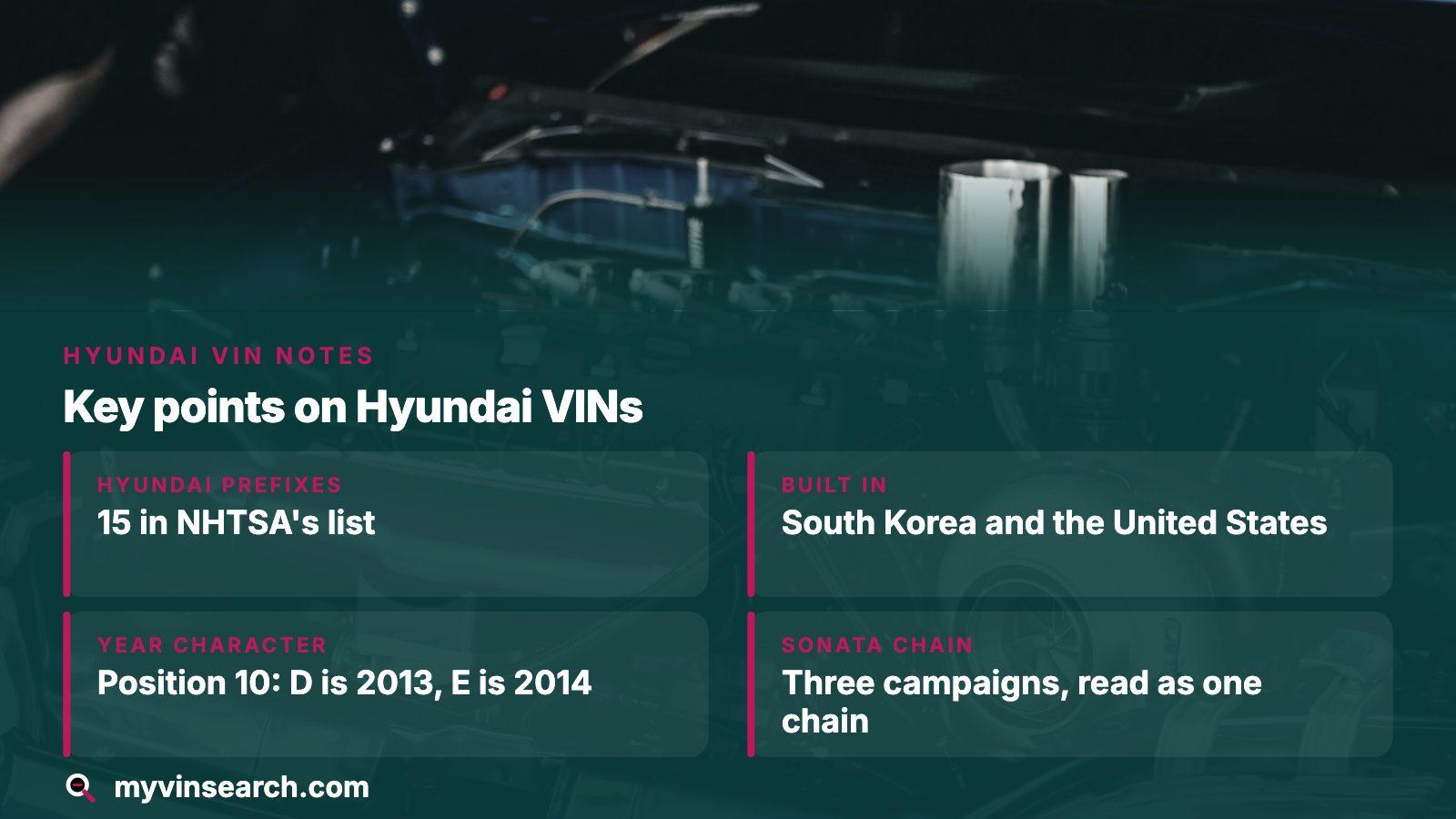
One Sonata, three campaigns: read the whole chain
A Hyundai's recall file can grow after the first repair. On the 2013 and 2014 Sonata, three filings follow one another:
- 17V226000, filed in March 2017: machining errors can wear the engine bearings until the engine seizes. Dealers inspect and replace the short block if needed. Hyundai calls it recall 162.
- 18V934000, recall 180: on cars already repaired under that campaign, the fuel pipe may have been damaged or wrongly torqued during the engine swap, and can leak.
- 22V312000, recall 227: a low-pressure fuel hose may crack from engine heat. It replaces 20V-121, so a car fixed under the old filing without a new hose needs it again.
Hyundai numbers its recalls separately from NHTSA, so give a dealer both. A closed entry proves a work order was filed, not that nothing came after it. Ask the seller which campaign the repair order belongs to, then look for a later one.
Mileage and model year: the entries that expose a bad listing
An odometer line that drops, or two lines that disagree with the dash, is the clearest warning a history report gives. A year character that disagrees with the advert is another.
From an NHTSA owner complaint
A buyer who drove a Sonata home from a dealer on February 26, 2026 told NHTSA the dash read 149,945 miles. A report the buyer ordered later showed 279,966 miles entered a few months before, on November 10, 2025, and gave the car's year as 2013 rather than the 2014 in the advert. According to the buyer, the dealer was told about the gap.
One buyer's account, yet it suggests two tests before paying: compare each mileage entry with the dash, and the year character with the advert. Put any gap to the seller in writing.
A branded title can follow a Hyundai into the service bay
States apply salvage, flood and rebuilt brands under their own rules, and once applied a brand stays in the federal record. On a Hyundai with engine campaigns in its past, the brand matters after the sale as well as before it.
From an NHTSA owner complaint
The owner of a 2014 Sonata wrote that the car came from a local dealer in 2016, and that its title carried a salvage brand the buyer had not known about. In 2021 the engine failed at 65,000 miles. The Hyundai dealer confirmed the engine was original, yet Hyundai turned down the warranty claim because of the title. The owner put a new engine at $6,000 to $8,000.
This is one owner's story, not Hyundai's published policy. A report shows the brand before you pay, so ask a dealer in writing how it affects engine work, and price in a bill that size.
Running it on a Hyundai you are about to buy
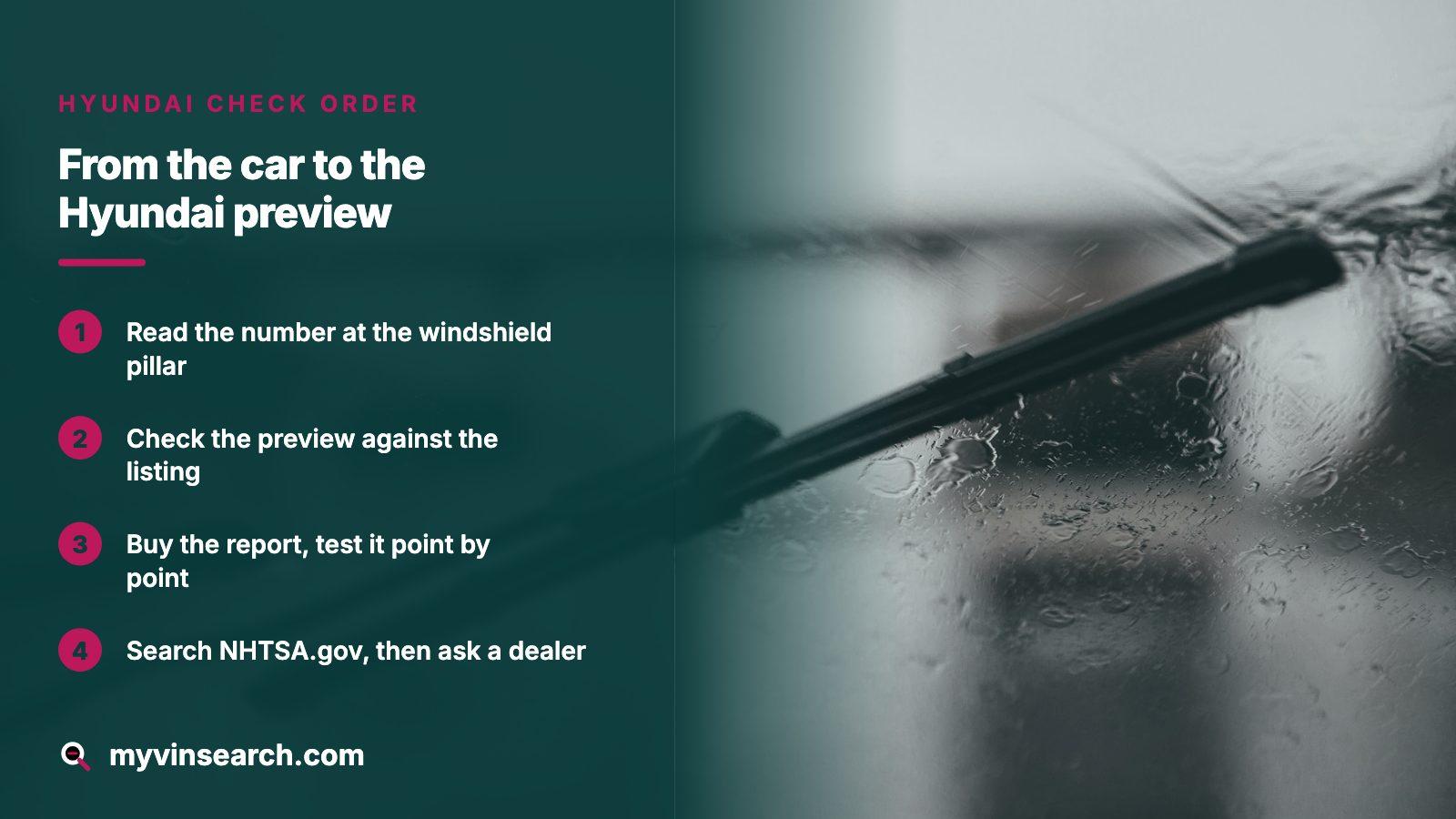
- Stand beside the driver-side windshield pillar, read the number through the glass, photograph it and compare it with the title paperwork.
- Enter it on MyVINSearch and read the free preview. If model or year differs from the advert, stop and ask why.
- If the preview fits, buy that car's report and test it against the points above.
- Search the same VIN on NHTSA.gov. New filings appear fast: the Palisade seat belt buckle campaign 25V607000 was searchable on September 13, 2025, the day after filing, with final owner letters not due until June 2026.
- Repeat the NHTSA search on the day you pay, then ask a Hyundai dealer which repairs it has recorded on the VIN.
Cost, and what a report cannot replace
Begin with the preview. It costs nothing and shows whether model and year agree with the ad. A report buys one VIN once; packs of 3, 5 or 10 exist for weighing several Hyundais, and no plan renews by itself. Sizes are on the pricing page.
Federal title data reaches about 87 percent of US vehicles and not all states report yet, so a car with a past can still return clean. Wear and mechanical faults rarely appear in a history report either. The FTC says to hire an independent mechanic even when a dealer has certified the car, and to get a written report carrying the VIN.
- Rank the shortlist by preview first, so you pay only for cars that fit.
- Ask to see the paperwork for any recall repair already done.
- Book the inspection and hand the mechanic the report's flagged entries.
Where this information comes from
- NHTSA vPIC: Hyundai manufacturer identifiers — The Hyundai prefixes with builder, vehicle class and country; the model lists by year come from the same service.
- NHTSA recalls data: Hyundai Sonata, model year 2014 — The Sonata chain; the other campaigns and counts come from the same lookup run for other models and years.
- 49 CFR Part 565: Vehicle identification number requirements — Year characters, the unused letters, the check digit and where the number must be readable.
- NMVTIS consumer information — What federal title records hold, how brands persist and why a clean result can still miss history.
- FTC: Buying a used car from a dealer — Why a history report does not replace an independent inspection.
- NHTSA owner complaint 11743583 — owner experience, paraphrased
- NHTSA owner complaint 11428092 — owner experience, paraphrased
Sources and photos: Facts checked against the sources above in November 2026. Photos by Richard R, Thibault Valjevac and Willian Cittadin on Unsplash; diagrams by MyVINSearch.
Keep reading
- Hyundai recall check by VIN: open campaigns for your exact modelA recall-first view of the same make, with the engine and anti-theft programs.
- Sample reportSee what a finished report looks like, section by section.
- PricingHow single reports and the 3, 5 and 10 packs are priced.
- Kia VIN check: read the VIN, then match it to your Kia modelThe same make-level walkthrough for Kia models, handy if you are cross-shopping.
Frequently asked questions
Can I run a Hyundai VIN check for free?
The preview is free: type in the VIN and see whether model and year fit the car. The full report is one purchase per car. NHTSA.gov also runs a no-cost recall search by VIN, which makes a handy second look.
What does a Hyundai VIN starting with KMH or 5NP tell me?
NHTSA files KMH under Hyundai Motor Co for passenger cars built in South Korea, and 5NP under the Hyundai-Kia America Technical Center in the United States. KM8 and 5NM are listed for multipurpose vehicles. None of them names the model.
Will a check show whether the engine recall was done on a Hyundai?
A recall lookup lists campaigns still open. Completed work sits in the dealer's service record, so ask a Hyundai dealer for the repair history on that VIN. Where the model had several engine campaigns, ask about each one by number.
Why do NHTSA and Hyundai give different recall numbers?
Each filing carries an NHTSA campaign number and a separate Hyundai number. The 2013-2014 Sonata engine recall is 17V226000 at NHTSA and 162 at Hyundai. A dealer may search by either, so keep both written down.
Does a clean Hyundai VIN check mean the car is sound?
No. It means nothing adverse reached the sources. Not every state reports title data, and history reports seldom list worn parts or mechanical faults. Treat a clean result as encouraging, then add the state title record and an independent inspection.
Now check the car itself
The guide explains what to look for. The report shows what this VIN has on record.