THE SHORT ANSWER
Read the 17-character VIN off the car, run it through the MyVINSearch preview, then repeat it on NHTSA's recall lookup and Hyundai's owner site. Any open safety recall is repaired at no charge for whoever owns the car now. Programs such as the anti-theft software update are not federal recalls, so ask a Hyundai dealer about those using the same VIN.
- Repair cost to the owner
- Nothing, parts and labor
- Where the VIN sits
- Windshield base or driver's door frame
- Lookups worth running
- NHTSA, Hyundai's owner site, a dealer
- Anti-theft update
- A maker program, not a federal recall
Start with the model, then narrow to the single car
Hyundai sells a wide spread of vehicles, and a recall is filed against a defined group of them, never against the badge. MyVINSearch is organized by make and model for that reason: decode what the VIN says the car is, then read the campaigns that can reach that model.
| Layer | What it answers |
|---|---|
| Make and model | Which Hyundai line the number describes, such as an Elantra, Sonata, Tucson, Santa Fe or Palisade |
| Build details | Plant and build date, which is how many campaigns draw their boundaries |
| VIN lookup | Whether a safety recall is still unrepaired on this one car |
| Dealer record | Campaign work already done, including work by earlier owners |
Running the check before you buy a used Hyundai
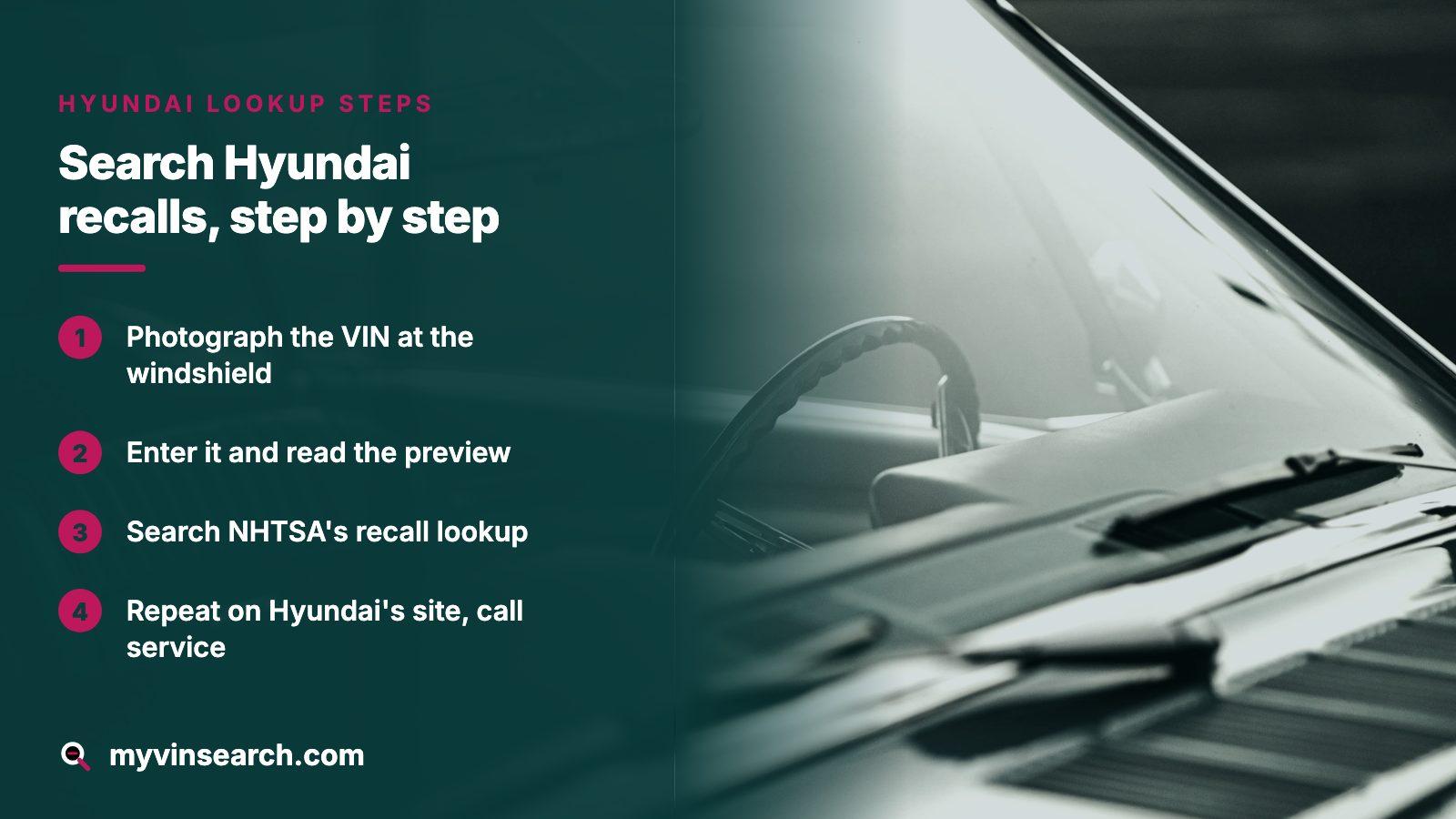
- Photograph the VIN at the lower driver-side corner of the windshield, or on the label in the driver's door frame. Retyping 17 characters by hand invites errors.
- Enter it on MyVINSearch. The free preview comes first, and the model decode tells you whether the car matches the listing.
- Put the same VIN into NHTSA's recall lookup. It covers every brand sold here and lists safety recalls never repaired.
- Repeat it on Hyundai's owner site, which can show service campaigns and product programs outside the formal recall system.
- Call a Hyundai service desk with the VIN. A dealer sees the whole campaign history, completed work included.
From an NHTSA owner complaint
The owner of a used 2017 Elantra wrote that the VIN check on the car showed no unrepaired recalls. Later the owner learned of a March 2017 power-steering recall, and the wheel was catching on right turns at higher speeds. The complaint says the owner could not work out whether that recall repair had ever been done on this car.
A clean lookup lists what is open today, not what was repaired. When your model year carried a recall, ask a dealer for the completed work on that VIN, or ask the seller for the repair order.
What each result means for the car in front of you
| Result | What it means | What to do |
|---|---|---|
| Open safety recall | Hyundai found a defect in a group that includes this VIN, and no repair is recorded | Read the notice for any driving or parking advice, then book the dealer |
| Nothing open | No unrepaired safety recall is on record today | Run the VIN again right before payment, since campaigns are added later |
| A recall you heard about is missing | The campaign was scoped by plant and build date, and this car falls outside it | Trust the VIN result over model-level reporting |
| Service campaign or bulletin | Maker guidance that is not a federal recall | Ask the dealer who pays and whether it applies |
An open recall on a used Hyundai is common and seldom a reason to walk away. Notice letters reach old addresses, and the repair never gets booked.
When the build date puts your car outside a recall
A recall window has a hard edge, and an owner can land on the wrong side of it.
From an NHTSA owner complaint
An Elantra owner told NHTSA that a front coil spring on a 2011 car snapped over a speed bump and tore the tire off the rim, a repair bill of $1,400.99. Only afterward did the owner find a recall for that exact failure, limited to cars built from November 2010 through March 2011. This one was built April 16, 2011, 16 days past the cutoff, and no notice ever arrived.
A clean VIN result means no recall covers this car, not that the part named in the headlines is sound. If your model has a known weak spot, ask a mechanic to look at that part before you buy.
Why the owner pays nothing for a recall repair
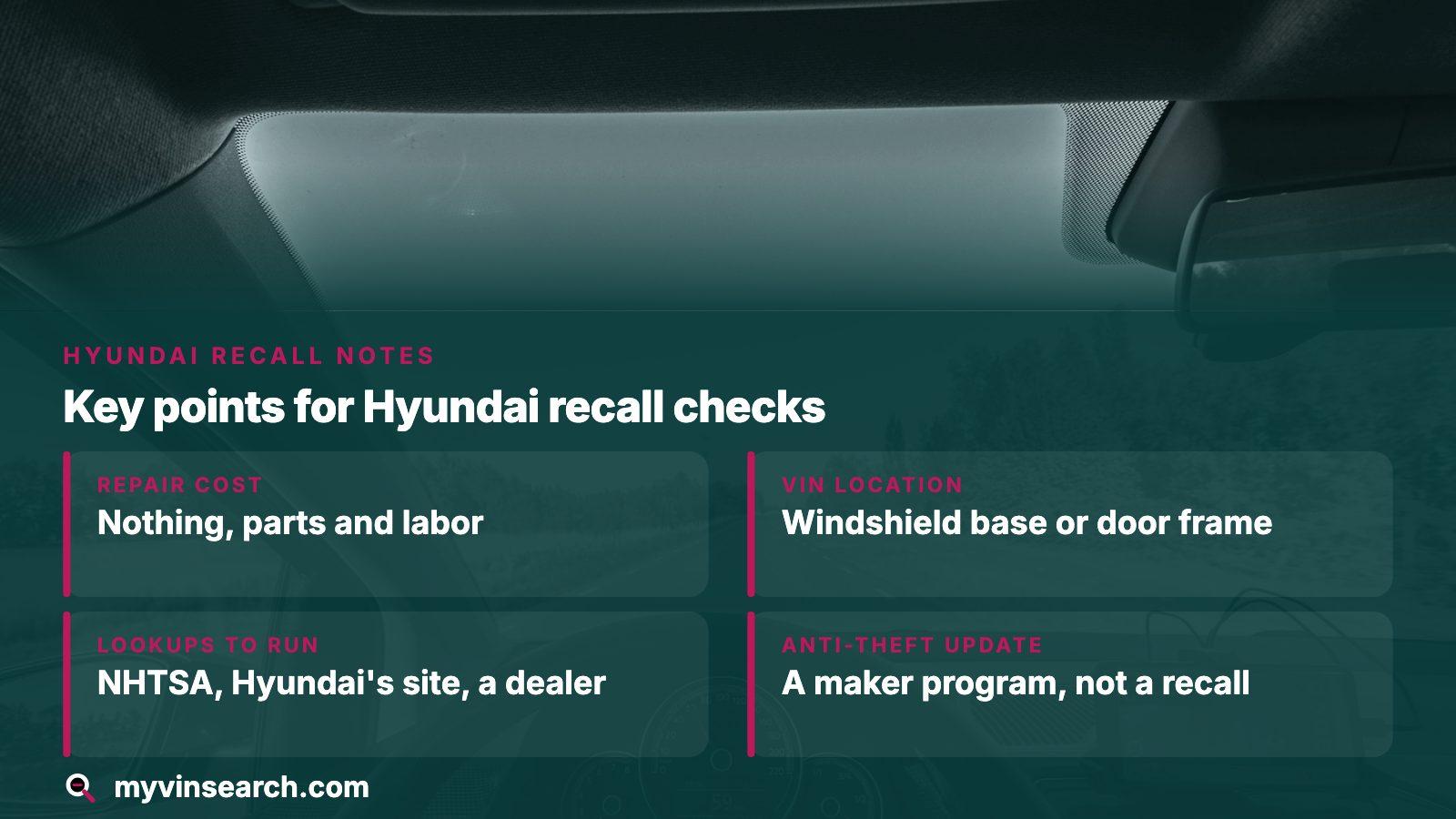
Federal law requires a manufacturer that finds a safety defect to remedy it without charge. The duty follows the car, so the fifth owner holds the same claim as the first. An age limit applies, measured from the date of first sale. Beyond that point the maker is not obliged to pay, although serious defects are frequently still fixed.
A recall repair also stands apart from warranty. Having the work done does not use up or shorten any coverage on the car.
Engine campaigns: ask about the VIN, not the model
Hyundai has run sizable engine-related campaigns on certain model years and engine families, and most shoppers have heard of them. Whether any of it touches the car you are considering depends on its VIN falling inside an affected range and on whether the remedy was already performed. Headlines answer neither question.
- Ask the dealer whether an engine campaign was carried out on this VIN, and on what date
- Ask whether the engine was ever replaced under a program, and whether extended coverage attached
- Keep the repair order, because it is evidence for the next buyer
- Settle any missing paperwork before agreeing a price
The anti-theft software update is a separate list
Some Hyundai and Kia model years were built without an engine immobilizer, which made them unusually easy to steal and led to a widely reported run of thefts. The makers answered with a software update and hardware measures, including a steering wheel lock.
Federally, this is not filed as a safety recall, so a blank NHTSA result says nothing about it. Ask a dealer, with the VIN, whether the car is eligible and whether the update was already applied. Some insurers priced affected models differently, so get a quote on the actual VIN first. The NICB runs a free theft lookup worth a minute on these cars.
From an NHTSA owner complaint
A 2018 Elantra owner told NHTSA that the used-car retailer mentioned no recalls at the April 2024 sale. The owner later found the car sits under Hyundai's anti-theft software campaign, number 993. More than a year on, the car was stolen and recovered with a blown engine. Hyundai agreed the VIN is covered yet would only install the software now, and the seller denied responsibility.
The seller here said it was unaware of the campaign, so ask about the update by VIN before paying, and book it at once if it is pending.
Used Hyundai: the order that protects you, and the paid report
Do the recall check before you settle on a price, and ideally before the trip to view the car. Since the repair is no-charge, an open recall does not add to the bill. It adds a job to your list. If one is open, ask the seller to have it completed before delivery. A seller who declines a no-cost safety repair has told you something.
A recall lookup answers a single question. MyVINSearch gives a free preview before any payment. A full report costs one payment per VIN, you can buy 3, 5 or 10 together when weighing several cars, and nothing renews. The pricing page lists the amounts. Besides open recalls, the report holds:
- Title brands, plus salvage and auction history with photos
- Accident and damage records alongside odometer readings
- Liens, impounds, theft and insurance records
After a recall repair on your own car, re-run the VIN a few weeks later. The recall should drop off the open list, showing the work was recorded.
Where this information comes from
- NHTSA: Recalls lookup — NHTSA's own VIN search for safety recalls still waiting on a repair.
- NHTSA: vPIC VIN decoder — Turns the VIN into a vehicle description, so you can check it against the listing first.
- NICB: VINCheck — A theft lookup from the insurance crime bureau, relevant to the model years with the anti-theft program.
- NHTSA owner complaint 11420770 — owner experience, paraphrased
- NHTSA owner complaint 11141262 — owner experience, paraphrased
- NHTSA owner complaint 11681055 — owner experience, paraphrased
Sources and photos: Facts checked against the sources above in November 2026. Photos by Mustafa Sheikhmouss, Dylan Michaud and Sander Jeurissen on Unsplash; diagrams by MyVINSearch.
Keep reading
- Sample reportSee what a full report holds beyond open recalls before you buy.
- PricingHow single reports and packs are priced, with no subscription.
- Honda recall check by VIN: open recalls for your exact modelAnother make checked the same VIN-first way, with its own do-not-drive case.
- Toyota recalls by VIN: find the model line, then the campaigns still open on itThe same recall check applied to a Toyota.
Frequently asked questions
How do I run a Hyundai recall check by VIN?
Enter the 17-character VIN on MyVINSearch, then repeat it on NHTSA's recall lookup and Hyundai's owner site. Each returns safety recalls still unrepaired on that vehicle. The two official tools need no account and cost nothing.
Are Hyundai recall repairs really free?
Yes. A manufacturer that finds a safety defect must remedy it at no cost to the owner, and that right passes to later owners. The one limit is an age cutoff counted from first sale. Charges quoted next to a recall are usually separate work, so ask the dealer to itemize them.
I heard about a recall for my model, but my VIN shows nothing. Why?
Campaigns are drawn around plant and build date, so a recall that names your model can still miss your car. Only the VIN result is definitive, and a second run right before purchase catches anything filed since.
Will the anti-theft update appear in a recall check?
Usually not. It is a manufacturer program rather than a federal safety recall, so NHTSA's lookup may not list it. Take the VIN to a Hyundai dealer and ask whether the car qualifies and whether the update was applied. Ask your insurer too.
If a Hyundai shows no open recalls, is it safe to buy?
It means no unrepaired safety recall is recorded today. Crash damage, branded titles, mileage tampering and loans on the car are recorded elsewhere and never show up in a recall lookup. Pair the result with a full history report before you pay.
Now check the car itself
The guide explains what to look for. The report shows what this VIN has on record.