THE SHORT ANSWER
Copy the VIN from the Land Rover, run the preview, and pay for the report once model and year match the vehicle you are looking at. You then see that VIN's title, damage, mileage, salvage and recall entries. Land Rover recalls target VINs within a model and year, and a few repairs were recalled again, so only the VIN shows whether a particular Range Rover or Discovery still owes work.
- Land Rover VIN prefixes
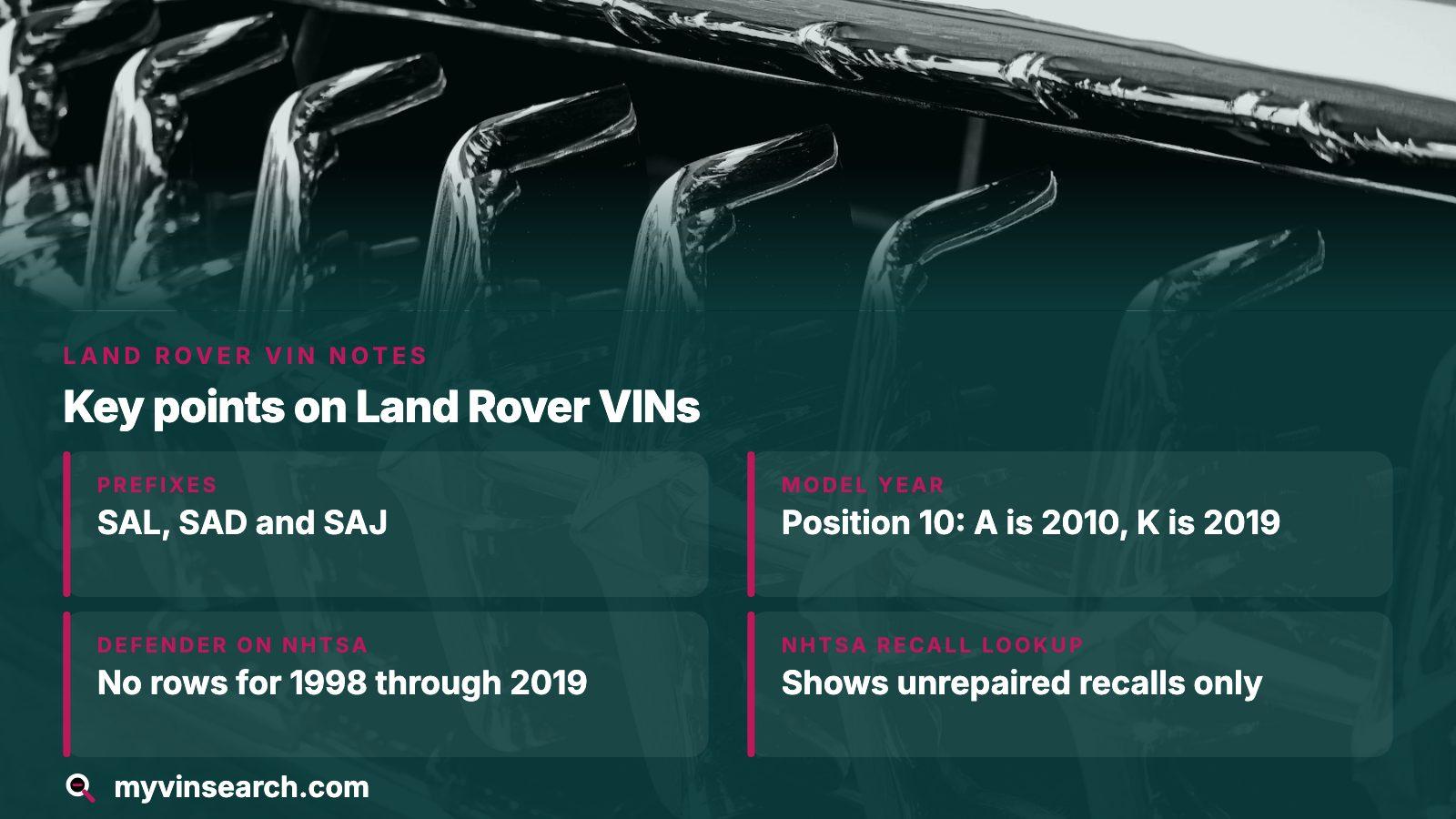
- SAL, SAD and SAJ, all filed to Jaguar Land Rover Limited
- Model year
- Position 10: A is 2010, K is 2019
- Defender on NHTSA's list
- No rows for 1998 through 2019
- NHTSA recall lookup
- Shows unrepaired recalls only
What a Land Rover VIN check pulls up
A used Range Rover or Discovery can carry a long past: several owners, a claim, an auction lot, a mileage count that does not add up. The check reads that past under one VIN, so the answer describes this vehicle alone.
- Title brand: salvage, junk or flood, if a state or insurer ever filed one.
- Damage: logged accidents, plus auction photos where the vehicle sold through a lot.
- Odometer: dated readings, where a figure that drops is the red flag.
- Also: open recalls, liens, impound and theft entries, and a market value.
Reading a Land Rover VIN: prefix, year character, plant
NHTSA files three manufacturer identifiers under the Land Rover name. SAJ is typed as a passenger car, while SAL and SAD are typed as multipurpose passenger vehicles. Jaguar Land Rover Limited in the United Kingdom owns all three, so a Range Rover decode naming it as builder is correct. Four partial VINs show what a decode returns.
| VIN starts with | NHTSA decodes it as |
|---|---|
| SALME154X6A | 2006 Range Rover HSE, 4.4 L V8, Solihull plant |
| SALSK2D44AA | 2010 Range Rover Sport, 5.0 L V8, Solihull plant |
| SALRR2RV5KA | 2019 Discovery HSE, 3 L V6, Solihull plant |
| SALCJ2FX1PH | 2023 Discovery Sport, 2.0 L four-cylinder, Halewood plant |
Position 10 holds the model year: digits cover 2005 to 2009 (6 is 2006) and letters take over from 2010 (A is 2010, K is 2019, P is 2023). Position 7 cross-checks it. A number there puts the year code in 1980 through 2009, a letter in 2010 through 2039. In the Sport row, D sits in position 7 and A in position 10, so the year is 2010. Position 11 is the plant. The letters I, O and Q are banned outright.
Why the model name in the ad can differ from the VIN
Land Rover names moved around, and NHTSA's list for the make shows it. Discovery is listed for 1994 to 2004 and again from 2017, with LR3 (2005 to 2009) and LR4 (2010 to 2016) standing in between. Freelander is listed for 2002 to 2005, LR2 for 2008 to 2015 and Discovery Sport from 2015, so model year 2015 holds both LR2 and Discovery Sport.
| Model year | Names filed that year |
|---|---|
| 2005 | Three: Range Rover, LR3 and Freelander |
| 2019 | Six: Range Rover, Sport, Evoque, Velar, Discovery and Discovery Sport |
| 2021 | Seven: the 2019 six plus Defender |
Decode first, then compare. If the ad names a model that is not on the list for the year in position 10, ask the seller why.
Defender ads from the gap years
The list has a hole. Defender appears for model years 1993 to 1995 and 1997, vanishes, and comes back from 2020. A Defender offered as an ordinary US-market vehicle from 1998 through 2019 has no row on NHTSA's Land Rover list for its year. That is not proof of anything illegal, but it puts the paperwork under a spotlight.
- Ask the seller for the import file and the title, and hold both against the decoded year and model.
- If the decode matches no name on the list for that year, slow down instead of blaming a typo.
Land Rover recalls: the VIN decides, and some repairs came back
A campaign names a model, a span of years and often a build window, so a matching badge proves little. NHTSA's records show three patterns worth testing.
| Campaign | Vehicles named | Fault | Lesson |
|---|---|---|---|
| 15V385, 19V392, 20V387 | Range Rover 2013 to 2016, Range Rover Sport 2014 to 2016 | Keyless door latch can leave a door unlatched | The same cars were called back twice more |
| 24V840, 25V514, 26V527 | Range Rover and Range Rover Sport, 2014 to 2017 at the widest | Front knuckle can crack; later, wrong knuckles fitted in an earlier repair | A closed recall can itself need correcting |
| 16V374, 17V015 | Range Rover 2007 to 2012, by where first sold or ever registered | Passenger air bag inflator can rupture | Registration history can put a car inside a zone |
NHTSA's text for 19V392 says those cars had already been through 15V-385 and need a second repair, and 20V387 says the second repair may not have been done properly. A service sheet marked recall done is a start. Ask for the repair order and rerun the VIN for anything opened since.
The air bag pair turns on registration. Zone A in 16V374 lists states such as Texas, Florida and California, and cars never registered in a listed zone fall outside it, so where a used Range Rover has lived matters.
Odometer and title: where private sales go wrong
The NMVTIS consumer page says federal title data comes from state titling agencies, insurers, recyclers and salvage yards, and covers brand history, the latest odometer reading and total-loss decisions. About 87% of vehicles are in the system and brand rules differ by state, so the page warns that a search can come back clean on a car with history.
From an NHTSA owner complaint
A private-sale purchase of a 2006 Range Rover went wrong on mileage. The odometer showed 79,500 miles at the deal, but when the owner registered the car the record showed 222,121. The owner filed the complaint as odometer fraud.
One dashboard figure is a claim; a run of dated readings is a record you can test. Pull the odometer history before cash moves, and step back if the latest entry sits far above the seller's number.
A clean result is encouraging, not final. Where a brand appears, ask for the repair papers. Where a Range Rover is priced oddly low and nothing shows, ask the state for its own title record.
Running the check, step by step
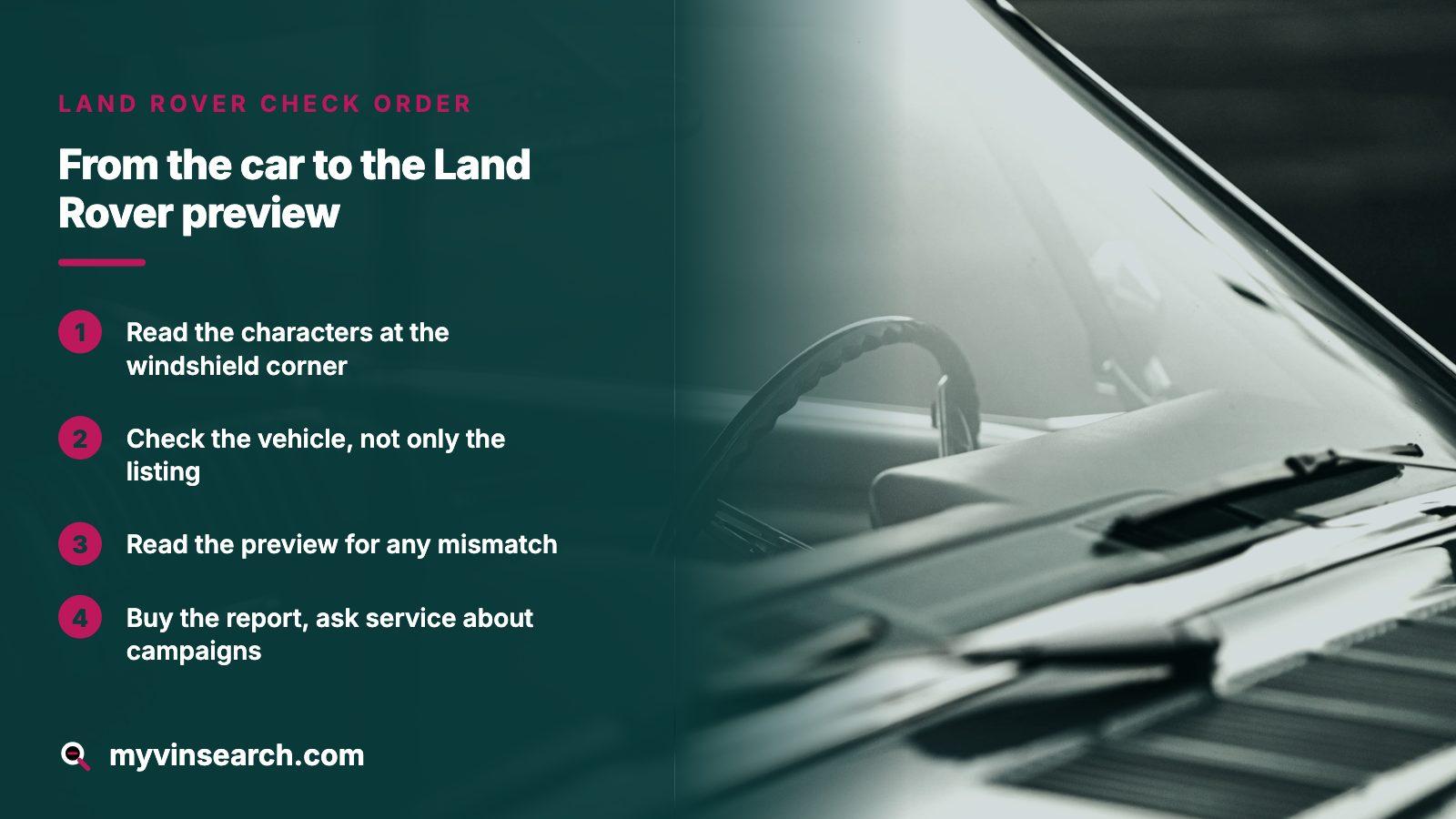
- Read the 17 characters in the windshield's lower left corner and compare them with the registration card. NHTSA adds that the insurance card may show the VIN too.
- Check the vehicle itself, not only the listing. By federal rule the number must be visible from outside the cabin, beside the left pillar, without moving anything.
- Enter it and read the preview. A different model, year or engine than the ad promised needs sorting out before any payment.
- If the preview fits, buy the report and set its open recalls beside NHTSA's lookup.
- Phone a Land Rover service department, ask which campaigns are closed on that VIN and request the repair orders.
NHTSA's lookup is useful but narrow. It reports unrepaired recalls only, omits campaigns whose VINs are not yet loaded, and skips those past 15 years unless the maker extends them. It shows no repaired recall, title brand or mileage trail, so it complements a report rather than replacing one.
Cost, and where to go from the result
The preview costs nothing and shows whether model, year and engine fit the ad. Each report is paid for once per vehicle, bigger sets exist for comparing several Land Rovers, and no subscription follows. Sizes are listed on the pricing page.
- Open recall: ask a dealer when parts arrive before settling on a price; the repair costs the owner nothing.
- Brand on the title: get repair records and an independent inspection first.
- Nothing found: rerun the VIN on signing day, since recall VINs are added over time.
Where this information comes from
- 49 CFR Part 565: Vehicle identification number requirements — The federal rules for VIN length, allowed characters, year codes, plant position and where the number must be readable.
- NHTSA vPIC: Land Rover manufacturer identifiers — The three prefixes, their vehicle types and the builder. The same service decodes the sample VINs.
- NHTSA vPIC: Land Rover models by model year — Model names filed under the make for each year, including the Defender gap. Change the year in the link to compare.
- NHTSA: Check for recalls by VIN — Where the VIN is, what the lookup shows and what it leaves out.
- NHTSA recalls data: Land Rover Range Rover, model year 2014 — Campaign text for the door latch, knuckle and air bag recalls discussed above.
- NMVTIS consumer information — What federal title records contain, who reports them and why a clean search can still miss history.
- NHTSA owner complaint 11677340 — owner experience, paraphrased
Sources and photos: Facts checked against the sources above in November 2026. Photos by Sean Foster, Dylan Michaud and Jacob McGowin on Unsplash; diagrams by MyVINSearch.
Keep reading
- Sample reportSee each section of a report before you pay for one.
- PricingHow single reports and multi-vehicle sets are priced.
- Porsche VIN check: what it shows for a 911, Cayenne, Macan or TaycanThe same make-level check applied to another European brand.
- Audi VIN check: run the VIN, then match it to your model lineAnother make where recalls name VINs inside a model and year.
Frequently asked questions
Can I run a Land Rover VIN check for free?
The preview is free: enter the VIN and see whether model, year and engine match. Buying the full report is a one-time payment and nothing renews. NHTSA also offers its own VIN lookup for open recalls, a handy second opinion.
Why does a Land Rover decode say Jaguar?
NHTSA lists SAL, SAD and SAJ for Land Rover, all filed to Jaguar Land Rover Limited in the United Kingdom. The builder name is the company, not a sign of a mislabeled car. The vehicle type field separates the prefixes.
What if a Defender ad falls between 1998 and 2019?
NHTSA's list shows no Defender row for those years. That calls for questions, not a verdict: ask how it entered the country, request the import file, and compare the decoded year and model with the title before discussing price.
The dealer says the recall is done, but the fault is back. Now what?
Treat it as a new fault. NHTSA's filings include Land Rover campaigns that returned for another repair, such as the door latch cars. Ask the dealer to recheck the VIN, hold on to the repair order, and tell NHTSA through a complaint if the symptom matches.
Can a clean Land Rover report hide something?
Yes. The federal title system holds about 87% of vehicles, so some history is simply absent, and each state defines brands its own way. A clean result is a starting point, so pair it with the state title record and a mechanic's inspection.
Now check the car itself
The guide explains what to look for. The report shows what this VIN has on record.