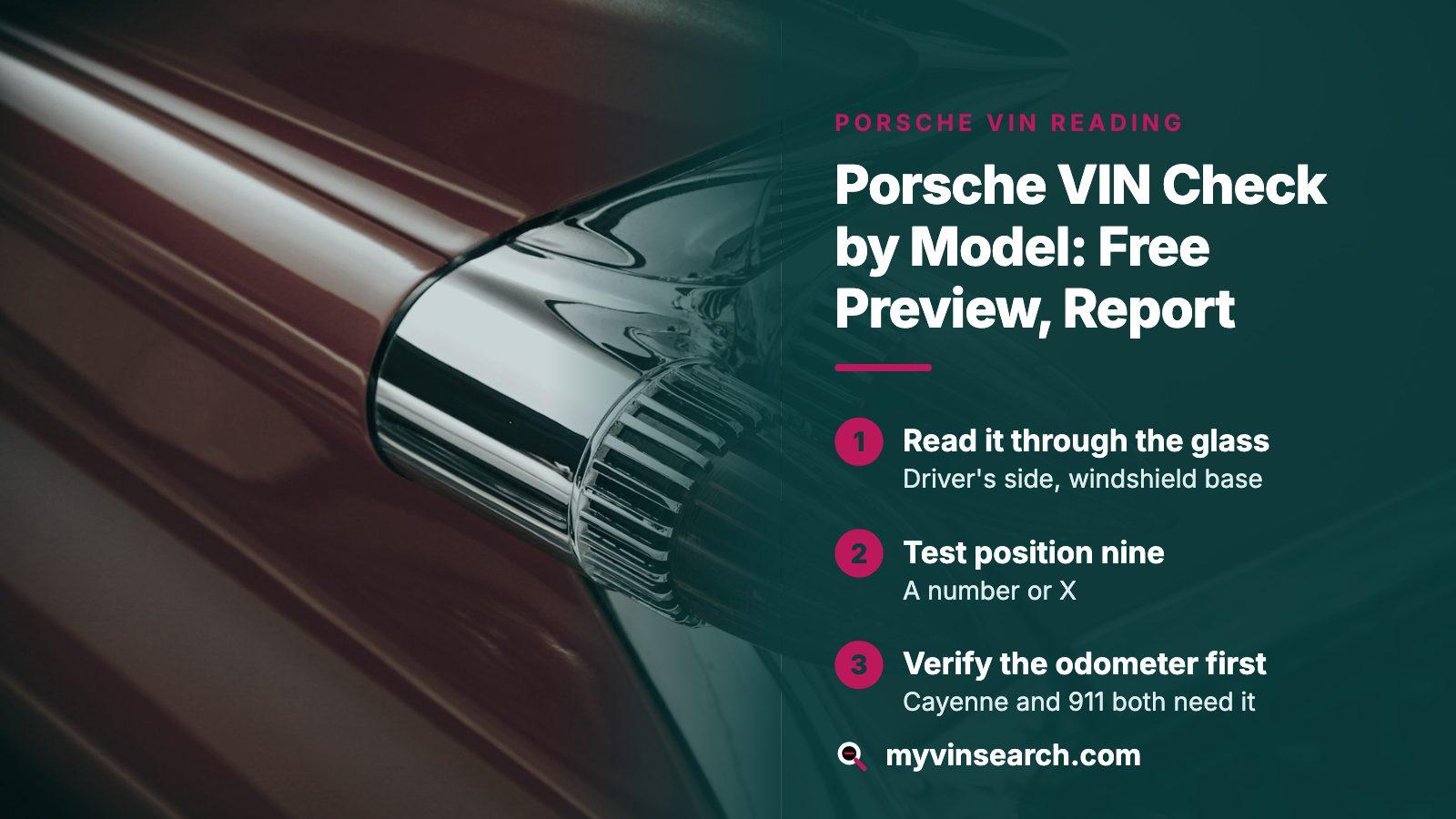
THE SHORT ANSWER
Read the VIN through the glass at the driver's-side base of the windshield, run it for the free preview, and buy the one-time report once the preview matches the car you are viewing. The report adds that VIN's title, damage, mileage, salvage, theft and recall entries. On a Porsche, read the odometer history first, then compare open campaigns with NHTSA's lookup, because campaigns name model years, build dates and options. Nothing renews.
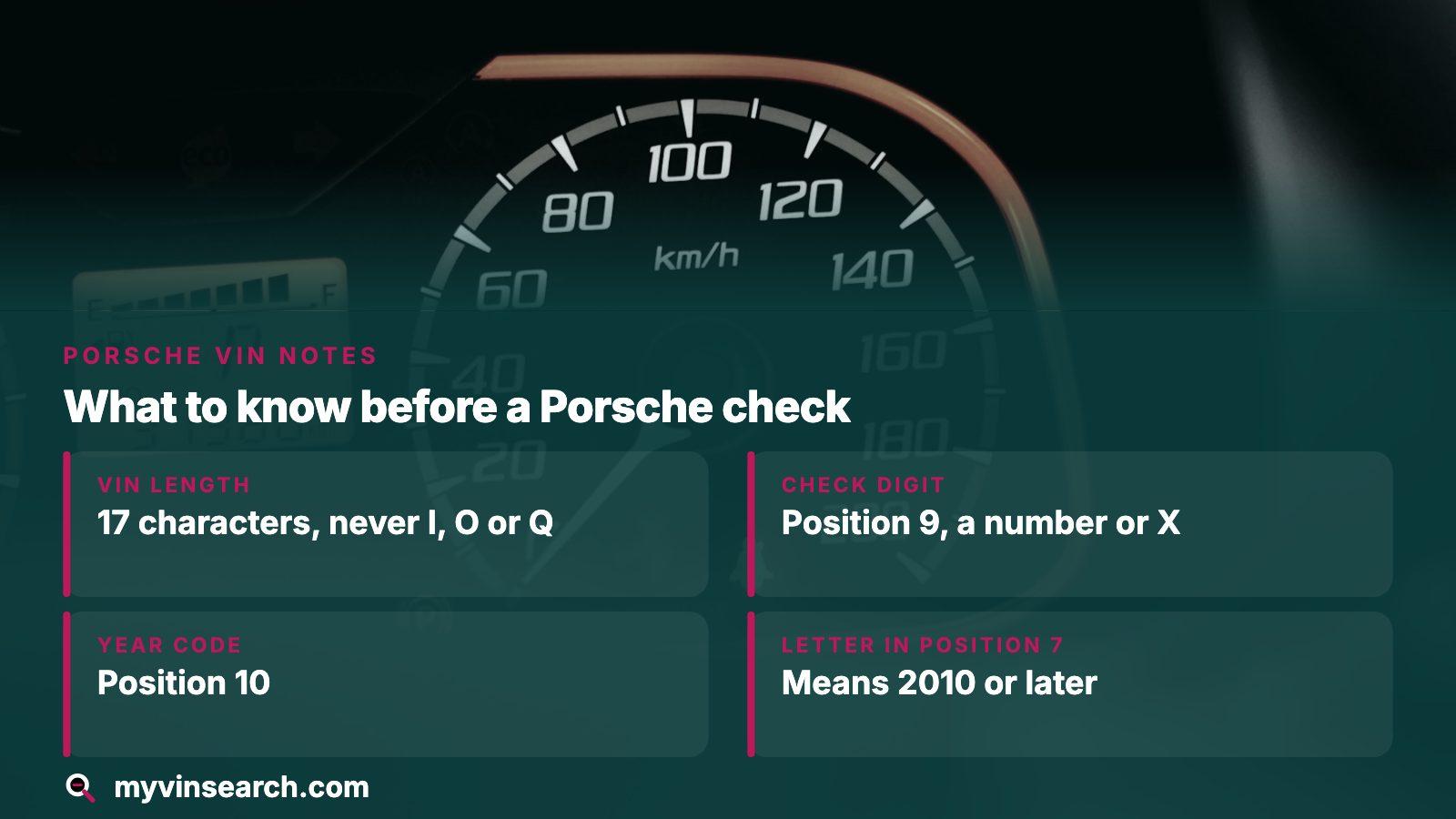
- VIN length
- 17 characters, never I, O or Q
- Check digit
- Position 9, a number or X
- Year code
- Position 10; a letter in position 7 means 2010 or later
- Preview
- Free; the report is one payment
What a Porsche check pulls from one VIN
The record follows the number, not the badge, so two Cayennes of one model year can read nothing alike. The check gathers:
- Whether a state or an insurer ever branded the title salvage, flood or junk.
- Crash entries and, for a car that went through a salvage auction, the sale photos.
- Dated odometer readings, which is where a rollback or a sudden jump shows.
- Liens, impounds, theft flags and insurance records.
- Open recalls on the VIN, the original factory specs, ownership and use type, and a market value.
Find the VIN and read it before you pay anything
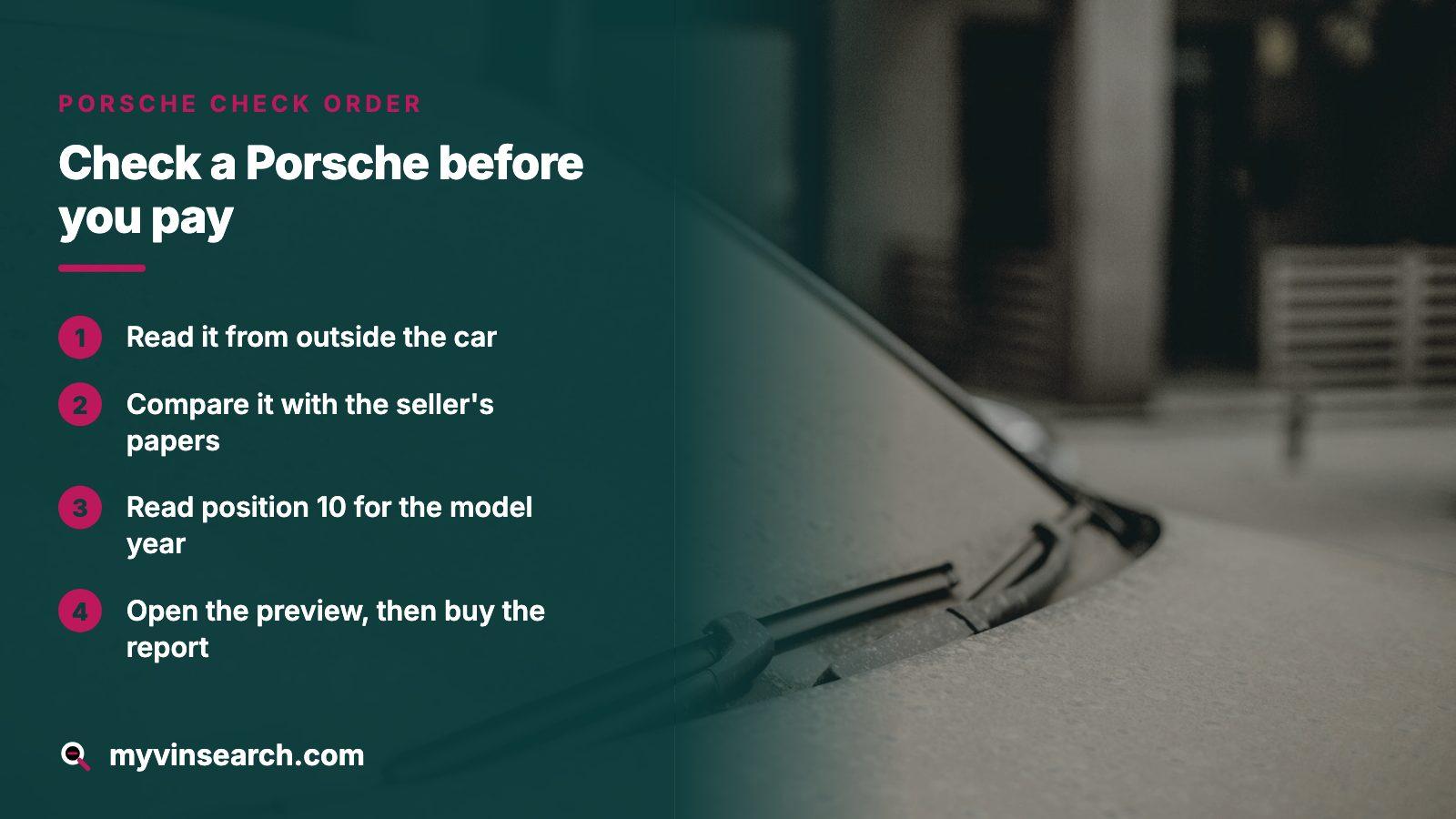
- Read it from outside the car, low on the windshield's driver-side corner. The registration card repeats it, and an insurance card may too.
- Compare it with the seller's papers, one character at a time. Federal rules exclude I, O and Q, so one of those in what you typed is a misread.
- Position 10 holds the model year code, and position 7 sets the cycle: a number there means the code reads 1980 to 2009, a letter means 2010 to 2039.
- Open the free preview. If the model or year differs from the ad, stop and ask why.
- If it fits, buy the report once and read title, damage and mileage first.
Position 9 is a check digit that catches typing slips.
Start with the odometer on any used Cayenne or 911
A false reading costs real money on a car this expensive. The report lists the odometer entries it found with dates, so a number lower than an earlier one stands out.
From an NHTSA owner complaint
The buyer of a 2012 Cayenne described a private sale that began with a post on an online marketplace. The odometer showed 125,383 miles at purchase, yet a history report run afterward listed 205,154. The owner filed it with NHTSA as odometer fraud.
The dash proved nothing there; the gap ran to tens of thousands of miles. Run the VIN before any deposit, and ask for title and service papers if the latest reading sits far above the dash.
Recalls by model: six Porsche lists compared
NHTSA files recalls by model year, and the lists vary in length. This table shows one model year from each line, as NHTSA's data returned it.
| Model and year | Campaigns listed | One example |
|---|---|---|
| 2020 Taycan | 12 | 24V731: battery module can short, fire risk |
| 2018 Macan | 5 | 20V077: fuel pump flange can crack and leak |
| 2012 Cayenne | 4 | 12V065: headlamps can work loose from the fender |
| 2014 Panamera | 3 | 19V322: water can short the A/C blower unit |
| 2019 911 | 1 | 21V201: rear axle control arm screw may be loose |
| 2003 Boxster | 4 | 03V004: key-lock cable on Tiptronic convertibles |
Two of the Boxster's four entries are aftermarket lamp recalls, not Porsche campaigns. A long list is not a bad car, and a short one is no clean bill.
Why the VIN decides which campaign applies
Campaign text names cars by model year, build window and sometimes options, so a year match proves little. Cayenne campaign 16V169 reaches cars assembled from April 28, 2010 through January 11, 2016. Taycan campaign 22V100 applies only to cars with the optional rear center seat. Campaign 22V656, on missing headlight-adjustment caps, spans Macan, Cayenne, Panamera and Cayman S cars from 2003 to 2020, plus Boxsters from 2001 to 2004. A VIN lookup applies those rules for you.
From an NHTSA owner complaint
The owner of a 2012 Cayenne S Hybrid wrote that the camshaft bolts sheared on a highway, the engine knocked, and the car coasted to the shoulder. The dealer quoted 14K or more. The owner pointed to recall 17V368 and said Porsche refused help because the VIN was missing from its list.
NHTSA's record for 17V368 lists several Panamera versions and only two 2011 Cayenne trims, the S and the Turbo, so a 2012 Cayenne S Hybrid appears nowhere in it. One account proves little, but a matching symptom does not create a recall. Ask a dealer to search the VIN, and file your own NHTSA complaint if the fault fits.
Taycan: reading the battery campaigns
Two campaigns filed in 2024 cover a high-voltage battery module that can short and raise fire risk: 24V731 for 2020 to 2023 cars and 24V732 for 2021 to 2024 cars. Owners are advised to cap charging at 80 percent until repairs are done. NHTSA's text for 24V731 adds that cars fixed under the earlier campaigns need the new remedy too, so an old repaired entry may describe an older job.
- Ask which campaign numbers show open on the VIN today.
- Ask whether battery work was done under the 2024 remedy or an earlier one.
- Get completion dates from the dealer in writing.
What the free lookups cover, and what slips past them
| Lookup | Question it answers | Blind spots |
|---|---|---|
| NHTSA recall lookup | Whether a recall is unrepaired on this VIN | Repaired recalls, recalls older than 15 years, international vehicles, VINs not yet loaded |
| NICB VINCheck | Insurer reports of unrecovered theft, salvage or flood damage | Insurers outside the program and police records; five searches a day per IP address |
| NMVTIS | Title brands, latest odometer reading, salvage and junkyard transfers | States that do not report, and brands a state never applied |
An early Boxster or 911 falls into NHTSA's 15-year gap, though a query by year, make and model returns the older campaigns. NMVTIS covers roughly 87 percent of vehicles and over half the states feed it, so an absent brand is not proof of a clean title. The paid report brings title, damage, mileage and recall entries together.
Porsche red flags and what to do about each
| You see | What it can mean | Do this |
|---|---|---|
| Model or year differs from the listing | The VIN belongs to another car than the one advertised | Settle it in writing before talking price |
| A salvage, flood or junk brand | A state or insurer recorded severe damage or a total loss | Ask for repair invoices and book an independent inspection |
| Odometer below an earlier reading | Mileage went backward somewhere | Ask the seller to explain it with papers |
| An open campaign on the VIN | A dealer repair that costs you nothing has not been done | Ask for the campaign number and a repair date |
| A total-loss tag on a stolen, then recovered, car | An insurer may tag a theft after 30 days unrecovered, and the tag can stay | Ask for the recovery paperwork and inspect the car in person |
Price, and the steps after the preview
Nothing is charged for the preview, which tells you whether the VIN's model and year agree with the listing. The report is bought once per VIN and never bills again. Someone comparing several Porsches can take 3, 5 or 10 reports in a single order. Exact amounts sit on the pricing page.
- Ask a Porsche dealer to search the VIN for campaigns, then compare with NHTSA's lookup.
- Pay an independent Porsche mechanic to inspect what no database records.
- Search again the day you sign, because records keep changing.
Where this information comes from
- NHTSA: Check for recalls — Where the VIN sits, what the lookup shows, and the recalls it leaves out.
- NHTSA recalls data: Porsche Taycan, model year 2020 — The 12 Taycan campaigns; the Macan, Cayenne, Panamera, 911 and Boxster lists were read the same way.
- NHTSA recall campaign 17V368 — The models named in the camshaft campaign and its dealer remedy.
- NMVTIS consumer information — What federal title records hold, who reports them, and why a clean search can still miss a brand.
- NICB VINCheck — The free insurer-record lookup, its search limit and its gaps.
- NHTSA owner complaint 11748836 — owner experience, paraphrased
- NHTSA owner complaint 11329783 — owner experience, paraphrased
Sources and photos: Facts checked against the sources above in November 2026. Photos by Clem Onojeghuo, JavyGo and muhammad dennisa on Unsplash; diagrams by MyVINSearch.
Keep reading
- Sample reportSee every section of the report before you pay for one.
- PricingAmounts for a single report and for multi-car packs.
- Tesla VIN check: what the VIN shows on a Model S, 3, X, Y or CybertruckAnother electric car, checked the same way, if you are weighing a Taycan against it.
- BMW VIN check: read the VIN, then match your engine and build dateA German rival with its own campaign lists, read the same way.
Frequently asked questions
Can I run a Porsche VIN check for free?
Only the preview is free; it confirms what model and year the VIN decodes to. The report is a single purchase per car with no renewal. Two other free tools reach less far: NHTSA's recall search covers open campaigns, and NICB's VINCheck covers insurer theft, salvage and flood reports.
Where do I find a Porsche's VIN?
Look through the glass from outside at the windshield's lower driver's-side corner, and confirm it against the registration card. Federal rules make capital letters mandatory and require the number to be legible from the left pillar's position.
Does NHTSA's lookup show every Porsche recall?
No. By NHTSA's account, the lookup leaves out repaired recalls, anything older than 15 years where the maker adds no extra coverage, international vehicles, and new recalls whose VINs are still being loaded. A year, make and model search returns the wider list.
Does a clean report guarantee a Porsche is sound?
No. NMVTIS covers about 87 percent of vehicles, and reporting comes from more than half the states, so a brand can go missing. NICB likewise says its tool should not be the only check. Pair the report with the state's title record and an independent inspection.
My Porsche has a fault that matches a recall, but the dealer says none applies. What now?
Campaigns apply to the cars they name, by model year, build window and equipment. Ask the dealer to search the VIN and read the campaign text with you. If the symptom fits but your car falls outside it, file an NHTSA complaint, which NHTSA says can lead to investigations and recalls.
Now check the car itself
The guide explains what to look for. The report shows what this VIN has on record.