THE SHORT ANSWER
Run the VIN through the free preview and confirm that model, year and plant letter match the listing. If they do, one payment buys the report. On a Tesla, read the title and odometer lines first, then the recall list: many campaigns are software, fixed by an update, while some need a service visit, and a clean paper title is not proof that no brand exists.
- Tesla prefixes in NHTSA's decoder
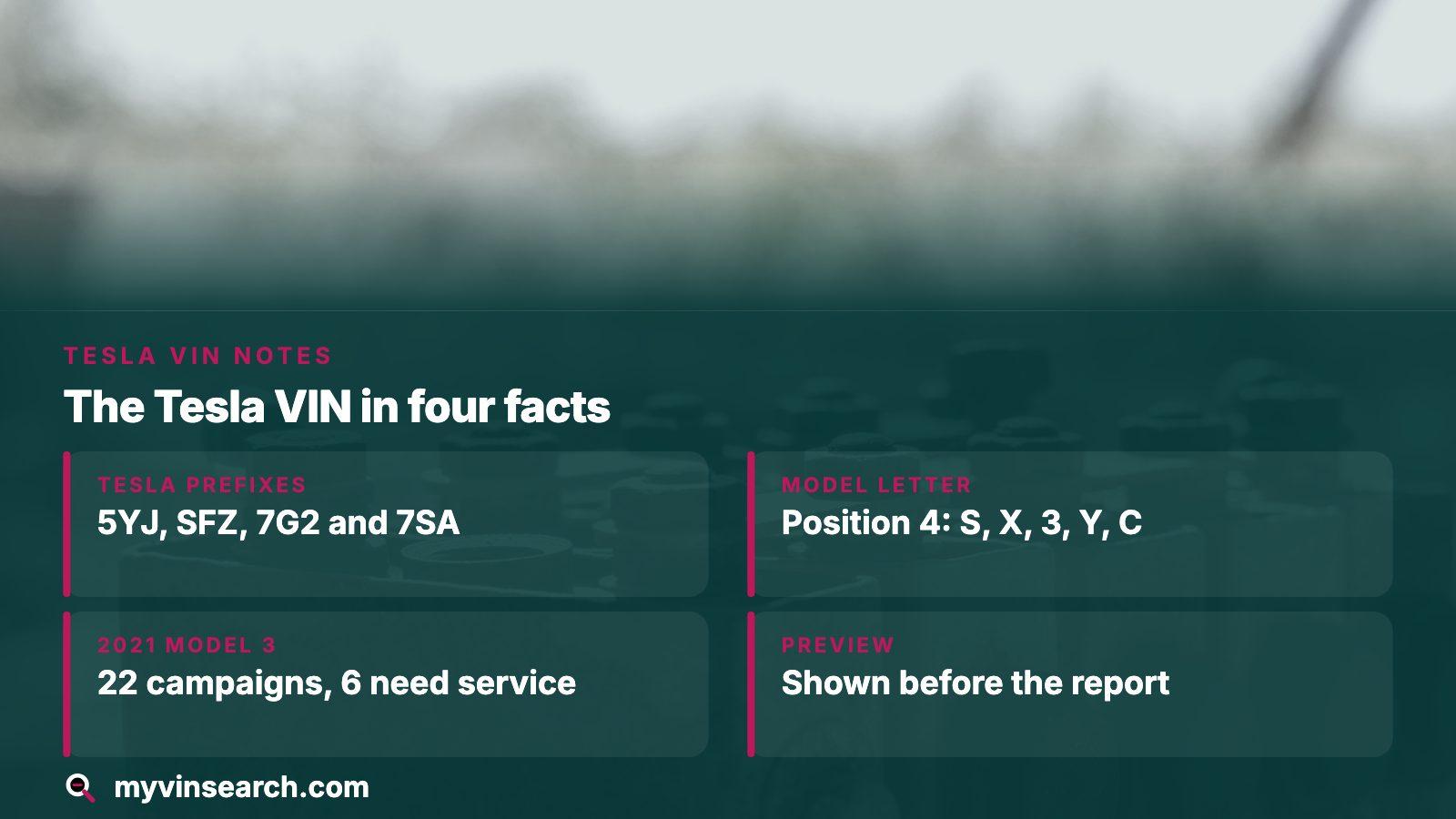
- 5YJ, SFZ, 7G2 and 7SA
- Model letter
- Position 4 in decoded examples: S, X, 3, Y, C
- Recalls naming a 2021 Model 3
- 22 campaigns, 6 need a service center
- Preview
- Free; the report is one payment
What a Tesla VIN check reports about one car
A badge gives the model line and little else; the check reads this single car's record.
- Title brands: junk, salvage, rebuilt or flood labels a state has filed.
- Damage: logged collisions and total-loss entries, with auction photos if the car passed through a salvage sale.
- Odometer: dated readings, so a drop or a long silence shows.
- Recalls: campaigns still open on this VIN, software and parts alike.
- Liens and theft: loans against the car, impound or theft entries.
Reading a Tesla VIN: prefix, model letter, plant letter
NHTSA's decoder lists four Tesla prefixes: 5YJ, SFZ, 7G2 and 7SA. Character 10 is the year code and character 11 marks the plant. In the starts below, taken from NHTSA's public owner complaints, character 4 names the model: S, X, 3 or Y, and C on the Cybertruck.
| VIN start | NHTSA decodes it as | Built at |
|---|---|---|
| 5YJSA1H15EF | 2014 Model S | Fremont, California |
| 5YJXCBE21JF | 2018 Model X | Fremont, California |
| 5YJ3E1EB6LF | 2020 Model 3 | Fremont, California |
| 7SAYGDED5SF | 2025 Model Y | Fremont, California |
| 7SAYGDEE1SA | 2025 Model Y | Austin, Texas |
| 7G2CEHED2RA | 2024 Cybertruck | Austin, Texas |
| LRW3E7EA8LC | No decode, error 7 | Not given |
The two Model Y starts share the 7SA prefix and differ only in the plant letter, F or A, so a Model Y ad can point to either factory. The LRW start returned error 7, NHTSA's flag for a maker with no registration for U.S. sale or import; ask for import papers if a U.S. listing shows one.
A model-year recall list is not your car's list
Search NHTSA by year, make and model and you get every campaign that names that year. Search by VIN and you learn whether this car still needs a repair. On a Tesla the gap is wide, as data read on November 3, 2026 shows.
| Model and year | Campaigns naming it |
|---|---|
| 2016 Model S | 10 |
| 2018 Model X | 9 |
| 2021 Model 3 | 22 |
| 2021 Model Y | 23 |
| 2024 Cybertruck | 11 |
Names add a second snag. NHTSA's complaint list carries 13 separate Model S entries for 2016, one per trim, and splits the 2021 Model X by seat count. A query by model name can return nothing for a car with plenty of history, so the MyVINSearch preview decodes the VIN first.
Software recalls and shop recalls share one list
A Tesla's open items mix software releases and parts jobs, in different proportions by model. The remedy line on each NHTSA record separates the two.
- 2021 Model 3, 22 campaigns: 16 are software releases. Six need a service center, among them a side curtain air bag that may be twisted (21V834), front suspension link fasteners (21V835), brake caliper bolts (21V387) and headlights (26V507), still waiting on a repair.
- 2024 Cybertruck, 11 campaigns: 4 are software. Seven need parts, among them the accelerator pedal pad (24V276), the wiper motor controller (24V456), the drive inverter (24V832) and the light bar (25V170).
NHTSA says owners are owed free remedies, and the service-center lines here all read free of charge. A buyer should ask which items need parts and whether those parts exist yet.
When the lookup and the maker disagree
NHTSA's lookup lists only what is unrepaired. It leaves out repaired recalls and some new ones whose VINs are still being added, so what it shows can differ from a shop's records.
From an NHTSA owner complaint
An owner of a 2014 Model S told NHTSA in December 2025 that the touchscreen keeps rebooting at speed, a fault the owner ties to recall 21V-035. Tesla, the owner says, claims a prior owner had that recall done but will not share proof, citing privacy, while NHTSA's lookup still lists it as incomplete. Tesla also said a diagnosis would be at the owner's expense.
A seller's word that a recall was done is thin evidence on a used Tesla. Ask for the shop invoice, and set it beside what the lookup shows on the day you buy.
Brands and mileage: a clean paper title shows neither
Federal title data keeps a brand once a state files one, yet a car can reach a new state and leave with a clean paper title if that state never asks where the car came from. States also disagree on what earns a salvage or flood brand.
About 87 percent of U.S. vehicles are in the federal title database, and it holds the latest reported odometer reading, but reporting is not yet complete, so a clean answer can still miss history.
From an NHTSA owner complaint
A buyer of a 2020 Model Y told NHTSA the car showed 78,823 miles when a dealer sold it. After driving off the lot, the buyer found 80,810 miles in the car's settings screen. The dealer offered no resolution, the buyer says, and then changed the mileage advertised on its website.
Before signing, set the dash reading beside the ad and the report's latest dated reading. A gap, even a small one, is something to settle in writing before money moves.
A salvage brand can follow a Tesla past the price
A brand cuts what a car is worth. On a Tesla, one owner says it also changes what the maker will do afterward.
From an NHTSA owner complaint
An owner of a 2014 Model S wrote that Tesla switches off DC fast charging on a car branded salvage until a paid inspection is done, whatever repairs came before. The owner says Tesla then declined an eMMC recall because that inspection had not been done, and asked NHTSA to stop the maker from putting conditions on recall work.
That is one owner's account, not Tesla's published policy, so confirm it before relying on it either way. On any branded car, ask Tesla service in writing which features work and whether open recalls will be done.
Run the check in this order
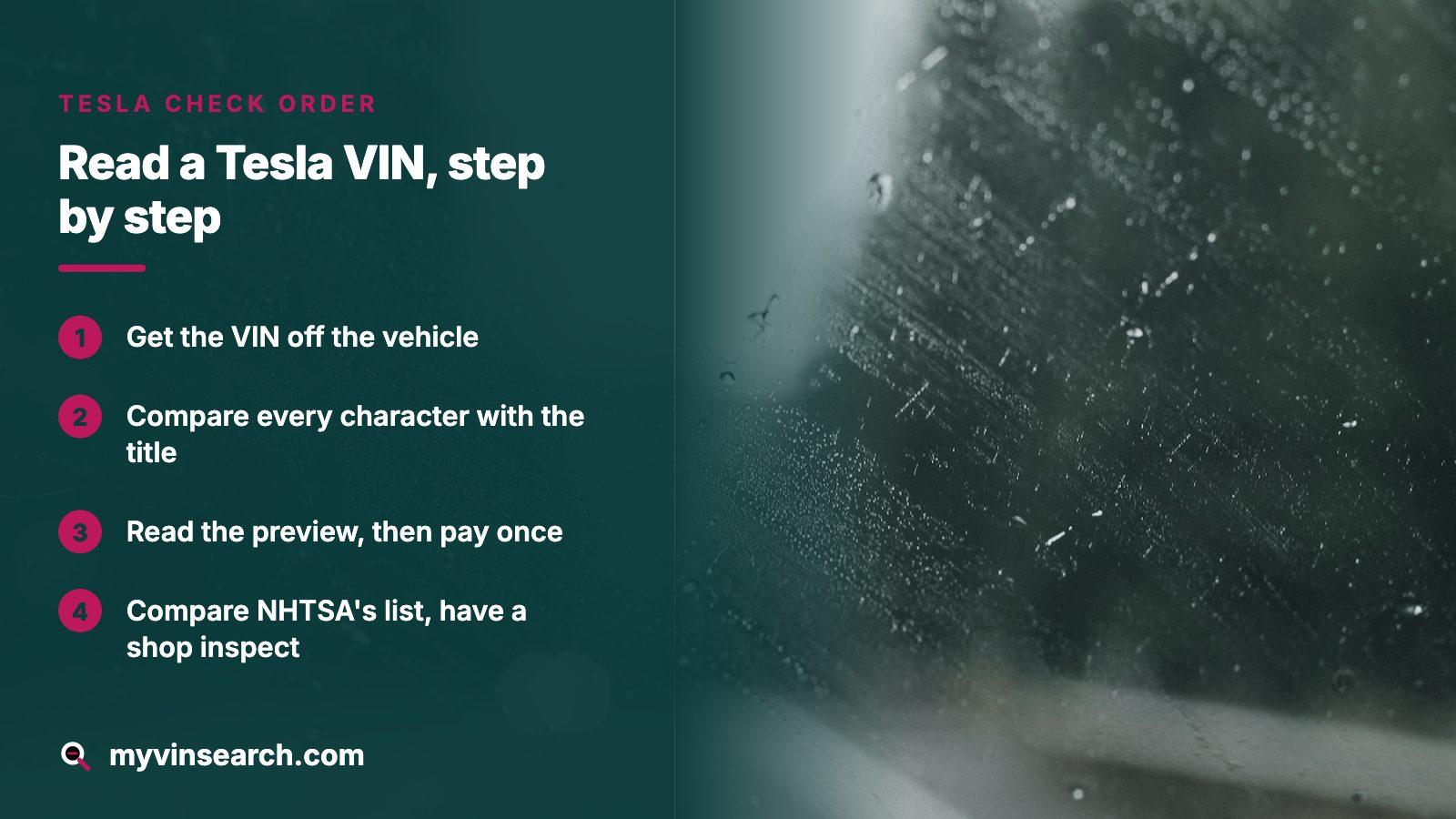
- Get the VIN off the vehicle, not from ad text: the lower-left corner of the windshield seen from outside, or the registration card the seller hands over.
- Compare every character with the title. One slip decodes to another car or to nothing.
- Enter it in the MyVINSearch preview. Model, year and plant letter should match the listing; if not, stop and ask the seller why.
- If the preview fits, pay once for the report and read title brands and odometer entries before recalls.
- Put the same VIN into NHTSA's recall lookup and compare the two lists.
- Have a shop read the battery and inspect the suspension and brakes. A history record carries neither.
What it costs, and what comes next
Entering a VIN in the preview costs nothing and shows at once whether model and year agree with the ad. Each full report covers one VIN and is paid for once; a buyer weighing several cars can take a bundle of three, five or ten. Nothing recurs, and prices are on the pricing page.
- Ask the seller for the shop invoice behind any recall marked done.
- Order the state's own title record if the report shows a brand, a gap or a conflict.
- Book an independent inspection, even on a certified car.
Where this information comes from
- NHTSA vPIC: Tesla VIN prefixes — The prefixes NHTSA lists for Tesla. The decoder calls behind the table of VIN starts use the same service.
- NHTSA: Check for recalls by VIN — What the VIN lookup shows and leaves out, and how it differs from a year, make and model search.
- NHTSA recalls data: Tesla Model 3, model year 2021 — The campaigns and remedy lines for that year. The Cybertruck and other model counts come from the same service.
- NMVTIS consumer information — What federal title records hold, how brands get washed, and why a clean result can still miss history.
- NHTSA owner complaint 11705673 — owner experience, paraphrased
- NHTSA owner complaint 11732358 — owner experience, paraphrased
- NHTSA owner complaint 11545026 — owner experience, paraphrased
Sources and photos: Facts checked against the sources above in November 2026. Photos by smart-me AG, Cole Keister and Stephen Mabbs on Unsplash; diagrams by MyVINSearch.
Keep reading
- Tesla recall check by VIN: match the model line, then the softwareWhy a Tesla recall can close by software update, and how to read it by VIN.
- Sample reportA look at the report layout before you decide to buy one.
- PricingPrices for a single report and each bundle size.
- GuidesMore buyer's guides by make, model and type of check.
Frequently asked questions
Can I run a Tesla VIN check for free?
The free MyVINSearch preview decodes the VIN and shows whether model and year fit the listing. A full report is paid for once and never renews. NHTSA's own recall lookup costs nothing either, though it covers recalls only, not titles or damage.
Can a clean Tesla VIN check still hide a title brand?
Yes. The federal title database does not yet receive reports from every source, and states define brands differently, so a clean answer can still miss history. Ask the state for its own title record and set it beside the paper title in the seller's hand.
Should open recalls on a Tesla scare me off?
Rarely on their own. Many are software releases, and NHTSA says remedies must be free to the owner. Sort out which items need parts and whether parts exist yet, and ask for shop invoices on anything marked done. A parts recall with no repair ready, like the 2021 Model 3 headlight campaign, belongs in the price talk.
Does the report show a Tesla's battery health?
No. Battery wear is measured on the car, so a history report cannot supply it. Have a Tesla service center or an independent EV shop read the pack, and use the report for title, damage, mileage, recalls and liens.
What if the Tesla's VIN will not decode?
Recheck each character against the title first, since one wrong character fails the decode. If the VIN is right and still returns nothing, as an LRW start did in NHTSA's decoder, the car may lack a U.S. sale or import registration. Ask the seller for the import and title papers before going further.
Now check the car itself
The guide explains what to look for. The report shows what this VIN has on record.