THE SHORT ANSWER
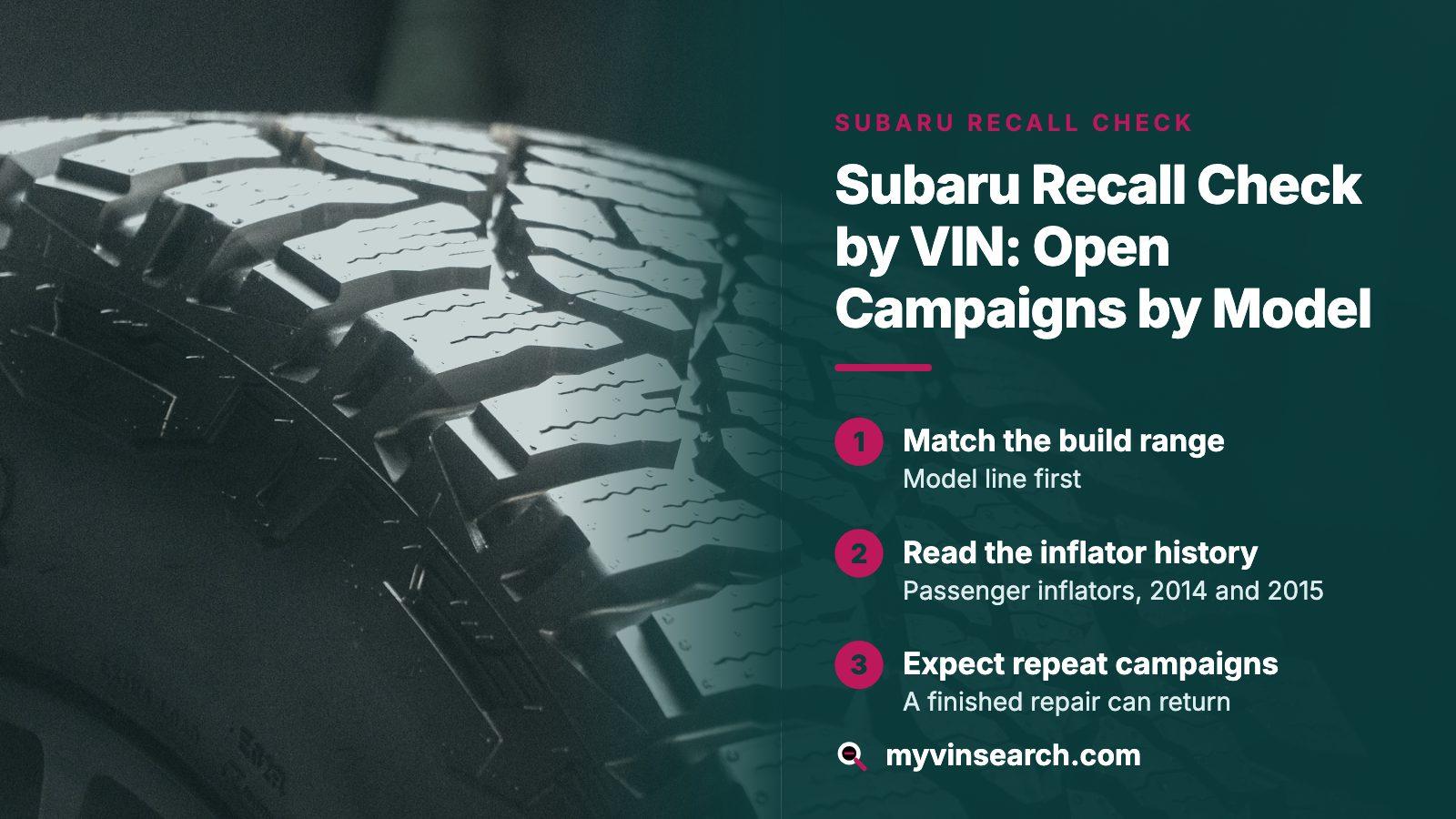
Pull the VIN off the car, run it, and confirm the model line and year before anything else. Then compare the result with NHTSA's federal lookup. Subaru is not on the federal do-not-drive list, but that does not make a car clear: older Legacy, Outback, Impreza, WRX and Forester models have had passenger inflator campaigns, some of them repeat filings. A safety recall repair costs the owner nothing.
- Federal do-not-drive list
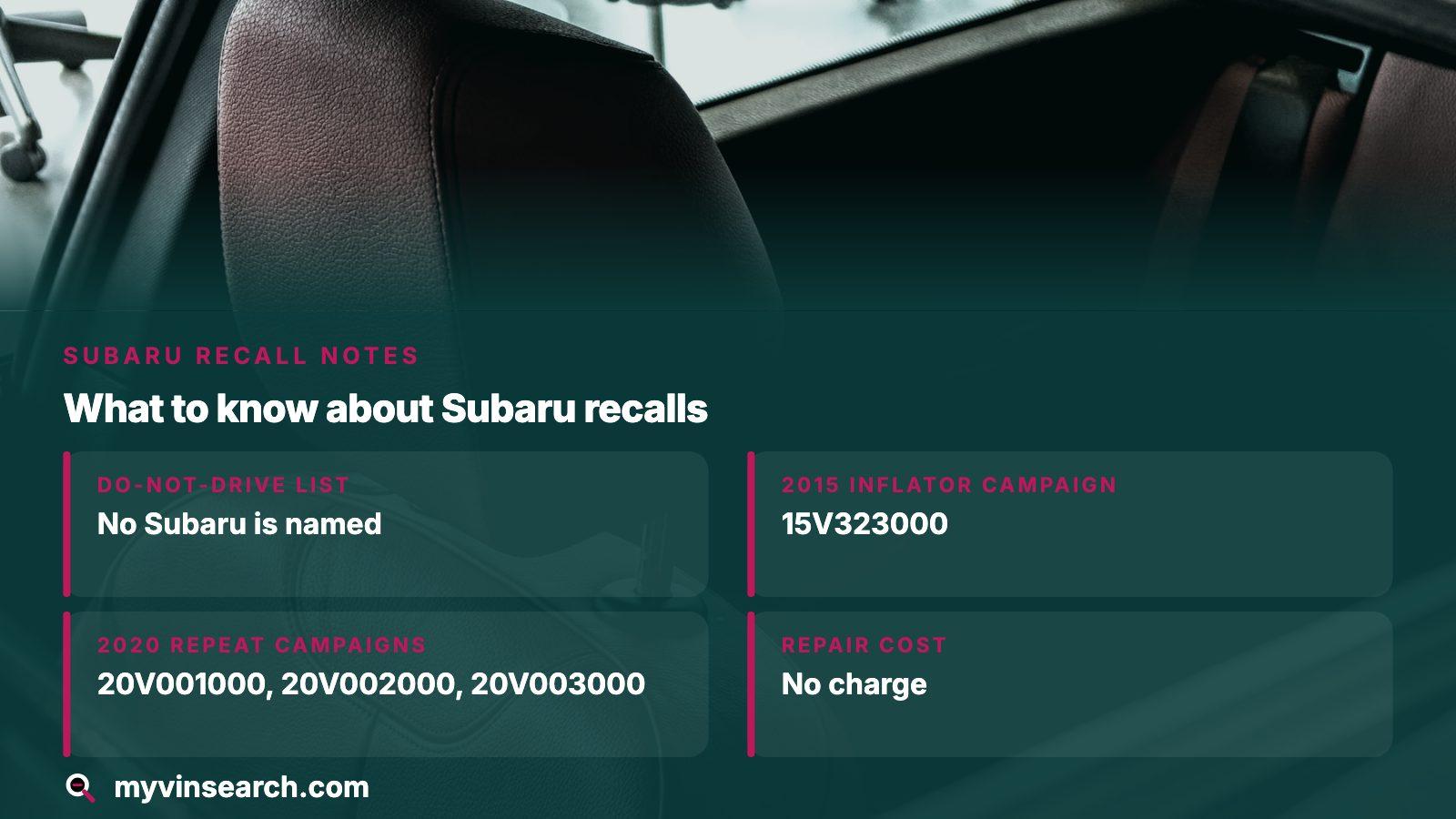
- No Subaru is named
- 2015 inflator campaign
- 15V323000
- 2020 repeat campaigns
- 20V001000, 20V002000, 20V003000
- Repair cost to the owner
- No charge
Start with the model line: Subaru files recalls by build range
Subaru campaigns attach to a model line and a span of build dates, so the badge settles little. MyVINSearch decodes make, model and year from the VIN first, then reads campaigns against that exact car.
| Model line | Years named in the 2020 inflator campaigns |
|---|---|
| Forester | 2009 to 2013 |
| Impreza | 2004 to 2011 |
| WRX, STI included | 2004 to 2014 |
| Legacy and Outback | 2003 to 2014 |
| Baja | 2003 to 2006 |
Those spans are the outer edge, not a verdict: build dates, earlier repairs and registration history narrow them. Newer lines follow other histories, so the table says nothing about a Crosstrek or an Ascent.
Running the check on a Subaru you might buy
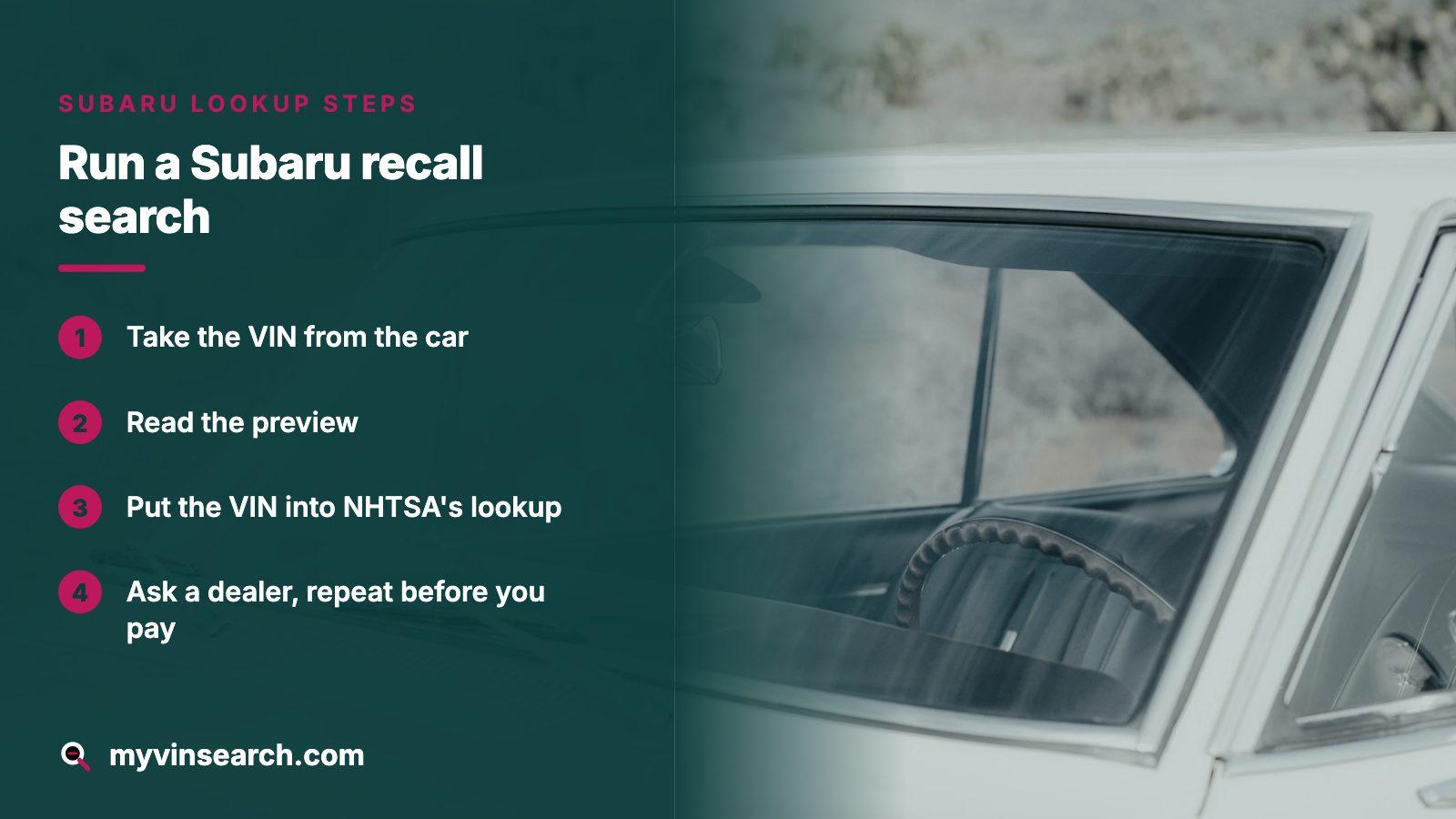
- Take the VIN from the car rather than the ad. Subaru stamps it on a dashboard plate you can read through the glass and repeats it on a door-frame sticker.
- Enter it on MyVINSearch and read the free preview, which confirms the model line and year. The full report is an optional paid step.
- Put the VIN into NHTSA's recall lookup as well. The federal record covers every manufacturer in one search.
- Phone a Subaru dealer and ask which campaigns were completed. Only a service record proves work was done.
- Repeat the lookup shortly before you pay, since new campaigns get filed and ranges have been widened before.
The passenger inflator recalls of 2014 and 2015
The campaign most used-Subaru buyers meet is 15V323000, filed in May 2015. It covers the passenger-side frontal air bag in early Impreza, Legacy, Outback and Baja models. NHTSA's record says moisture can get into the inflator and, over time, make it rupture on deployment, throwing metal fragments toward the occupants. In December 2015 Subaru widened it to add the Baja and the 2003 to 2008 Legacy and Outback. Dealers replace the inflator at no charge.
An earlier filing, 14V763000 from December 2014, aimed at 2003 and 2004 Legacy and Outback cars from very humid places such as Florida, Hawaii and Puerto Rico. The 2015 campaign absorbed part of it, so a repair history can name either number.
A finished repair can come back as a new campaign
In January 2020 NHTSA logged three more Subaru filings: 20V001000, 20V002000 and 20V003000. They reach cars whose passenger inflators were already replaced once with a part of the same design, which the record warns can deteriorate after years in humid air and temperature swings. Subaru sorted them into zones A, B and C by where a car was first sold or has been registered. Dealers fit the replacement at no cost.
From an NHTSA owner complaint
A 2010 Forester owner filed in 2020 after a dealer visit for the air bag recall. Letters kept coming saying the work was still due, and the owner suspected the job had been skipped or never logged. The record does not say how it ended.
A seller's "replaced years ago" proves little either way. Run the VIN again after any repair, and keep the work order.
Why a Subaru missing from the do-not-drive list proves little
The most dangerous Takata populations carry a stop-driving warning from NHTSA. It lists certain models from Honda, Mazda, Nissan, Toyota and other makers, and no Subaru. That is good news about the top tier of urgency and nothing beyond it.
| What you know | What stays unknown |
|---|---|
| Subaru is missing from the warning list | Whether this VIN has an open inflator campaign |
| A former owner had an air bag replaced | Whether a later campaign reached the new part |
| Today's lookup shows nothing | What gets filed next, since ranges have grown before |
NADI inflators, a different design, sit in a campaign of their own. A car clear of one campaign can be open on another, so the VIN decides.
Reading what comes back: four outcomes
| Result | What it means | Next step |
|---|---|---|
| Open inflator campaign | The passenger air bag still needs a new inflator | Book a dealer visit and ask about parts first |
| Old campaign closed, newer number listed | A repeat filing may reach the replacement part | Ask the dealer if the newer campaign applies |
| Open campaign on another system | A different safety repair is still owed | Same no-charge repair, settled before the sale |
| Nothing open | No unrepaired campaign on file today | Run the VIN again just before payment |
From an NHTSA owner complaint
A 2010 Forester owner near Atlanta phoned a dealer about an air bag recall notice. The dealer read the VIN and said no air bag recall was active, only one for brake line corrosion. An online lookup run by the owner still showed the air bag recall, so the owner filed with NHTSA to find out which was true. The record gives no answer.
When a dealer and a lookup disagree, ask the dealer to re-run the VIN and put the answer in writing.
An open recall with no parts: the front seat rule
Subaru's 2015 owner letters told people to keep passengers out of the front seat until the inflator was swapped. Complaints filed in the following years describe dealer waits of weeks and then months, with parts short and loaners hard to get.
From an NHTSA owner complaint
A 2005 Legacy owner wrote in March 2016 that the recall letter warned the inflator could rupture and throw metal fragments, and told the family to leave the front passenger seat empty. The dealer said the wait for parts "could be a year". The owner asked why no loaner was offered.
If a car you are buying has an open campaign and parts are short, treat the seat advice as binding, and make the seller's repair visit a condition of the sale.
Who pays, and why a humid past raises the stakes
Under federal law the maker bears the cost of fixing a safety defect, and that duty stays with the car through every resale. Buying a used Subaru with an open campaign means inheriting the errand, not the bill.
Moisture drives the campaigns above: years of damp air and temperature swings wear down the propellant. A car that lived in coastal Texas or Hawaii carries more risk than a dry-climate one, and each added year works against it. That is why the 2020 zone letters follow registration history.
What a recall result leaves out on a used Subaru
A recall lookup answers one question: is a safety campaign unrepaired on this VIN today. It is silent on Subaru owners' usual worries, such as an older engine's head gaskets, oil use and the continuously variable transmission, which service records and a mechanic's test drive cover. The history behind the VIN covers the rest:
- Title brands, plus salvage or auction history with photos
- Collision damage set against the odometer readings
- Liens, impound events and theft flags
Paying for the full report, and when it makes sense
The preview for a Subaru VIN is free to read. One report covers one VIN and is paid for once. Bundles of 3, 5 or 10 reports suit a shortlist, nothing renews, and the pricing page has the amounts. Buy when the preview and the federal lookup leave a car worth pursuing.
Before you pay for a Subaru
VIN taken from the car, model line confirmed, federal lookup clean or booked for repair, the dealer's completed list in hand, history report read.
Where this information comes from
- NHTSA: Recalls lookup — The federal VIN search for open campaigns, and the record for the Subaru filings named here.
- NHTSA: Takata air bag recall spotlight — Background on the moisture-driven rupture risk behind the inflator campaigns.
- NHTSA: Takata do-not-drive warning — Which makers the highest-urgency warning names, and that Subaru is not among them.
- NHTSA owner complaint 11329760 — owner experience, paraphrased
- NHTSA owner complaint 11042212 — owner experience, paraphrased
- NHTSA owner complaint 10849776 — owner experience, paraphrased
Sources and photos: Facts checked against the sources above in November 2026. Photos by Rob Wingate, Wesley Tingey and Obi on Unsplash; diagrams by MyVINSearch.
Keep reading
- Honda recall check by VIN: open recalls for your exact modelHonda is named on the federal do-not-drive list that Subaru is not, read the same VIN-first way.
- Mazda recall check by VIN: open recalls for your exact modelAnother make with Takata campaigns, checked by model line.
- Sample reportSee what a full report holds beyond open recalls before you buy.
- PricingHow single reports and packs are priced, with no subscription.
Frequently asked questions
How do I run a Subaru recall check by VIN?
Take the VIN from the car, run it on MyVINSearch to confirm the model line and year, then repeat the search on NHTSA's recall lookup, which needs no account. A Subaru dealer can confirm which campaigns were completed.
Are Subarus part of the Takata recalls?
Yes. Passenger-side frontal inflators in several older Subaru lines have been recalled over moisture-related rupture risk, and a separate campaign covers NADI inflators. Whether one car is affected turns on its VIN and registration history.
Does the federal do-not-drive list include Subaru?
No. It names certain models from other makers. Staying off it means no Subaru sits in the highest-urgency group, not that a car is free of open campaigns. A car outside that group can still need an inflator replaced.
Can a Subaru show an open recall after the air bag was replaced?
Yes. Three campaigns filed in 2020 cover cars whose inflators were already replaced once with a part of the same design. Run the VIN after any repair and keep the work order, since letters and records do not always agree.
What does a Subaru recall repair cost a used-car owner?
Nothing. The maker bears the cost of a safety recall repair, and the duty follows the car, not the first buyer. Ask about parts before agreeing a price, since waits have run to months on past inflator campaigns.
Now check the car itself
The guide explains what to look for. The report shows what this VIN has on record.