THE SHORT ANSWER
Search the car's 17-character VIN and see which recalls come back open. A software recall stays open on a car until that car has installed the release, so an open item on a used Tesla can simply mean it sat offline. Hardware recalls need a service visit. The remedy costs the owner nothing either way, and the right passes to the next owner.
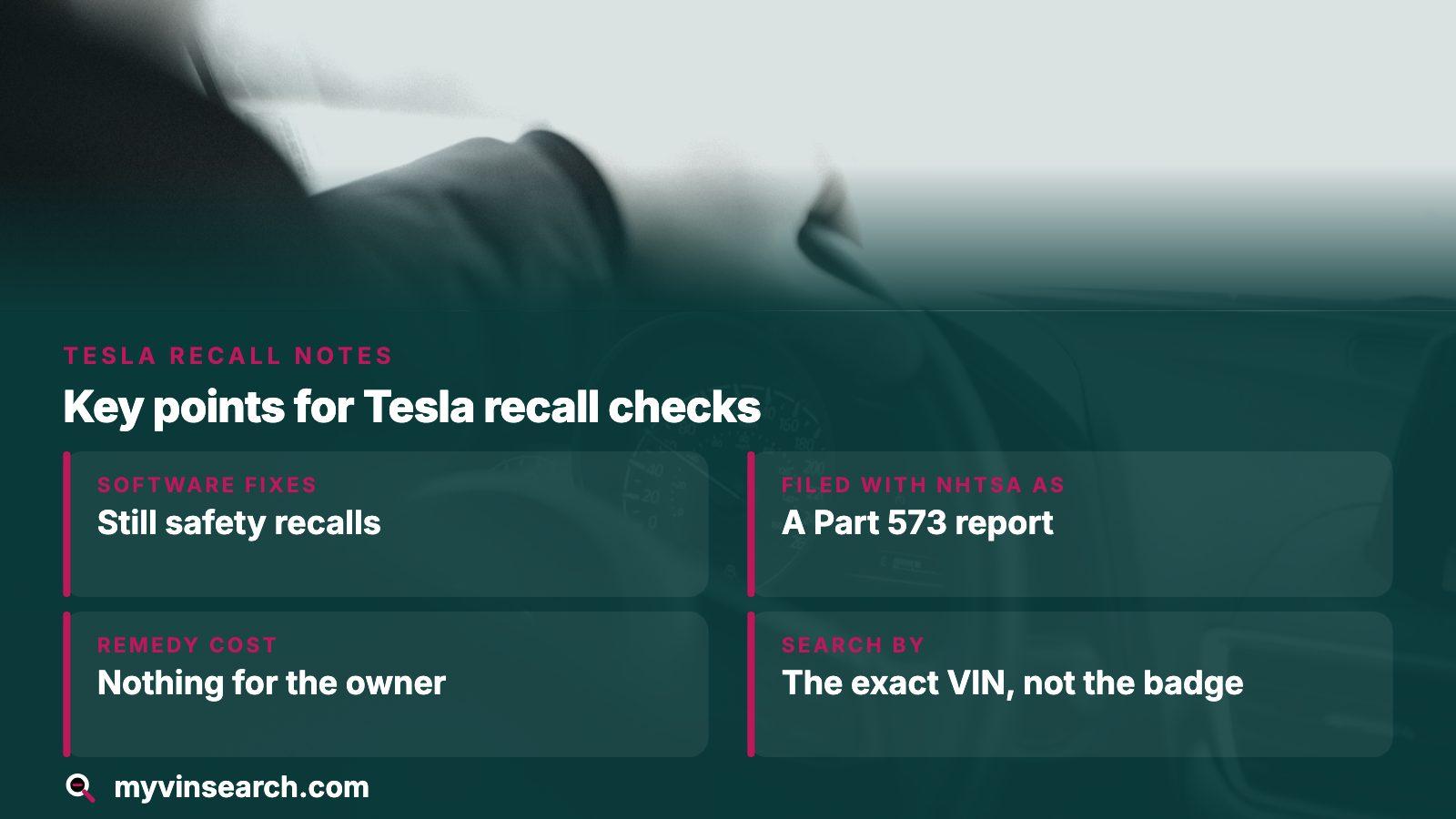
- Software fixes
- Still safety recalls, with a federal number
- Filed with NHTSA as
- A Part 573 report
- Remedy cost
- Nothing for the owner
- Search by
- The exact VIN, not the badge
Why a Tesla search begins with the model line
A recall is never filed against a brand. Each filing names model lines and a span of build dates, and Tesla's list is short: Model S, Model 3, Model X, Model Y and the Cybertruck. Two Teslas parked side by side can sit in different campaigns.
That is why MyVINSearch is built around make and model: the VIN spells out the car before any recall is read.
| VIN characters | What they settle for a recall match |
|---|---|
| 1 to 3 | The manufacturer |
| 4 to 8 | Model, body style and powertrain, the details a campaign is written around |
| 10 | Model year, which decides whether a filing applies to the car |
| 11 | The assembly plant |
If the listing says Model Y and the VIN decodes to a different car, stop and settle that first. NHTSA's public decoder, vPIC, gives an independent reading of the same characters.
An over-the-air fix is still a federal recall
Owners sometimes shrug off a Tesla campaign because nothing came in the mail and nobody asked them to book a visit. When a safety defect or a missed federal standard turns up, Tesla submits a Part 573 report to NHTSA, the campaign receives an official number, and the remedy line describes a software release in place of a part.
Two things follow. The campaign appears against the VIN in the federal database, and it keeps appearing until that particular car has installed the release.
No letter is not the same as done
Nothing is sent to tell you a software recall finished on your car. The VIN lookup and the software version shown on the car's screen are the two places to see it.
Two Tesla filings, read for what they show
The NHTSA reports for 24V-935 and 25V-092 make a useful pair, because both are software recalls and both show how a campaign picks out its cars.
| Filing | Cars named | What was wrong | How it was fixed |
|---|---|---|---|
| 24V-935 | Model 3, Model Y and Cybertruck running certain software releases | The tire pressure warning light did not stay on after the car was switched off or went to sleep between drives | An over-the-air release at no cost; cars built after the fix shipped with it |
| 25V-092 | A limited run of 2023 Model 3 and Model Y on older software | Steering assist could drop out once the car stopped, leaving manual steering, with a message on the screen | An over-the-air release; the report says no service visit is needed once it is installed |
Both reports describe the VIN range as not sequential. Cars are picked out by model, build dates and the software they run, so a neighbor's Model 3 can be included while yours is not. Search the exact VIN instead of judging by looks.
Running the search on a Tesla you are considering
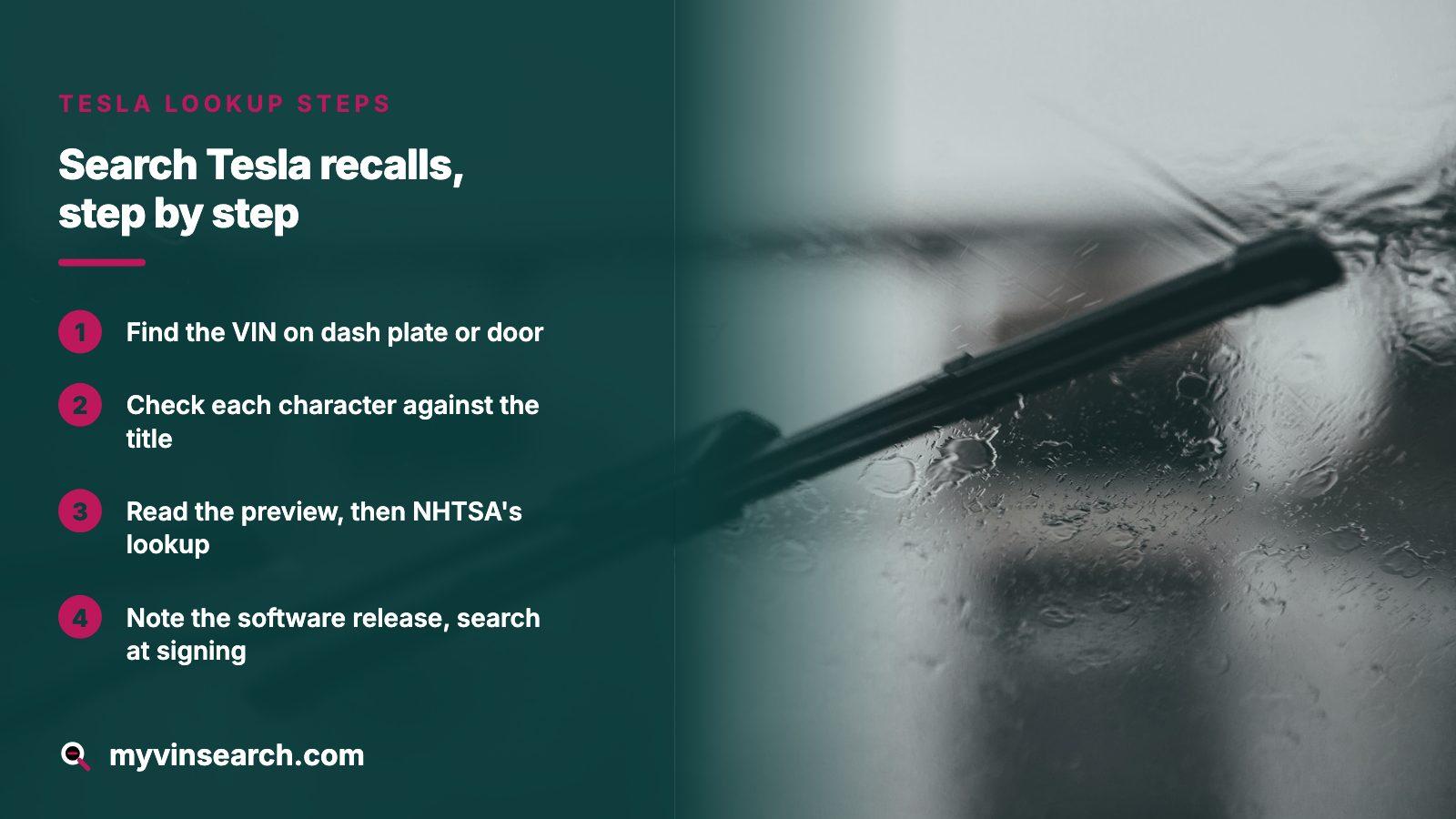
- The car carries its VIN in two easy spots: a dashboard plate readable through the glass at the driver's end, and a label in the door jamb.
- Check each character against the title and the ad, since one wrong digit pulls up a different car.
- Enter it on MyVINSearch and start with the free preview, then confirm the model and year it reports match the ad.
- Put the VIN into NHTSA's free recall lookup as well, and see whether the two agree.
- Note the release number on the car's software screen and compare it with the release named in the recall text.
- Search again at signing, since new campaigns can appear before the sale.
Reading what comes back, and the red flags
| What you see | What it usually means on a Tesla | What to do |
|---|---|---|
| An open software recall | The car has not installed the release, often after sitting offline | Ask the seller to connect the car and install the update, then search again |
| An open hardware recall | A part still needs inspection or replacement at a service visit | Book the visit; the repair costs the owner nothing |
| Nothing open | No unfinished campaign is on file today | Repeat the search just before payment |
From an NHTSA owner complaint
The owner of a 2019 Model 3 wrote to NHTSA in early 2023 that the car had carried an open recall since it was purchased. Tesla's reply, as the owner relayed it, was that software updates had "most likely" dealt with it. The owner wanted a more direct answer, and the complaint never names the recall.
An open software recall seldom justifies passing on the car, since the fix is written and costs nothing. What deserves pressing is why it is still open: "probably handled" is a guess, not a status. A seller who cannot say when the car last updated has told you something about how it was kept.
What the law gives the next owner of a used Tesla
The duty to repair a recalled defect at no charge attaches to the car, not to whoever first bought it, so a used Tesla with an open campaign does not come with a repair bill. The right stops at the recall remedy itself. Anything else a shop spots during the visit is a separate quote.
From an NHTSA owner complaint
A 2020 Model Y owner told NHTSA in April 2026 that the car had sat on one software build for over two years, leaving four software recalls unfinished. It is a US-market car living in Latvia, and the owner said service centers in the Baltics and in Poland would not send the updates, calling it "unsupported".
A free remedy still has to be delivered by someone. A hardware recall closes only when a technician does the work, so an open one is a job waiting for you. A software recall closes when the car installs the release, which depends on the car staying connected and on the maker being willing to support it where it sits. Ask where a Tesla has been registered and driven, and get the repair plan on paper before settling the price.
What a recall search will not tell you
A recall result answers one question: is a manufacturer safety campaign still open on this car. It says nothing about crashes, branded titles, odometer accuracy or how the car was driven, and on an electric car it is silent on the traction battery. Battery condition comes from service records, a diagnostic scan and a long test drive.
For the rest, the full MyVINSearch report adds:
- Branded-title flags and any salvage or auction listing, photos included
- Crash and damage entries next to recorded odometer readings
- Lien holders, impound stays, theft flags and insurance entries
Cost, and the sensible next step
The preview carries no charge. The full report is one payment: a single VIN, or a bundle for several cars, with packs of 3, 5 and 10. Nothing renews. The pricing page has the amounts.
Before money changes hands
Match the VIN to the car, read the open recalls, ask about the software version and how often the car updates, and read the full history before you pay the seller.
Where this information comes from
- NHTSA: Recalls lookup — The federal VIN search for open safety recalls, whatever the remedy turns out to be.
- NHTSA: Part 573 report for recall 24V-935 — The tire pressure warning filing, source for the cars named and the over-the-air remedy.
- NHTSA: Part 573 report for recall 25V-092 — The steering assist filing, source for the not-sequential VIN range and the no-visit remedy.
- NHTSA: vPIC VIN decoder — Confirms which model a Tesla VIN describes before you match it to any campaign.
- NHTSA owner complaint 11507723 — owner experience, paraphrased
- NHTSA owner complaint 11731004 — owner experience, paraphrased
Sources and photos: Facts checked against the sources above in November 2026. Photos by smart-me AG, Thibault Valjevac and Miles Loewen on Unsplash; diagrams by MyVINSearch.
Keep reading
- Sample reportSee what the full report holds beyond recalls before you buy.
- PricingHow single reports and packs are priced, with no subscription.
- BMW recall check by VIN: match your model to open campaignsThe same make-and-model check for a BMW and its water pump campaign.
- Nissan recall check by VIN: match the model, engine and yearThe recall check for a mainstream make, read the same way.
Frequently asked questions
Does a Tesla software update count as a recall?
Yes. The manufacturer files a Part 573 report with NHTSA, the campaign gets a number, and it is listed against the VIN. An over-the-air remedy changes the delivery, not the status, and it stays open on a car until that car installs the release.
How do I check a Tesla for recalls by VIN?
Find the VIN on the dashboard plate or door-jamb label, enter all 17 characters on MyVINSearch, and read the open recalls. Compare with NHTSA's lookup, and confirm the model and year match the car in front of you.
Why does my Tesla still show an open recall after an update?
The release may not have installed on that car yet, or a different campaign may be open. Compare the software version on the screen with the one the recall names, let the car connect, and search the VIN again.
Do I have to pay for a Tesla recall repair?
No. The manufacturer must correct a safety defect without charging the owner, and that duty stays with the car through later sales. Only the recall remedy is covered; other work a shop suggests is billed as normal. Software fixes arrive over the air, while hardware ones need a service visit.
Does a recall search show the battery health of a used Tesla?
No. A recall search lists manufacturer safety campaigns, nothing more. Battery condition comes from service records, a diagnostic scan and a test drive. The full MyVINSearch report covers title brands, crash and damage records, odometer readings and salvage, theft and insurance history, which matter on any used car.
Now check the car itself
The guide explains what to look for. The report shows what this VIN has on record.