THE SHORT ANSWER
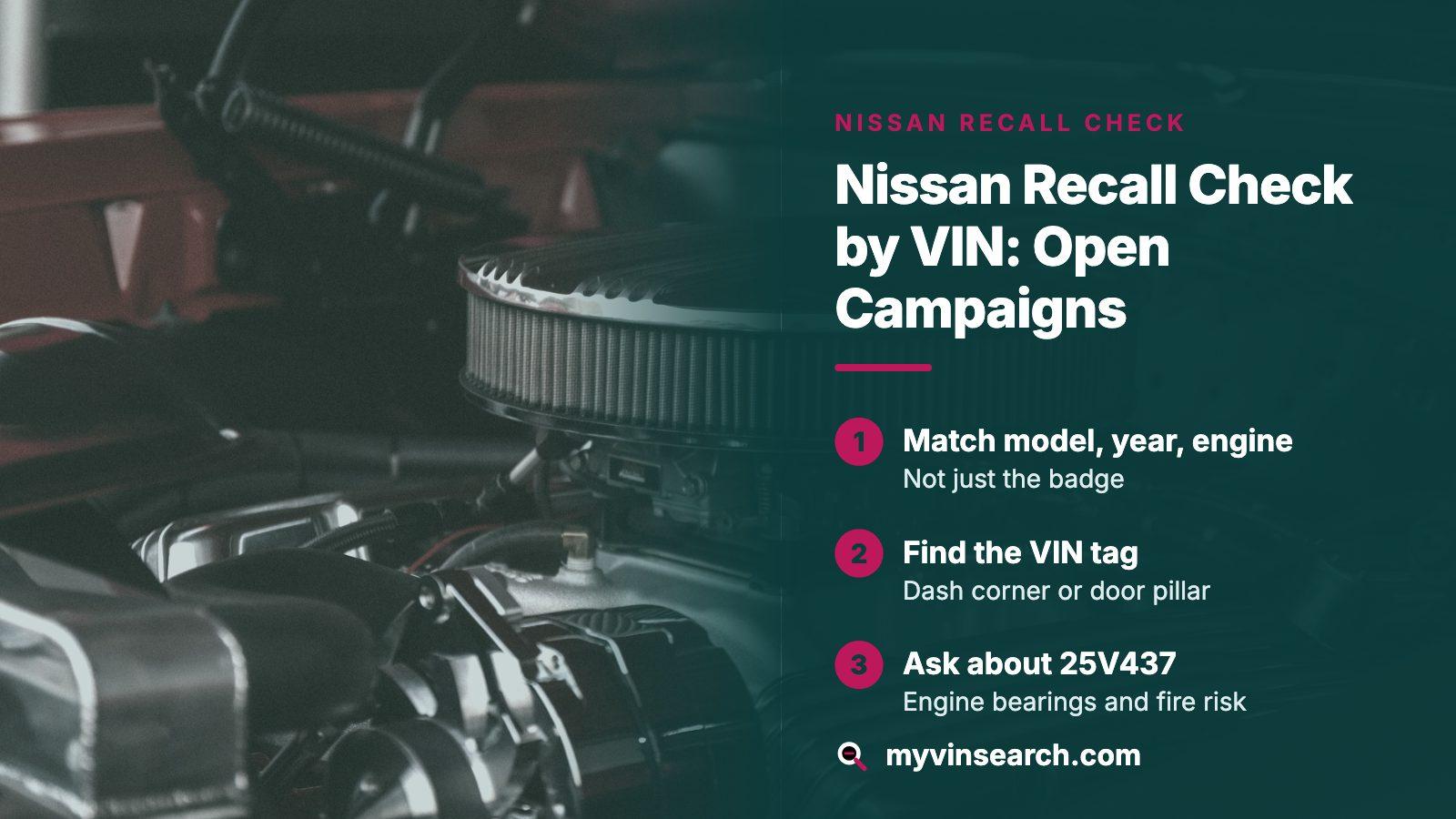
Copy the 17-character VIN from the tag in the dashboard corner, readable through the windshield, or from the sticker on the driver's door pillar, and run it through a recall lookup. It lists safety campaigns still open on that Nissan. Check the engine too: campaign 25V437, filed June 27, 2025, covers certain Rogue, Altima, QX50 and QX55 cars with a VC-Turbo engine, and the dealer repair costs the owner nothing.
- Largest open campaign
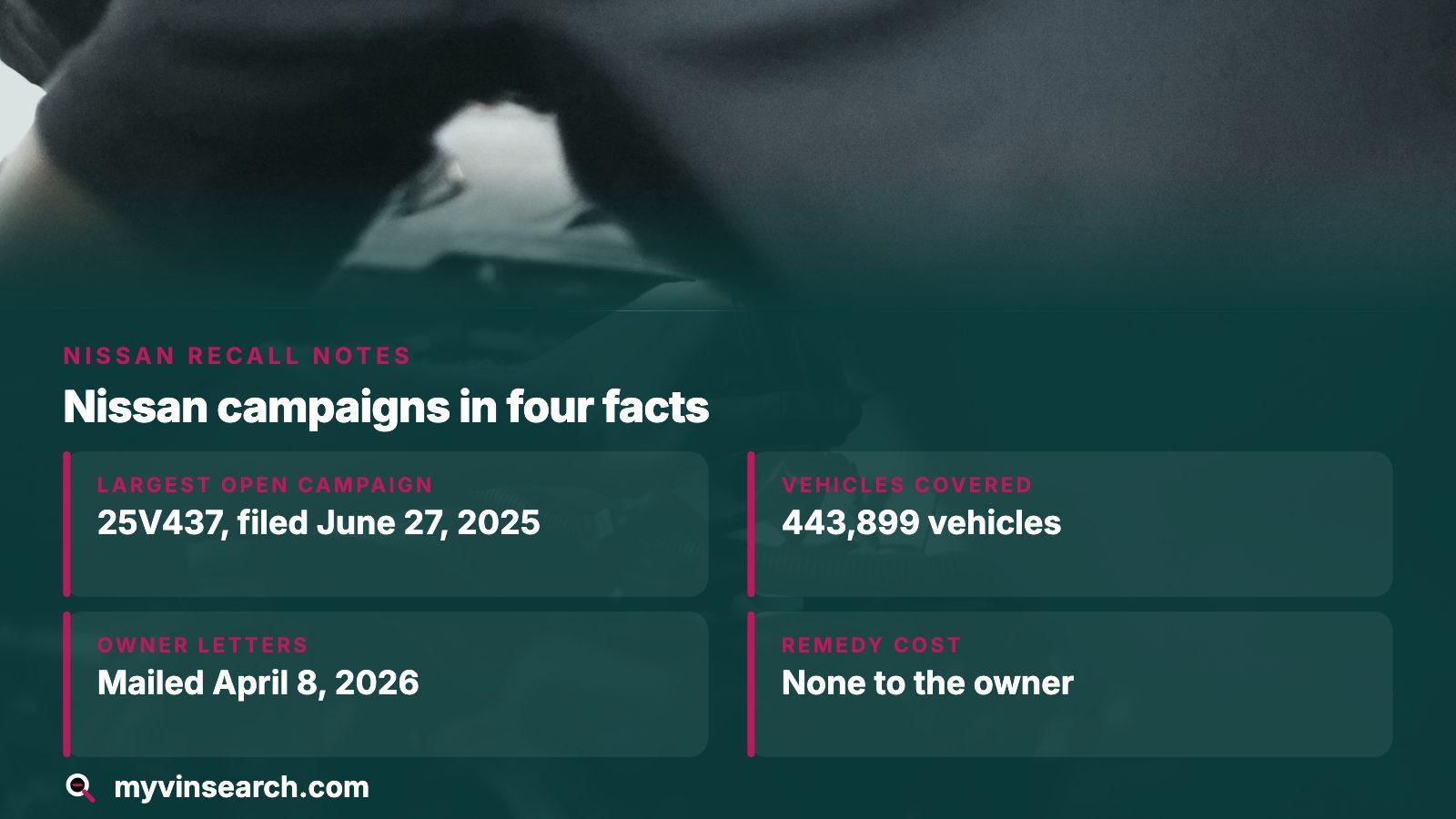
- 25V437, filed June 27, 2025
- Vehicles covered
- 443,899
- Owner letters mailed
- April 8, 2026
- Cost of the remedy
- $0 to the owner
Why MyVINSearch checks a Nissan by model, year and engine
Recalls are never filed against Nissan as a whole. Each campaign names model lines, years and usually an engine, so two Nissans side by side can carry different exposure. MyVINSearch sorts checks by make and model for that reason: the VIN decodes to one car, and that car decides which campaigns apply.
| Engine | Model | Model years |
|---|---|---|
| 1.5L VC-Turbo, three cylinders | Nissan Rogue | 2021 to 2024 |
| 2.0L VC-Turbo, four cylinders | Nissan Altima | 2019 to 2020 |
| 2.0L VC-Turbo, four cylinders | Infiniti QX50 | 2019 to 2022 |
| 2.0L VC-Turbo, four cylinders | Infiniti QX55 | 2022 |
From an NHTSA owner complaint
A 2019 Altima owner wrote to NHTSA in July 2025 about a warning lamp that kept returning and hesitation like an impending stall. The owner knew an engine recall was active for that model year, but the car has the 2.5-liter four-cylinder, not the turbo, so it falls outside. The owner suspects the problem reaches beyond the campaign and wants it investigated.
Model and year only get you to the right neighborhood. The engine the VIN describes decides whether 25V437 applies.
Running the check on a Nissan you are about to buy
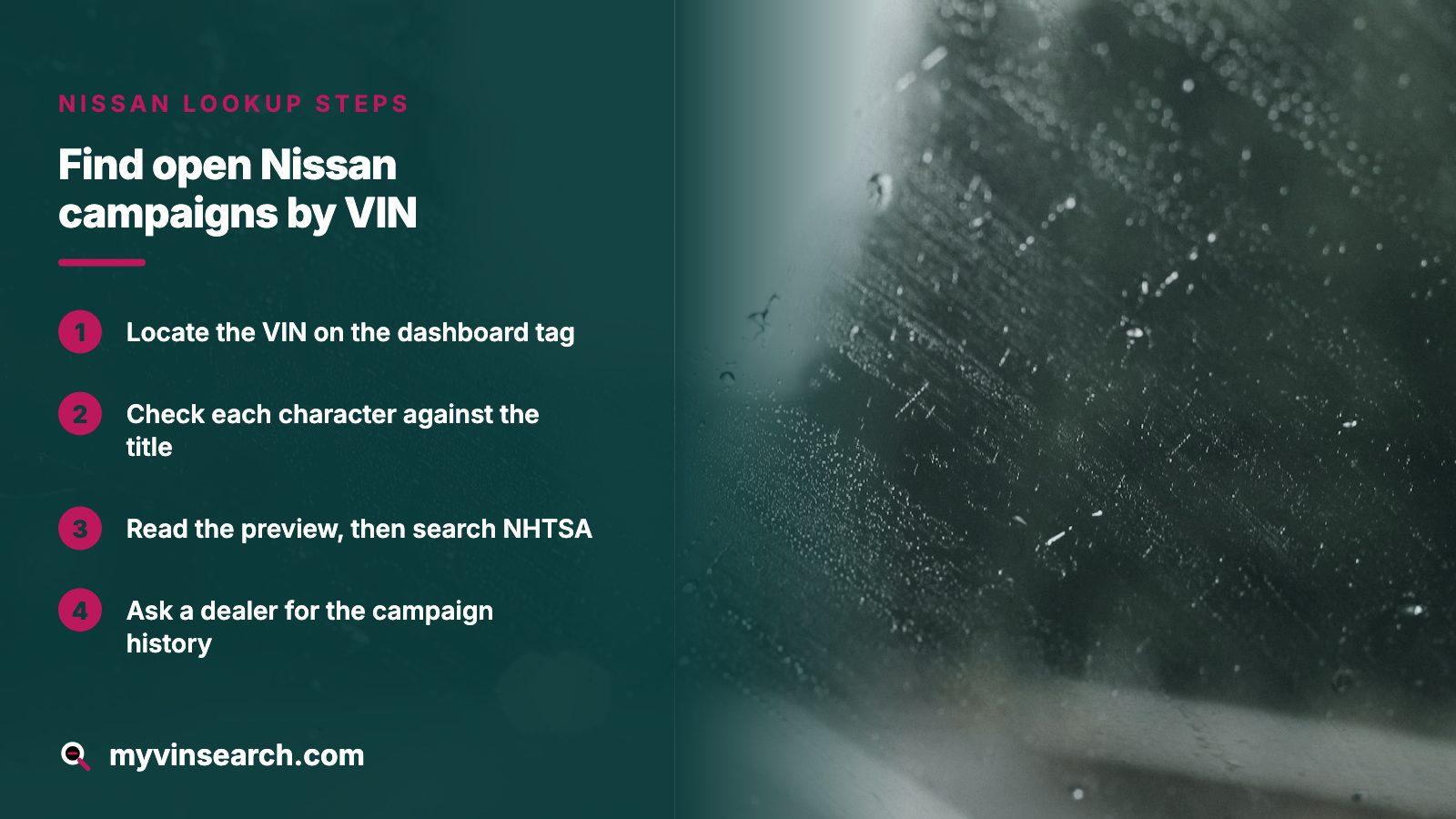
- Locate the VIN on the car: the dashboard-corner tag seen through the windshield, or the sticker on the driver's door pillar.
- Check each character against the title and the ad, because one wrong character pulls up a different car.
- Enter it on MyVINSearch for the free preview; the full report is one payment.
- Search the same VIN on NHTSA's recall page, which costs nothing, and compare answers. It also takes a year, make and model while you are still shopping.
- Decode the VIN with NHTSA's vPIC to confirm the engine.
- Ask a Nissan dealer for that VIN's campaign history, which covers work the federal record never held.
Campaign 25V437: engine bearings and the fire risk
Nissan's filing reached NHTSA on June 27, 2025. The defect on record is engine bearings that may carry manufacturing flaws, which can end in engine failure.
Two consequences turned this from a warranty dispute into a safety matter. Losing power without warning in traffic raises crash risk, and a failed bearing can breach the block and discharge hot oil, raising fire risk. An engine that merely quits is a repair bill between owner and maker; one that throws hot oil is a hazard, which is why this sits in the recall system at all.
What the dealer does, and what it costs you
Per the federal remedy record, the dealer reprograms the engine control module, reads the car for diagnostic trouble codes and takes it on a test drive, all at no charge to the owner.
Software cannot repair a flawed bearing. Nissan's teardown analysis pointed to high oil temperature under some operating conditions, which degrades lubrication, and the new programming targets that trigger. Metal debris in the oil pan means a bearing is already breaking up, and then the engine is replaced where required.
Nissan's internal codes for the repair are R25A8, R25A9, R25B1 and R25B2, worth quoting when you phone. Owner letters went out on April 8, 2026, so on a car that changed hands recently the VIN lookup is the surer route.
The transmission worry a recall lookup will not show
Shoppers often search a Nissan for CVT trouble, find no recall and decide the tool is broken. It is working as built: no federal safety campaign ever targeted CVT durability for the model years most tied to those complaints. Nissan answered with longer warranty terms and, separately, class action settlements, and NHTSA records neither.
Run an Altima from those years through NHTSA's year, make and model search and read the component column: no transmission durability campaign appears.
A quiet result answers one question only
A clean recall result says the maker owes no free safety repair today. It says nothing about how the transmission was treated or whether extra coverage was ever applied.
Reading the result and the red flags
| What you see | What it means | What to do |
|---|---|---|
| 25V437 shown open | Covered engine, repair not done | Get the reprogramming done before purchase, or write it into the deal |
| No open campaign | Nothing unrepaired on file today | Check again just before paying; new filings keep arriving |
| Engine differs from the ad | The VIN describes another engine than the seller states | Settle this first, because coverage depends on it |
| Clean result, rough transmission | The CVT sits outside the recall record | Ask the dealer for campaign history and coverage applied |
From an NHTSA owner complaint
In October 2025 a 2019 Altima owner told NHTSA the car was listed under R25B1, part of 25V-437, with the status "remedy not yet available". Nissan's consumer line and local dealers said no repair or parts could be had. By the owner's account, the state DMV refused to register the car while the recall stood open.
An open campaign alone rarely means walking away, since the repair costs the buyer nothing. But the repair must exist today, so ask the dealer whether parts and procedure are available and settle the status before signing.
Who pays for a Nissan recall repair, and what to ask
Under a genuine safety recall the manufacturer covers parts and labor, and the entitlement follows the car to its current owner, so a private sale does not weaken it. The cutoff compares the date the car was first sold with the date the defect was determined: fewer than 15 years apart, and the repair is free.
From an NHTSA owner complaint
A 2020 Altima owner with the 2.0L turbo wrote to NHTSA in October 2026 after the car would not start one morning, at about 147,540 miles. A mechanic and a Nissan dealer both found bearing debris in the oil pan, and the dealer first treated it as a recall engine replacement. Per the owner, Nissan then declined, blamed lost compression and asked for close to ten thousand dollars.
One owner's side of a dispute is not a ruling, but it shows why a buyer should get the dealer's written finding on the oil pan before paying. Questions to put to a dealer, VIN in hand:
- Which safety campaigns are open on this VIN, and has the 25V437 reprogramming been done?
- Which engine does the car carry, as opposed to the one the ad names?
- Was any warranty extension or service campaign applied, and when?
What a recall result leaves out, and what a report adds
A recall lookup says whether the maker currently owes the car a safety repair, and nothing more. Everything else about the car's past sits in other records.
Start with the free preview for the VIN, then decide on the report. Pay once for one car, or take a bundle of three, five or ten reports when several Nissans are on your list. Nothing renews, and the pricing page lists the amounts. On a Nissan, read these parts first:
- Odometer readings, since mileage matters most when the transmission's history is invisible
- Collision and damage records, plus any title brand
- The report's own recall status, to set against NHTSA's answer
Where this information comes from
- NHTSA: Recalls lookup — The federal VIN search for open safety campaigns, including 25V437.
- NHTSA: Part 573 Safety Recall Report 25V437 — Nissan's filed description of the defect and the remedy.
- NHTSA: vPIC VIN decoder — Confirms which engine a Nissan or Infiniti VIN describes before you match campaigns.
- NHTSA owner complaint 11673079 — owner experience, paraphrased
- NHTSA owner complaint 11695531 — owner experience, paraphrased
- NHTSA owner complaint 11772284 — owner experience, paraphrased
Sources and photos: Facts checked against the sources above in November 2026. Photos by Victor Hughes, Cole Keister and Mustafa Sheikhmouss on Unsplash; diagrams by MyVINSearch.
Keep reading
- Sample reportSee what the full report holds beyond recalls before you buy.
- PricingHow single reports and packs are priced, with no subscription.
- Toyota recalls by VIN: find the model line, then the campaigns still open on itThe same recall check run on a Toyota.
- Honda recall check by VIN: open recalls for your exact modelThe make-and-model recall check for a Honda.
Frequently asked questions
How do I run a Nissan recall check by VIN?
Take the 17-character VIN off the car, enter it on MyVINSearch for the preview, and compare the result with NHTSA's recall lookup. Both list campaigns still open on that car. A Nissan dealer can add completed campaign history, which an open-recall lookup does not show.
Which Nissans does the VC-Turbo engine recall cover?
Campaign 25V437 names Rogue cars from 2021 to 2024, Altimas from 2019 to 2020, and Infiniti QX50 (2019 to 2022) and QX55 (2022) models, 443,899 vehicles in all, each with a VC-Turbo engine. The VIN and engine settle whether a given car is affected.
Was the Nissan CVT ever part of a recall?
Not for durability, on the model years most linked to the complaints. Nissan answered with longer warranty terms and class action settlements, and NHTSA records neither, so a lookup can return nothing about the transmission.
Does an open recall make a used Nissan a bad buy?
Not by itself, because the dealer repair costs the owner nothing. Find out whether the repair is done, whether parts are available, and what the rest of the record shows. With 25V437 open, get the car to a dealer soon after purchase, given the fire risk.
Do Infiniti models show up in a Nissan recall check?
Only through the VIN. Recalls are filed per brand, so a search on the Nissan name skips Infiniti entries, while a VIN returns everything attached to the car. The QX50 and QX55 share 25V437 with the Rogue and Altima because the engine family is shared.
Now check the car itself
The guide explains what to look for. The report shows what this VIN has on record.