
THE SHORT ANSWER
The chassis number on a US-market Toyota is its VIN, and entering all 17 characters in a make-and-model VIN search gives you a free preview. A Japanese import is identified differently, by a frame number that pairs a model code with a serial after a hyphen. No VIN tool decodes it, and NHTSA's decoder returns errors. Check the length and look for a hyphen before anything else.
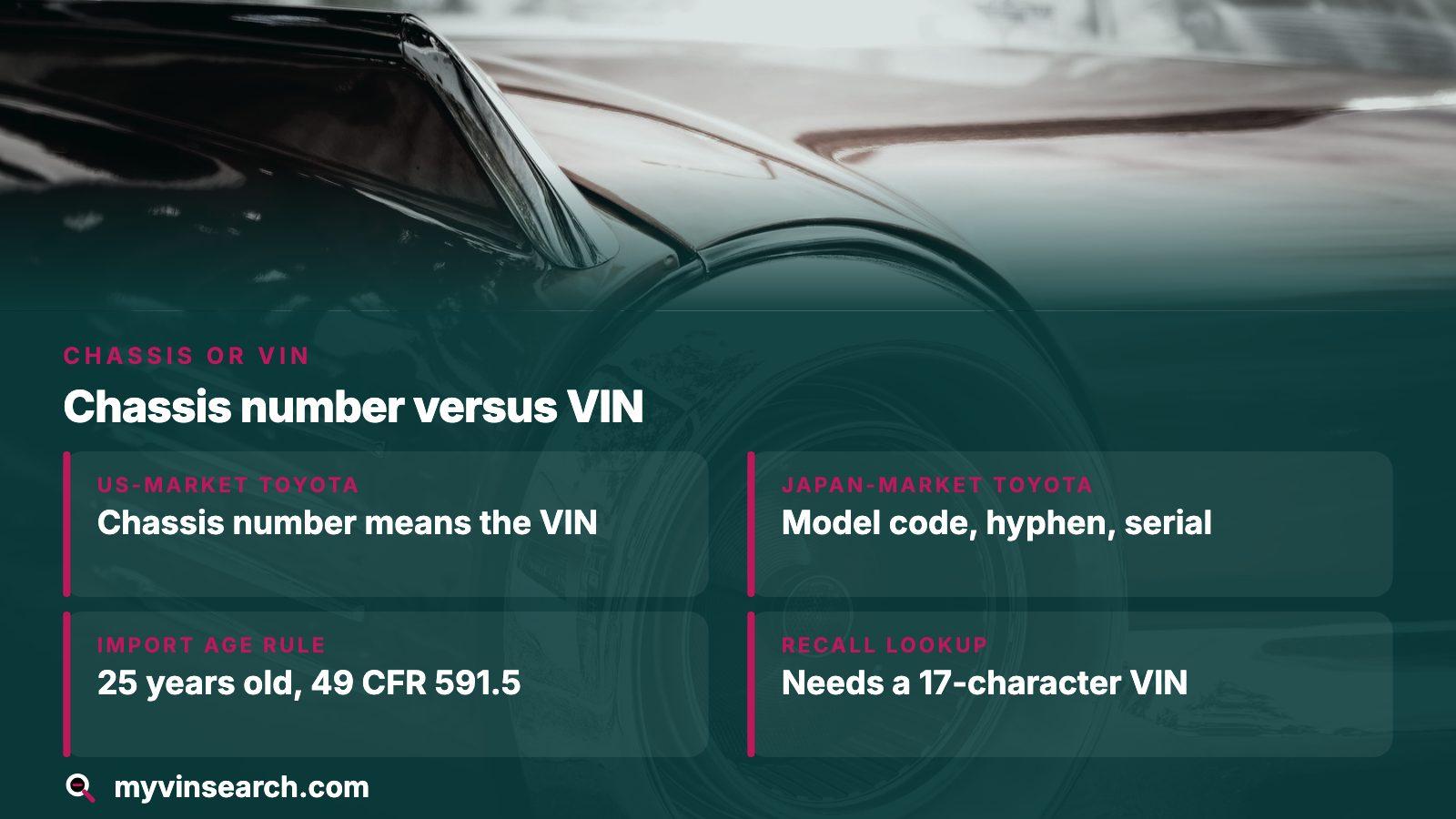
- US-market Toyota
- Chassis number means the 17-character VIN
- Japanese-market Toyota
- Model code, hyphen, serial: not a VIN
- Import age rule
- 25 years old, 49 CFR 591.5(i)(1)
- Recall lookup
- Needs a 17-character VIN
Start with where the Toyota was sold new
A search by make and model works only on numbers built to the federal pattern, so the sales market comes first. Ask the seller, or read the paperwork, and place the car in one of three groups.
| Where the car was first sold | What chassis number means there | Next move |
|---|---|---|
| The United States | The VIN, said loosely | Search the VIN on the Toyota page |
| A country that uses 17-character VINs | The VIN, as a local habit | Check the characters, then search it the same way |
| Japan, for domestic buyers | A frame number in a different format | Skip the decoders and work from the import and auction papers |
A seller who cannot say which group the car belongs to has told you something. Ask for a photo of the stamped number and a copy of the registration.
What a Toyota VIN tells a model search, position by position
When the number is a real VIN, a search by make and model reads the positions that say what the car is. Checking them against the listing takes about a minute.
- Characters 1 to 3 identify the manufacturer.
- Characters 4 to 8 describe the model, body and engine.
- Character 9 is the check digit.
- Character 10 gives the model year, and character 11 the plant that assembled the car.
- Characters 12 to 17 are the serial.
Compare the model and year the decoder returns with the ones in the advertisement. A mismatch means a typo in the number or a car that is not what the ad claims, and both deserve an answer before you spend money.
Why a Japanese frame number fails every VIN tool
Federal rule 49 CFR Part 565 defines the VIN: 17 characters, a set meaning for each position, no I, O or Q, and a check digit in position 9 that catches typing slips. It governs cars built for American sale. A Toyota made for Japanese buyers follows its home market's format instead, a model code and a serial joined by a hyphen, usually shorter than 17 characters.
No check digit, no safety net
Misread one character of a frame number and the result still looks valid, so nobody downstream can tell. Photograph the stamping and copy from the photo instead of typing it by hand.
Chassis code, chassis number, chassis: pick the right one for the job
Enthusiasts use chassis code for a platform and engine pairing. Thousands of cars share one, which makes it excellent for sorting parts and forum threads and useless for identifying a single car. Add a serial after the code and you have the chassis number. Regulators use the word for the metal structure. Toyota draws this question more than other makes because owners meet chassis codes constantly, and because Japan built many Toyotas that were never sold to Americans.
- Parts counter: the chassis code.
- Title, insurance and identity: the full number, serial included.
- Recall lookups and history reports: a 17-character VIN.
A code without a serial
An ad that lists a short code and no serial gives you a model name, nothing more. Request the whole number, in a photo of the stamping, before you discuss price.
What NHTSA's decoder returns for these numbers
The agency's vPIC decoder costs nothing, and it gives two errors for Japanese-format strings, whether a full frame number or only the model code. Error 6 flags an incomplete VIN. Error 7 says the maker has not registered the vehicle with NHTSA for the US market. Together they report that the input is not a VIN and the car never entered the federal system, which is accurate, so read the output as an answer rather than a fault. Error 7 reflects registration status, not legality, and a lawfully imported Toyota gets it too.
The 25-year provision behind the imports
Importers lean on 49 CFR 591.5(i)(1) when the car is at least 25 years old, because such a car may enter without meeting the federal safety standards. The line advances every year, so another model year of Japanese-market Toyotas becomes eligible each time. Part 565 itself expects non-conforming numbers, because cars imported under 591.5(f) by someone other than the manufacturer or its subsidiary sit outside several of its sections.
The age rule settles one agency's question. Customs, the EPA and your state each apply their own rules, so clearing one tells you nothing about the others.
Four places to look for the number
- Windshield base, driver's side. A US-market car shows its VIN here from outside, and 17 readable characters end the search.
- Door jamb label. The certification sticker prints the VIN with tire and weight data, and a Japanese-market car lacks the US version.
- Body structure. Every car carries a stamped number. Japanese-market Toyotas often hide it in the engine compartment or behind interior trim, and that stamping outranks any document.
- Import file. The export certificate, auction sheet, customs entry and translations record an imported car's identity.
Compare the stamping against each document one character at a time before you trust either.

When the number is a VIN, run the check
Put the 17 characters in the search box here and read the free preview. If the Toyota is still a contender, buy the report once, with no subscription behind it. The pricing page explains how a single report and the packs work. The report pulls these records:
- Title brands, plus salvage and auction history with photos
- Accident and damage records
- Odometer readings over time
- Liens, impounds and theft
- Insurance records and open recalls
- Ownership, use type, market value and factory specs
NHTSA's own recall lookup and decoder cost nothing and take a VIN, so run those as well.
If it is a frame number, buy on paperwork and inspection
No US recall check or history report works without a 17-character VIN, and neither reaches back to the car's years abroad. Any US record starts at import and titling. Build your confidence another way:
- Get the export certificate and auction sheet. They carry mileage and often a graded condition note.
- Hire an independent inspector, the one check that examines the car itself.
- Ask your state, ideally in writing, whether it will title the car before money changes hands.
- Phone an insurer. Online quotes expect a 17-character VIN, and specialist insurers handle imports more comfortably.
- Keep the file complete for the next buyer.
Where this information comes from
- eCFR: 49 CFR Part 565, VIN requirements — Backs the 17-character format, the check digit and the carve-out for vehicles imported under 591.5(f).
- eCFR: 49 CFR 591.5, importation of nonconforming vehicles — Paragraph (i)(1) is the age provision behind the 25-year import rule.
- NHTSA: vPIC VIN decoder — The public decoder that returns error 6 and error 7 for Japanese-format frame numbers.
- NHTSA: check for open recalls by VIN — The recall lookup takes a 17-character VIN, which a frame number cannot supply.
Sources and photos: Facts checked against the sources above in November 2026. Photos by Scott Graham, Justin Cron and Warren Griffiths on Unsplash; diagrams by MyVINSearch.
Keep reading
- Toyota recalls by VIN: find the model line, then the campaigns still open on itThe next step once you hold a 17-character Toyota VIN: open campaigns by model and year.
- Yamaha VIN lookup: find the right number, then check the machineAnother make where the number on the machine is not always a VIN.
- Sample reportSee what a finished report looks like before you pay for one.
- PricingHow the one-time payment works, for a single report or a pack.
Frequently asked questions
Does chassis number mean VIN on a Toyota?
For a car first sold in the United States, yes: both phrases point to one 17-character number. For a car built for Japanese buyers, no. Its chassis number pairs a brief model code with a serial. Check the length and look for a hyphen, and you will know which one is in your hand.
Why does my Toyota chassis number show as an invalid VIN?
Either it is a Japanese frame number, which VIN tools cannot read, or it is a real VIN with one wrong character. If you count 17 characters and no hyphen, return to the car and read the stamping again. A VIN has a check digit, so a single bad character makes the whole number fail.
Can I check Toyota recalls with a chassis number?
Only when the chassis number is a 17-character VIN. NHTSA's lookup is keyed to the VIN, so a frame number returns nothing. Campaigns issued in Japan went to owners recorded there, and nothing forwards them to an exported car. For those cars, lean on service records and a physical inspection.
Which number do I use to order Toyota parts?
Start with the chassis code, the short designation for the platform and engine pairing, because parts catalogs are organized that way. Keep the full number handy for anything about identity, such as title, insurance or a history report. Most of the confusion comes from using one of these where the other belongs.
Will my state title a Japanese-market Toyota?
Titling imports is routine for states, but the steps differ from a domestic car's and vary from state to state. Plan on producing the import paperwork and an inspection that matches the number on the body to the documents. Contact your state's titling office before you buy, not after.
Now check the car itself
The guide explains what to look for. The report shows what this VIN has on record.