THE SHORT ANSWER
Read the 17 characters off the Toyota itself, run them through the MyVINSearch preview, and compare the answer with NHTSA's lookup. What comes back is every safety campaign not yet repaired on that particular vehicle, matched to its model and build. An open item is repaired at no cost to the owner at any Toyota dealer, and the dealer can also show campaigns already closed on that VIN.
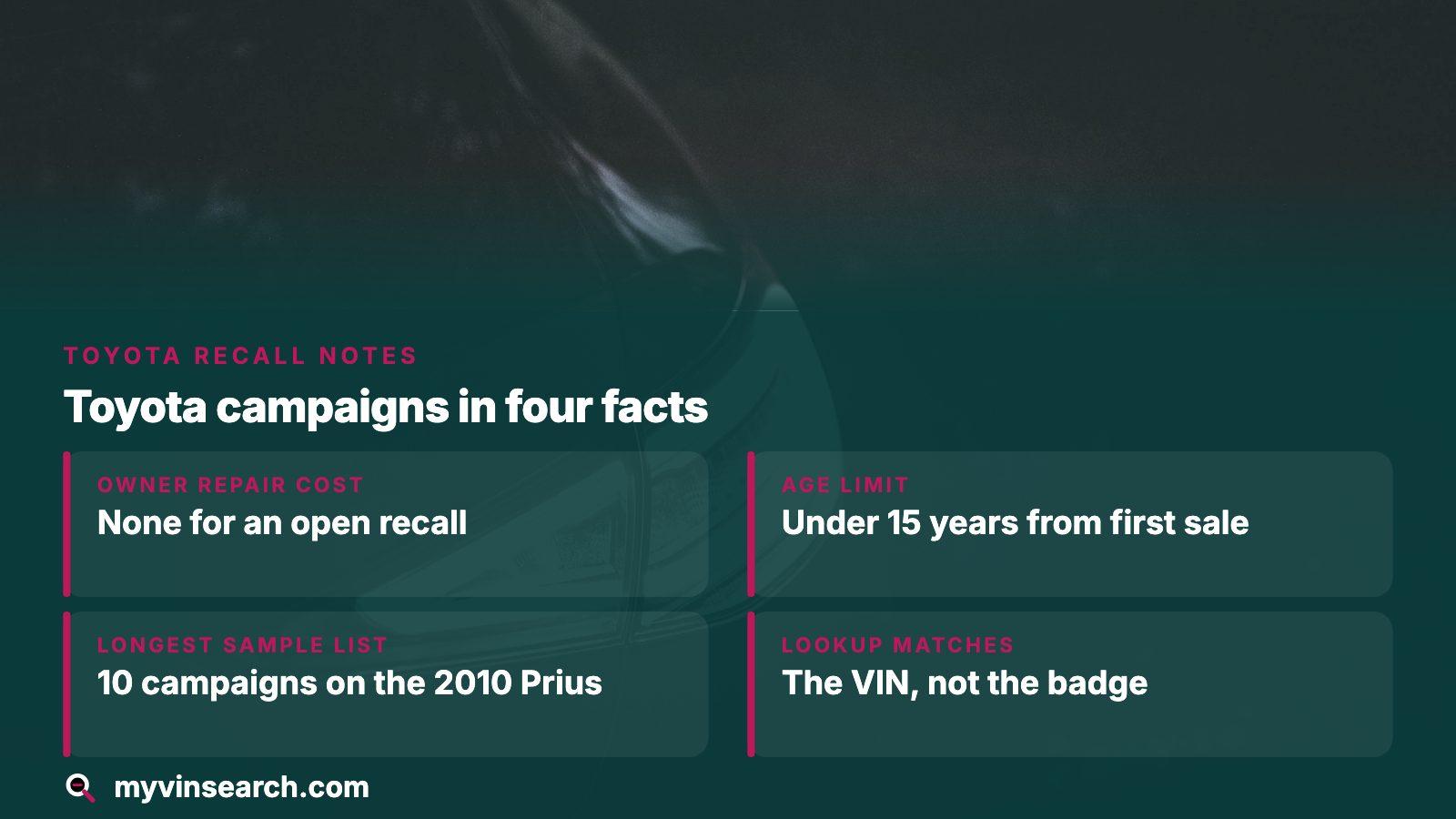
- Repair cost to the owner
- None for an open safety recall
- Age limit on the remedy
- Under 15 years from first sale to the defect finding
- Longest sample list
- 10 campaigns on the 2010 Prius
- What the lookup matches
- The VIN, not the badge
Toyota's model lines carry very different recall lists
One badge covers a sedan, a hybrid hatchback, a minivan, a crossover and a pickup, and a campaign rarely reaches all of them. That is why a search sorted by make and model works: line and year decide which notices can apply. The counts come from NHTSA's list for one sample year per line, read when this page was written, and they only grow.
| Toyota sample | Campaigns on NHTSA's list | What the list leans toward |
|---|---|---|
| 2010 Prius | 10 | Hybrid inverter, brake booster pump, curtain air bag inflator, seat heater wiring |
| 2018 Camry | 8 | Fuel pump, brake vacuum pump, V6 fuel pipes, pistons in the four-cylinder |
| 2016 Sienna | 5 | Sliding door wiring, front belt adjusters, brake lines on wheelchair conversions |
| 2016 Tacoma | 4 | Crank position sensor, rear differential leak, knee air bag bolts, a hood scoop |
| 2016 Highlander | 3 | Brake fluid sensor wiring, a load label, aftermarket windshields |
| 2017 Corolla | 3 | Air bag control unit, spare tire pressure, a load label |
Check who filed each entry, too. Several came from a distributor, an accessory installer or a van converter, so a bare count says little.
Same year, same model, different VIN
A notice names a build range, usually by production dates or serial numbers, not every truck wearing the same name. Two owners of one model can search and get opposite answers, which is the reason this check runs on the VIN.
From an NHTSA owner complaint
A 2016 Tacoma owner's truck stalled after a stop while off-roading. An online search turned up a recall for crank position sensor failure, but the VIN lookup said the truck was not in it, and the owner wrote "I don't have that recall" even though the year and model matched. The owner added that a stall on the road could have caused a crash.
The point for a buyer: a recall you read about online is a lead, not a verdict. If a notice fits the symptom but your VIN comes back clear, tell the dealer in writing and report the problem to NHTSA yourself.
Running the Toyota check in six steps
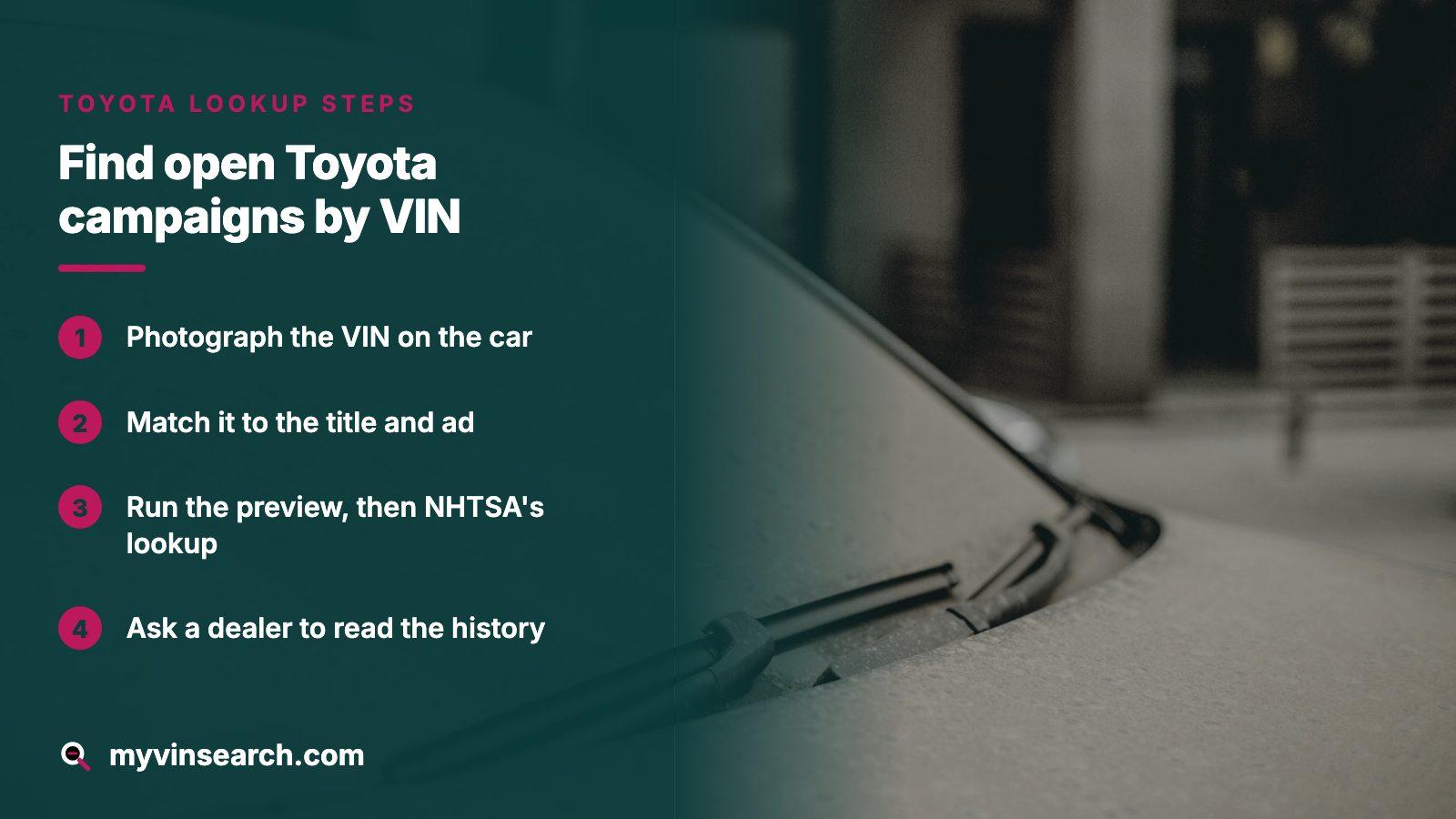
- Photograph the VIN on the car: the dashboard plate where it meets the windshield, or the label on the driver's door pillar. A phone picture beats a squint through glass.
- Match it to the title and the ad. Every one of the 17 characters has to line up, and the model should too.
- Run it on MyVINSearch. The preview is at no charge; a full report is bought separately, once.
- Put the same VIN into NHTSA's recall lookup, the federal record for every maker.
- Open Toyota's owner site for customer support programs, which are not safety recalls.
- Ask a Toyota dealer to read the campaign history on the VIN, earlier owners' repairs included.
Campaigns for Lexus and Scion are filed under their own marque names, so a search on the word Toyota can miss some. The VIN returns whatever is attached to that car.
Red flags and ordinary findings in a Toyota result
- An open campaign is common on a used car and rarely a sign of a dishonest seller. Letters follow the owner on record, and owners move.
- A model that differs from the ad is a real red flag. Settle which car the VIN describes before anything else.
- A seller who says the work was done should produce the dealer's paperwork, because an open list cannot prove a repair.
- Your model named in a notice but your VIN absent means the car sits outside the build range today. Search again later, since lists can widen.
An open campaign is a chore that comes with the car, so raise it before money changes hands.
When a Toyota recall is open and the part is not
Notices sometimes go out before the remedy is stocked, leaving the owner with a letter and a car that cannot yet be repaired.
From an NHTSA owner complaint
A 2014 RAV4 owner received notice of a battery-related campaign, but the dealer said parts were "not yet available". Later, on a right turn at about 20 mph, the SUV lost power with no warning light and was towed to a dealer. The mileage was roughly 170,000, and the owner did not blame the campaign for the stall.
That campaign was filed in 2023 against a model year 2014, so an older Toyota can still pick up a new notice. If yours is open with no part on the shelf, try these.
- Ask the dealer to put the VIN on the waiting list for the part.
- Read the notice for driving or parking advice and follow it to the letter.
- Run the VIN again every few weeks instead of waiting for a second letter.
- Report any failure to NHTSA, even when a recall already exists.
Safety recalls, support programs and the letter that went elsewhere
Toyota runs customer support programs and warranty enhancements beside its safety recalls. They can carry real value, but they are not safety campaigns, so NHTSA's list never shows them. Toyota's owner site is where they turn up.
From an NHTSA owner complaint
A 2014 RAV4 owner asked for help under a Toyota paint program after the factory pearl finish peeled, and was refused because the report came shortly after coverage ended. The owner said the company never told them the program existed, and that two representatives blamed letters sent to the previous owner, though the owner had held the car for three years before they were mailed.
Mail reaches whoever Toyota had on file, not necessarily whoever has the keys now. A used buyer should look the VIN up directly and not wait for the post.
Older Toyotas, the pedal campaigns and the 15-year line
For a Toyota from around 2009, two filings stand out. Campaign 09V-388 covered 4,445,056 vehicles whose driver's floor mat, loose or wrongly fitted, could pin the accelerator. Campaign 10V-017 covered 2,230,661 vehicles whose accelerator mechanism could drag, stick down or spring back slowly. NASA engineers reviewed Toyota's throttle software for ten months alongside NHTSA and found no electronic fault able to open the throttle that far.
Whether either campaign is closed on a given car is a VIN question. The maker pays for parts and labor, and the duty travels with the vehicle to later owners. Age sets the limit: the duty generally holds only when the defect was determined within 15 years of the car's first retail sale. Both of these filings, from 2009 and 2010, sit within that window for the vehicles they name.
What a recall result leaves out, and what the full report costs
A clean recall result says Toyota owes no safety repair on that VIN today. It says nothing about crashes, title brands, rolled-back odometers, liens or theft, which sit in other records. A Toyota can show no open campaign and still have been written off by an insurer. The full report gathers those records.
Nothing is charged for the MyVINSearch preview. You pay once for a full report, and if a few Toyotas are on your shortlist, a 3, 5 or 10 report bundle spreads the cost. No subscription is involved. Amounts are on the pricing page.
Before you pay
Photograph the VIN, run the preview, ask a dealer about anything open, and search once more on payment day.
Where this information comes from
- NHTSA: Recalls lookup — The federal VIN search for unrepaired safety recalls, and the record behind the campaign counts used here.
- NHTSA: vPIC VIN decoder — A second reading of the model a Toyota VIN describes, useful before matching campaigns to it.
- US DOT: NHTSA-NASA study of unintended acceleration — The ten-month review of Toyota's throttle electronics and what it found.
- NHTSA owner complaint 11321537 — owner experience, paraphrased
- NHTSA owner complaint 11681310 — owner experience, paraphrased
- NHTSA owner complaint 11640949 — owner experience, paraphrased
Sources and photos: Facts checked against the sources above in November 2026. Photos by John Kakuk, JavyGo and Maurice Sahl on Unsplash; diagrams by MyVINSearch.
Keep reading
- Toyota chassis number: is it your VIN, and can you search it?What a Toyota chassis number is, and whether it is the VIN you just searched.
- Honda recall check by VIN: open recalls for your exact modelThe same make-and-model recall check for a common rival in compacts and crossovers.
- Sample reportSee what a full report holds beyond recalls before you buy.
- PricingHow single reports and packs are priced, with no subscription.
Frequently asked questions
What is the quickest way to check Toyota recalls by VIN?
Start with the 17-character VIN in the MyVINSearch preview, then repeat it in NHTSA's recall lookup. Each reads one specific vehicle. Add Toyota's owner site for support programs, and call a dealer when you want completed repairs confirmed.
Will a Lexus or Scion show up in a Toyota search?
Not reliably by name. Their campaigns are filed under their own marques, even though the same company handles them. A search by VIN returns whatever is attached to that vehicle, whichever badge it wears.
My Toyota is old. Is a recall repair still at no charge?
Generally yes, if fewer than 15 years passed between first retail sale and the defect finding. The clock stops at the finding, not at the repair date. Past it, a dealer may still do the work, but ask before booking.
Will an open recall stop my Toyota from passing inspection?
In most states it will not. Safety and emissions inspections usually leave open recalls out. Each state sets its own rule here, so ask your motor vehicle agency.
Can I see which recall repairs a Toyota has already had?
A dealer can, since service departments see the campaign history on a VIN, including work an earlier owner had done. An open-recall list shows only what is still owed, so ask for the paperwork when a seller says it was fixed.
Now check the car itself
The guide explains what to look for. The report shows what this VIN has on record.