THE SHORT ANSWER
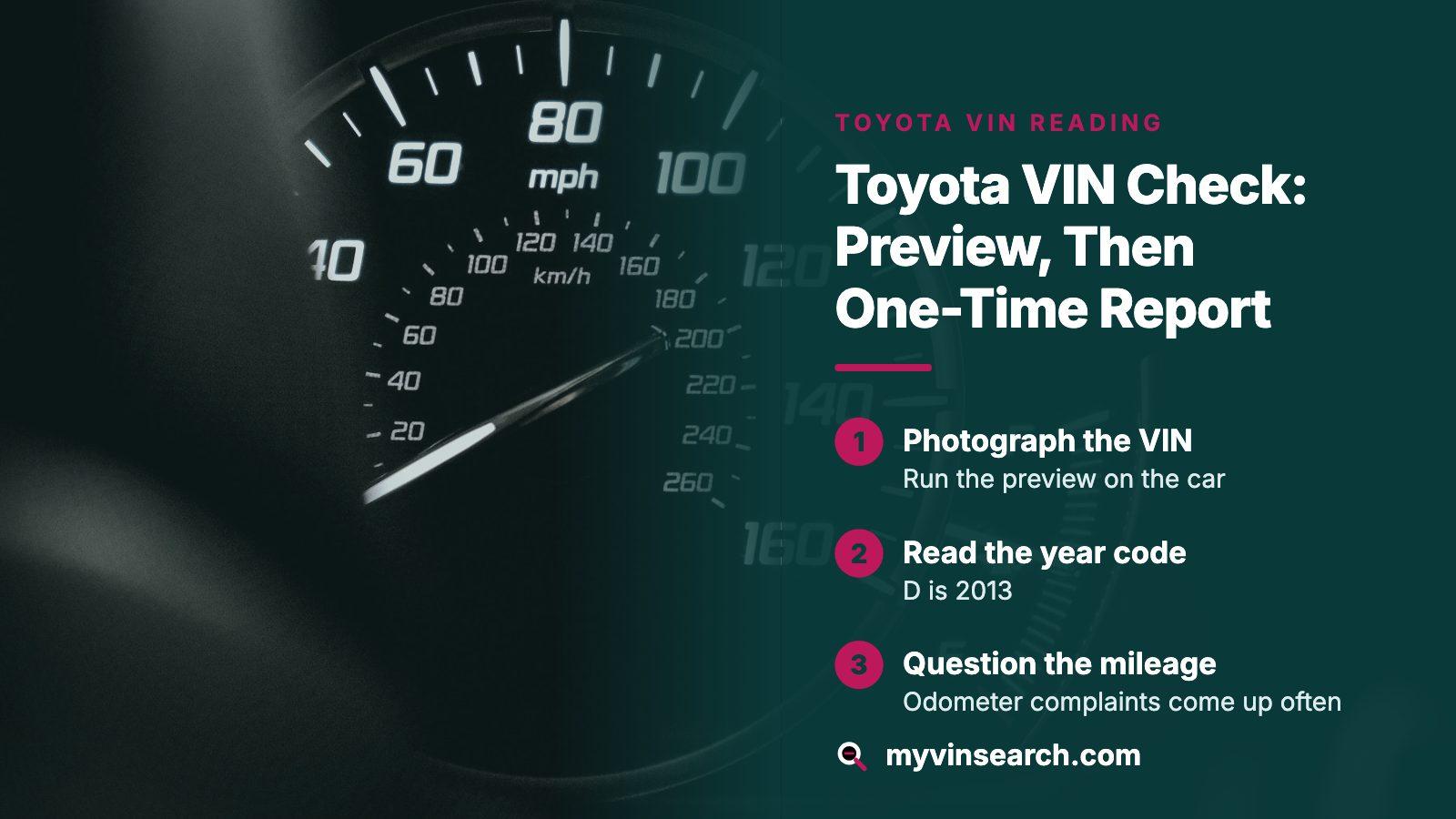
Photograph the VIN on the Toyota, run the preview, and buy the one-time report when the model and year it returns match the listing. The report brings together title, damage, mileage, salvage and recall entries for that number. Read mileage first, because owners keep filing odometer-fraud complaints about used Toyotas. Previews are free; each report is one charge, with current prices posted on the pricing page.
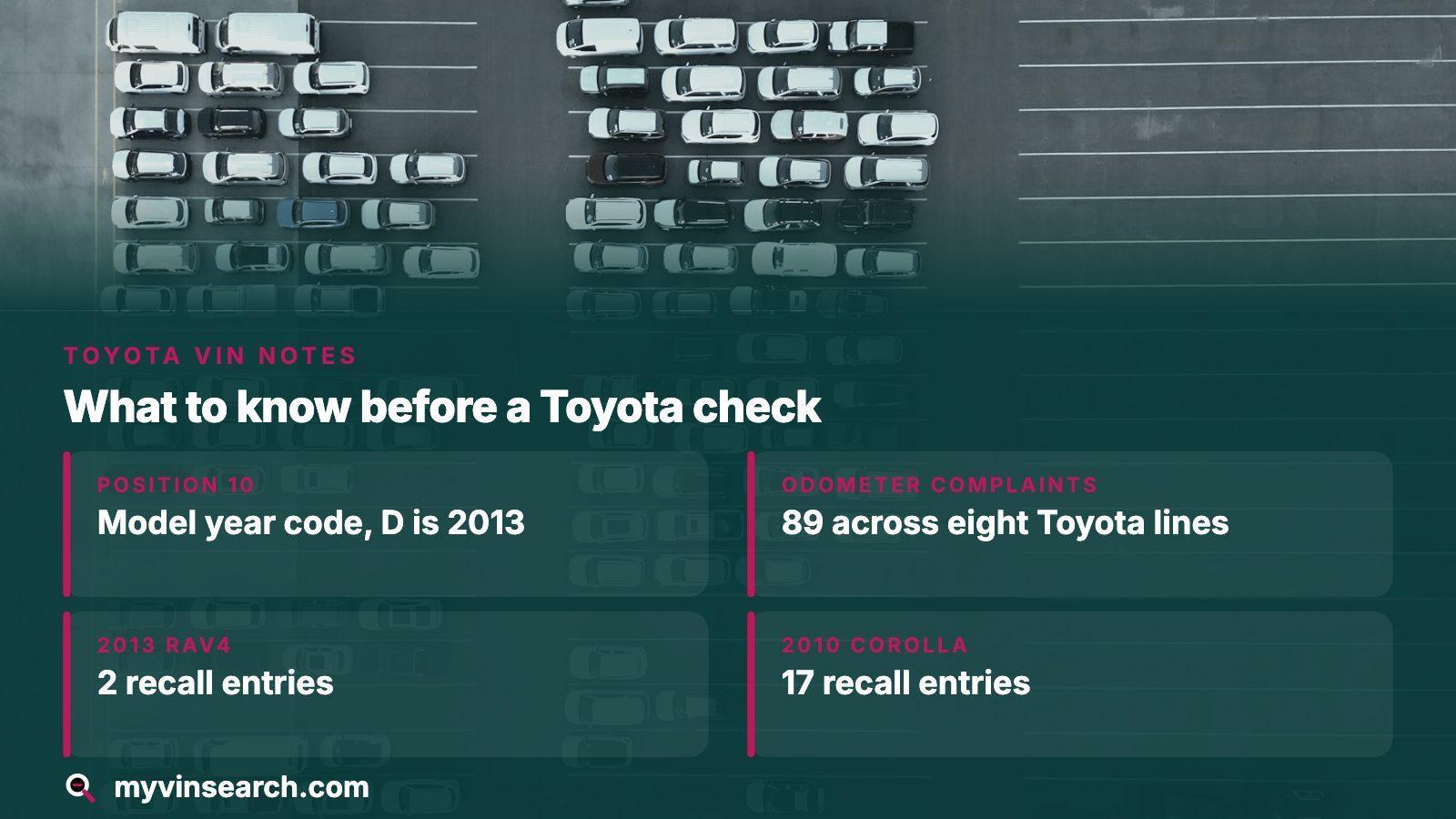
- Position 10 of the VIN
- Model year code, such as D for 2013
- Odometer-fraud complaints, eight Toyota lines
- 89 in NHTSA's files
- Recall entries by model year
- 2 for a 2013 RAV4, 17 for a 2010 Corolla
- Preview
- Free; the report is one payment
What a Toyota VIN check turns up before you pay
The badge says what a Toyota was built to do; the VIN record says what has happened to this one. Five kinds of entry matter most.
- Mileage: every odometer reading on file, so a figure that falls stands out.
- Title brands (salvage, junk, flood) and the insurer total-loss entries behind them.
- Damage and salvage sales, with auction photos.
- Liens, impounds, theft and insurance entries.
- Open recalls on the VIN, plus market value and factory specs.
A report reads records, not metal. The FTC wants a mechanic's inspection as well, so let the check come first and the inspection second.
Two 2013 RAV4s, two different VIN starts
Toyota VINs do not all start alike, even inside one model year. NHTSA prints the first 11 characters of the VIN in its owner complaints, and two filed for 2013 RAV4s differ. Part 565 of the federal rules assigns each position, and the table follows it.
| Position | What it records | First RAV4 | Second RAV4 |
|---|---|---|---|
| 1 to 3 | Maker and vehicle type | JTM | 2T3 |
| 4 to 8 | Vehicle descriptors | WFREV | BFREV |
| 9 | Check digit | 7 | 0 |
| 10 | Model year (D is 2013) | D | D |
| 11 | Assembly plant | 5 | W |
Same model and year, yet the opening characters, the fourth position and the plant character all differ. Other lines show it too: 2010 Corollas in complaints start 1NX, 2T1 or JTD, 2018 Tacomas 3TM or 5TF, and 2012 Camrys 4T1 or 4T4. A listing that says only 2013 RAV4 does not identify the car's record. The VIN does.
Run the check on the vehicle itself, in this order
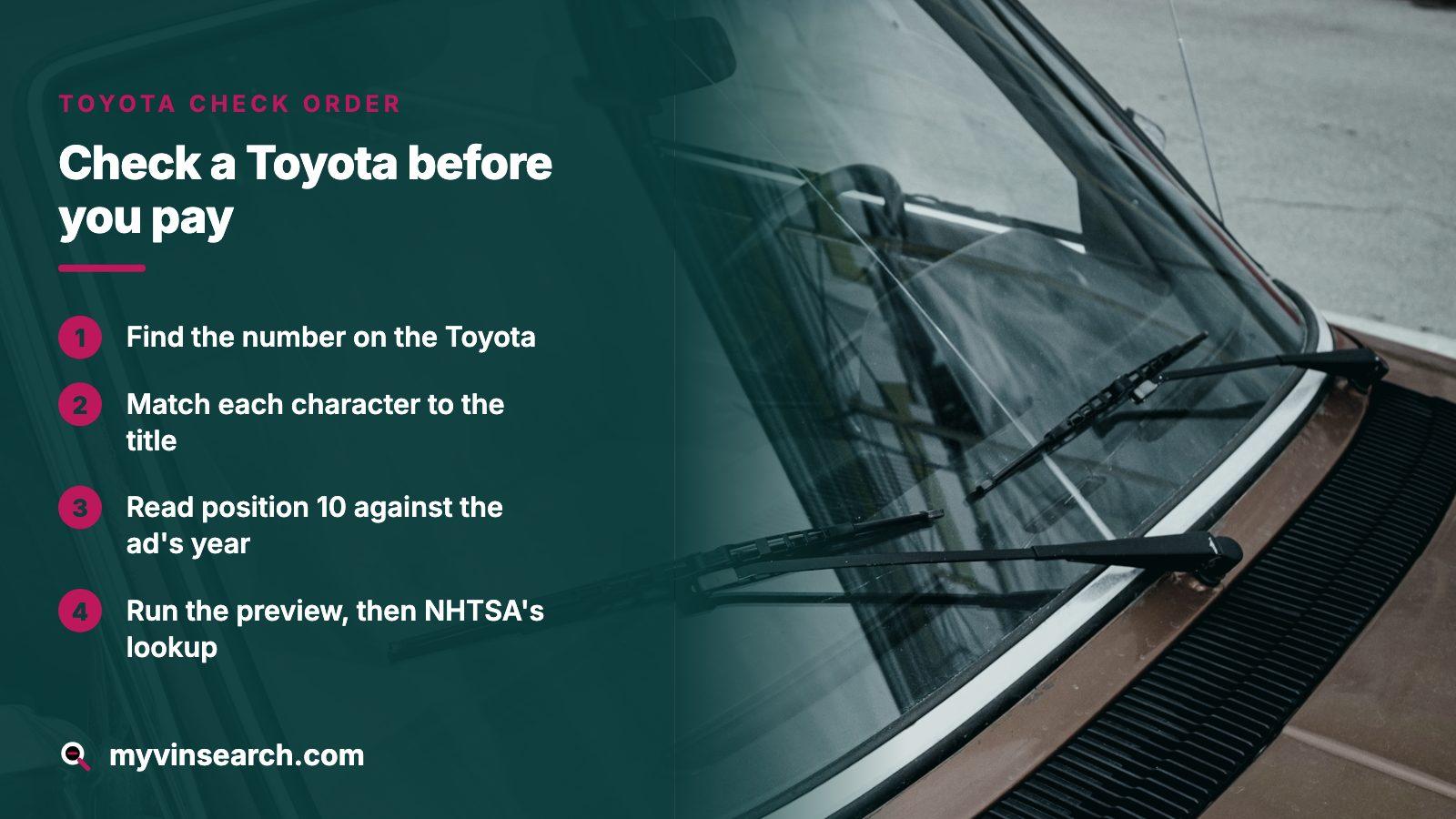
- Find the number on the Toyota, not in the ad. Under the rule it must be readable in daylight from outside the car, looking through the glass at the left windshield pillar. Photograph it.
- Match each character against the title and the listing. Should your copy contain an I, O or Q, it is wrong, since VINs leave those letters out to avoid confusion with 1 and 0; the check digit at position 9 catches other slips.
- Read position 10 against the year in the ad, provided position 7 is a letter: C is 2012, G is 2016, K is 2019, L is 2020.
- Run the preview. Model and year must agree with the listing, and if they do, buy the report and read mileage and title first.
- Put the number through NHTSA's recall lookup as well, then book a mechanic.
Mileage is where Toyota buyers report being misled
NHTSA's owner complaints for eight Toyota lines (Camry, Corolla, Highlander, RAV4, Sienna, Tacoma, Tundra and 4Runner), model years 2006 to 2025, include 89 that open with the words Odometer Fraud. All but one were filed in 2025 or 2026. Of the 89, 70 describe a private sale and 17 a dealer sale; 44 mention a history report and 45 a registration, state office or title. These are owners' accounts, not agency conclusions.
From an NHTSA owner complaint
A buyer's 2020 Camry, bought from a private seller on Facebook Marketplace, showed 63,129 miles at the sale. A history report read the next day put the odometer at 352,000.
That report ran after the money moved. Run the VIN before, while walking away costs nothing.
When the seller supplies the papers
A printout or title handed over by the seller proves only what the seller chose to show. Two more owners show what that can mean.
From an NHTSA owner complaint
One buyer of a 2014 Tundra says the private seller supplied a fake history report and a fake title, and the fake title was enough to register the truck. A genuine report exposed the gap, and the original seller confirmed it: 111,000 miles at purchase, 230,000 on record.
Order your own report from the VIN you read off the truck.
From an NHTSA owner complaint
A 2011 Sienna bought privately showed 102,694 miles, yet a history report later pointed to about 202,000. The buyer recalls being handed a different VIN at the sale, mileage that disagreed across the different titles, and a report filed with the state police.
The VIN on the van, on the title and in the listing must be the same 17 characters. If one differs, stop.
Recall lists run from 2 entries to 17, and the VIN sorts them
Counts are what NHTSA's recall data returned on November 3, 2026, one model year each; they rise as notices are filed.
| Model year | Entries | What fills the list |
|---|---|---|
| 2013 RAV4 | 2 | An accessory trailer light module; replacement 12-volt batteries that may not seat |
| 2015 Tundra | 5 | Accessory wheels, a tire placard, a load label, two for leaking steering gears |
| 2010 Corolla | 17 | Air bag inflators, pedals, a window switch, seat heater wiring, labels |
Four Corolla entries concern passenger air bag inflators. One of them, campaign 19V005000, sorts cars into zones by the states where each was sold or ever registered. In that notice Corollas sit in zone B for 2011 to 2013 and zone C for 2010 to 2013, never zone A. A 2010 Corolla thus appears only under zone C, so whether it is named depends on where it has been registered. The VIN lookup settles it, and a dealer repairs whatever is open.
Reading the result: what each finding means on a Toyota
| You see | It suggests | Next step |
|---|---|---|
| Model, year or plant differs from the ad | The VIN fits another vehicle, or the ad is wrong | Get an explanation in writing before price talk |
| Mileage drops between entries | A wound-back odometer, or a misread | Ask for service invoices; walk away if there are none |
| A salvage, junk or flood brand | A total loss was recorded | Ask for repair records; book an inspection |
| An open recall | A dealer repair is owed on this VIN | Have the dealer book it, or lower the price |
| No record at all | Nothing reported, which is not nothing happened | Inspect the car; ask the state for its title record |
A blank is weak evidence. The federal title database covers 87 percent of the vehicle population, and more than half the states contribute, which leaves the rest out. States also differ on what they brand, so a car an insurer treated as salvage may carry no brand. NICB's VINCheck, listed by the FTC, answers three narrower questions: flood damage, theft without recovery, and a salvage declaration.
What it costs and what to do once the report opens
Running the preview costs nothing and settles one question: does this VIN match the model and year in the ad. If two or more Toyotas made your list, buying reports in a group of three, five or ten lowers the cost of each. None of it renews; see the pricing page for amounts. After you open a report:
- Save it with the VIN and the date.
- Have a Toyota dealer book any open recall; the 2021 Tundra steering notice, for one, states there is no charge.
- Ask for invoices behind any mileage that looks too low for the year.
- Book the inspection before you sign, and rerun the recall lookup on the day you pay.
Where this information comes from
- 49 CFR Part 565: VIN requirements (eCFR) — The rule behind the 17 characters, the check digit, the year codes and where the number must be readable.
- NMVTIS consumer information (Bureau of Justice Assistance) — What the federal title database holds and where its gaps lie.
- FTC: Used cars — Advice to read a history report, check recalls and still have the car inspected.
- NHTSA recalls data: 2010 Toyota Corolla — The 17-entry list; the RAV4 and Tundra counts come from the same lookup with another model and year.
- NHTSA owner complaint 11747189 — owner experience, paraphrased; the same complaints data gives the tally and VIN starts above
- NHTSA owner complaint 11653887 — owner experience, paraphrased
- NHTSA owner complaint 11763081 — owner experience, paraphrased
Sources and photos: Facts checked against the sources above in November 2026. Photos by NATHAN MULLET, Max Tokarev and Iain on Unsplash; diagrams by MyVINSearch.
Keep reading
- Toyota recalls by VIN: find the model line, then the campaigns still open on itThe recall half of a Toyota check, followed model line by model line.
- Lexus VIN check: what the VIN shows for an ES, RX, IS, GX or NXSome Toyota notices list Lexus models too, so read this if the badge is Lexus.
- Sample reportOpen a finished report to see its layout before you buy one.
- PricingHow single reports and the 3, 5 and 10 packs are priced, with no subscription.
Frequently asked questions
Where is the VIN on a Toyota?
Look inside the cabin at the left windshield pillar: a car sold in the US must show the number there, readable from outside in daylight. The title and registration repeat it. Photograph the plate, then check each character against the papers before typing it anywhere.
Does a Toyota VIN check show recalls?
It lists the safety recalls still open on that VIN. NHTSA's own lookup is free and takes a VIN too. A recall list says nothing about how an earlier repair was done, so ask for the invoice behind any recall the seller calls finished.
Is the VIN preview really free?
Yes. The preview tells you which make, model and year the number belongs to. Everything deeper, from title brands to accident and mileage history, sits in the one-time report, bought separately. It is a one-off purchase; the pricing page has the figures.
Can a VIN check show an odometer rollback on a Toyota?
It lists the odometer readings on file, so a falling or stalled sequence can stand out. It cannot see a reading nobody recorded. Compare the dash figure with the latest entry, and treat a large gap as a reason to ask for invoices.
Is a clean Toyota VIN report enough to buy?
No. A history report covers only what was recorded, and the FTC still wants a mechanic to inspect the car. Gaps in state reporting mean an empty record is not a clean one. Rerun the recall lookup on the day you pay.
Now check the car itself
The guide explains what to look for. The report shows what this VIN has on record.