THE SHORT ANSWER
Enter the 17-character VIN, confirm the decoded model matches the car, and read the open safety recalls for that exact vehicle. Then run the VIN through Volkswagen's own search, which carries service and emissions campaigns the federal database never sees. Safety recall repairs cost the owner nothing, and the right passes to whoever buys the car next.
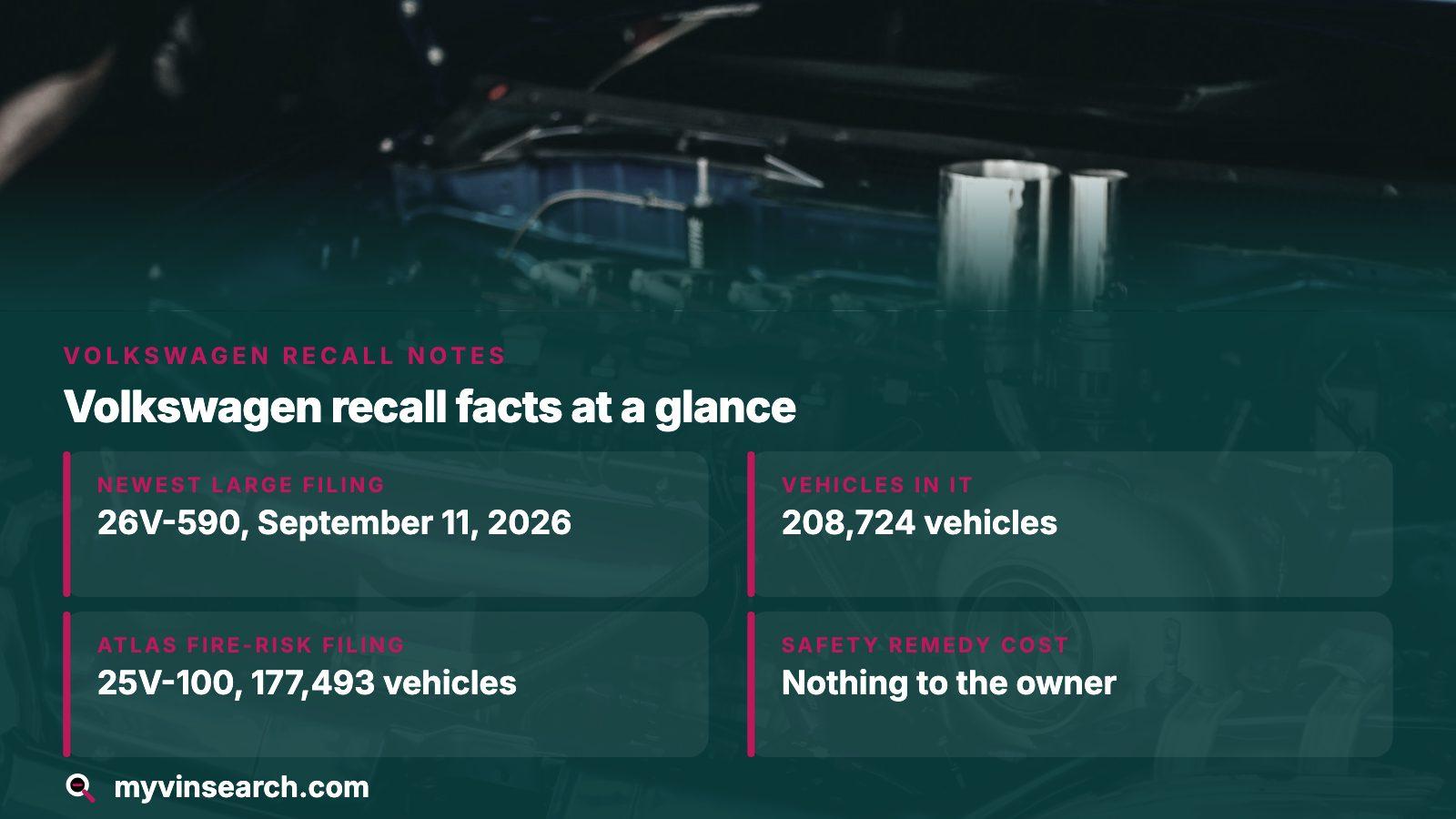
- Newest large filing
- 26V-590, September 11, 2026, 208,724 vehicles
- Atlas fire-risk filing
- 25V-100, 177,493 vehicles
- Lookups to run
- NHTSA first, then Volkswagen's own
- Safety remedy cost
- Nothing to the owner
Why the model line decides which recalls you see
Volkswagen recalls a Tiguan from one production window or an ID.4 from another, not the brand as a whole. Two cars on one lot can share nothing on paper. That is why MyVINSearch is built around make and model, and why the VIN leads: positions 4 to 8 name the model line, body and engine, and position 10 gives the year.
NHTSA's records show the spread. These counts come from its recall listings at the time of writing and shift as filings land.
| Model year | Recalls NHTSA lists | A campaign that stands out |
|---|---|---|
| 2018 Tiguan | 14 | 18V-324, a ball joint nut, with advice not to drive until repaired |
| 2019 Atlas | 12 | 18V-904, rear coil springs, plus the 2026 steering rack bolt |
| 2024 Atlas | 8 | 25V-100, an engine cover that can loosen and touch hot parts |
| 2022 ID.4 | 7 | Four camera or display filings, two on door handles |
| 2015 Jetta | 8 | 19V-679, a repurchase offer rather than a repair |
Running the check on a Volkswagen before you buy
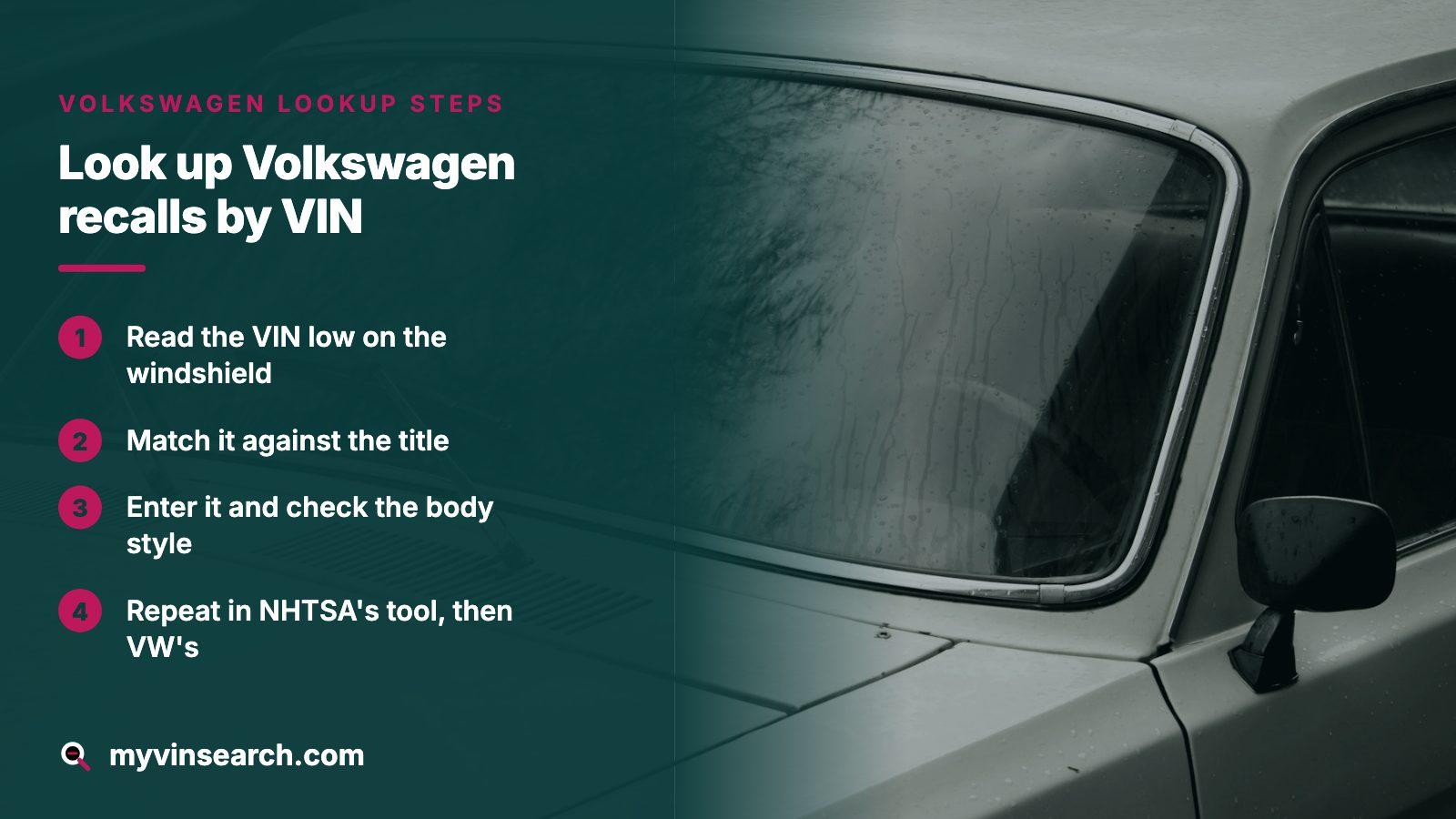
- Read the VIN from the car itself: it is visible low on the windshield, driver's side, and repeated on the door pillar.
- Match it against the title. One wrong character returns another car's record.
- Enter it on MyVINSearch. The free preview decodes the car, so model line and year are settled before you spend anything.
- Check the decoded body style, since some campaigns name the long-wheelbase Tiguan on its own.
- Repeat the VIN in NHTSA's recall tool, then in Volkswagen's search, which returns recalls and service campaigns from the last 15 years.
Why one clean lookup is not enough on a Volkswagen
NHTSA's tool carries safety recalls: defects that create an unreasonable risk, or failures to meet a federal safety standard, each filed as a Part 573 report. Volkswagen also runs emissions campaigns under manufacturer codes of their own. They are administered separately and never show in the federal tool, so a clean federal result means no open safety recall, not no open campaign.
| Lookup | What it carries | What it leaves out |
|---|---|---|
| NHTSA recalls | Safety recalls | Service and emissions campaigns |
| Volkswagen's search | Recalls and service campaigns, some emissions related | Notices older than 15 years |
| Both together | Manufacturer campaigns for the VIN | Collisions, title brands, odometer honesty |
Audi follows the pattern. The brands share platforms, so one filing often names both: 26V-590 covers the 2018 Tiguan, the 2018 to 2019 Atlas and the 2019 to 2021 Audi Q3, and 25V-120 pairs the ID.4 with the Q4 e-tron.
Three filings, read the way a buyer should
- 26V-590, filed September 11, 2026: a corroding bolt that holds the steering rack to the subframe can break, and the rack housing can then fail, costing the driver steering control. It lists 208,724 vehicles, and dealers replace the right-side bolt at no charge. VINs became searchable on September 16, 2026.
- 25V-100, filed February 17, 2025: on 177,493 Atlas and Atlas Cross Sport models, an engine cover refitted badly at a service visit can loosen and touch hot parts, a fire risk. The repair is to remove the cover.
- 18V-324, filed May 2018: the nut holding each front lower ball joint can work loose, so the joint may separate. The notice told owners not to drive until it was repaired.
One is a part that corrodes, one a service-visit error that touched only some cars, one a do-not-drive warning. A result reading only open hides those differences, so read the campaign text.
Reading the result, and when to push back
| What the result shows | What it means | What to do |
|---|---|---|
| Open, remedy ready | Unrepaired safety recall, parts available | Book the dealer repair and keep the repair order |
| Do-not-drive advice | The maker says the car should not be used yet | Repair it where it sits, or price the visit into the deal |
| Old repair, newer campaign | A later filing can widen an earlier one | Read the new text: 24V-651 says ID.4 doors fixed under 23V-312 or 23V-213 need the new remedy |
| No open recall | Nothing unrepaired on file today | Run it again when you pay; filings keep arriving |
From an NHTSA owner complaint
A 2019 Atlas owner filed in September 2026 after a clacking, wobbly steering rack turned out to be loose on the subframe. Aware of a recall for a corroding mounting bolt, the owner found it "not showing" against the car's VIN.
Whether that Atlas belongs in the campaign is for NHTSA and Volkswagen to decide. The buyer's takeaway is narrower: a lookup is only as current as the filing, and 26V-590 VINs became searchable only on September 16, 2026. Re-run before paying, and ask a dealer to check the VIN by hand.
A closed recall does not prove the fault is gone
A completed line shows the remedy was applied, not that the fix held. The ID.4 shows why: four of the seven filings on the 2022 model concern the rear camera or displays, and one, 23V-436, exists because a replacement infotainment unit installed in an earlier repair arrived with faulty software.
From an NHTSA owner complaint
An ID.4 owner reported that Volkswagen's display software recall, 919A, was done on April 28, 2025, and that in March 2026 the blackout-and-restart fault came back on the highway, with the speedometer panel inverting its colors during the reboot.
Ask for the repair order behind any closed campaign, and test an ID.4's screens and reversing camera yourself. If a fault returns, tell the dealer in writing and file with NHTSA.
Who pays, and how long the wait can run
An open safety recall is repaired without charge to the owner, and that entitlement belongs to the car, so a second or third owner holds the same claim as the first. Extra work a shop proposes during the visit is billed like any other job.
Parts and software lag the filing. Owner letters for 25V-100 went out March 7, 2025, under three weeks after filing; for 26V-590 they were expected November 10, 2026, about two months after. In campaign 22V-823, Volkswagen owners were told to wait for a letter until replacement cameras existed.
What the recall result leaves unsaid
Both lookups answer one question about manufacturer campaigns. Neither speaks to collisions, title brands or an odometer rolled back, and a Volkswagen with no open recalls can still be a rebuilt write-off. That story sits in title, insurance and auction records, which the full MyVINSearch report pulls together alongside open recalls. Salvage or auction photos, where they exist, show damage no recall lookup can. Treat the recall result as one line of a buying decision, not the verdict.
Cost, and the next move
The preview is free and shows the decoded car, so you can judge whether the wider history is worth buying for this particular Volkswagen. The full report is bought once per VIN, and shortlists are served by packs of 3, 5 or 10. Nothing renews. Amounts sit on the pricing page.
Before you pay
Match the VIN to the car, run the preview, check NHTSA and Volkswagen's search, and ask a dealer whether remedy parts are in stock for anything open. Check the VIN again at the moment you pay.
Where this information comes from
- NHTSA: Recalls lookup — The federal VIN search for open safety recalls and the scope it states for itself.
- Volkswagen: Recalls and service campaign lookup — The maker's own VIN search, which separates safety recalls from service campaigns, some of them emissions related.
- NHTSA: Recall 25V-100 report — The federal filing behind the Atlas engine cover campaign, a worked example of the Part 573 format.
- NHTSA: vPIC VIN decoder — A public decoder for confirming the model and year a VIN describes before matching campaigns.
- NHTSA recalls API: Volkswagen by model year — The public record the table counts were read from; swap in any model and year.
- NHTSA owner complaint 11765298 — owner experience, paraphrased
- NHTSA owner complaint 11738467 — owner experience, paraphrased
Sources and photos: Facts checked against the sources above in November 2026. Photos by Richard R, Tigran Shishmanyan and Willian Cittadin on Unsplash; diagrams by MyVINSearch.
Keep reading
- Sample reportSee the title, accident and odometer records that sit beside the recall result.
- PricingWhat one report or a pack costs, and why nothing renews.
- Tesla recall check by VIN: match the model line, then the softwareThe same make-and-model check for an electric make, with campaigns of its own.
- BMW recall check by VIN: match your model to open campaignsThe recall check for another German make, with its own large fire-risk campaign.
Frequently asked questions
Does a clean Volkswagen VIN result mean there are no open campaigns?
No. A clean federal result means no open safety recall. Emissions and service campaigns are tracked elsewhere, so run the same VIN through Volkswagen's search too, and ask a dealer to confirm the campaign history before you buy.
Is the Volkswagen recall check free?
NHTSA's lookup and Volkswagen's search cost nothing. On MyVINSearch the free preview decodes the car first, and the full report is one payment per VIN, with no subscription. Amounts are listed on the pricing page.
Do I need a separate recall check for an Audi?
No. The VIN carries the model, so the federal lookup treats an Audi like any other car, and Volkswagen and Audi often file together. Confirm the decoded model before you read any campaign list.
Why does my Volkswagen not show a recall that matches its symptoms?
Campaigns apply to VIN ranges, not whole model years, and a new filing can take days to become searchable. Re-run the VIN later, describe the symptoms to a dealer, and file your own NHTSA complaint if the fault is real.
Can a second owner get a Volkswagen recall repair done?
Yes. The remedy stays with the vehicle, so any owner can book it, whoever holds the title. Bring the VIN, ask whether parts or software are ready, and keep the repair order as proof the campaign is closed.
Now check the car itself
The guide explains what to look for. The report shows what this VIN has on record.