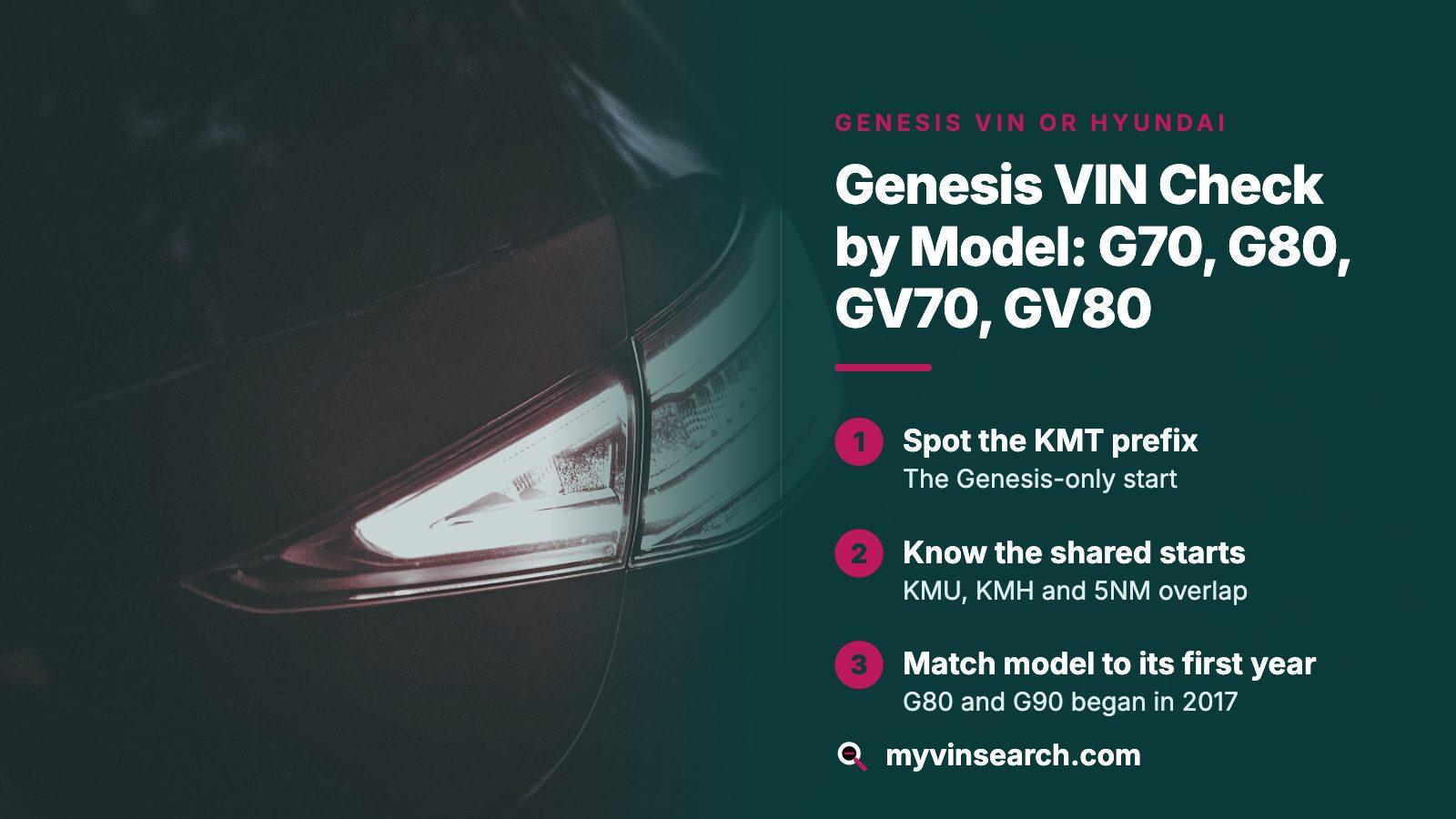
THE SHORT ANSWER
Copy the 17 characters from the Genesis and enter them for the free preview. If the model and year match the advert, buy one report for that car. It lists title, damage, mileage and recall entries for that exact VIN. Genesis files campaigns that span several models, so the badge alone cannot tell you whether a car is on a list.
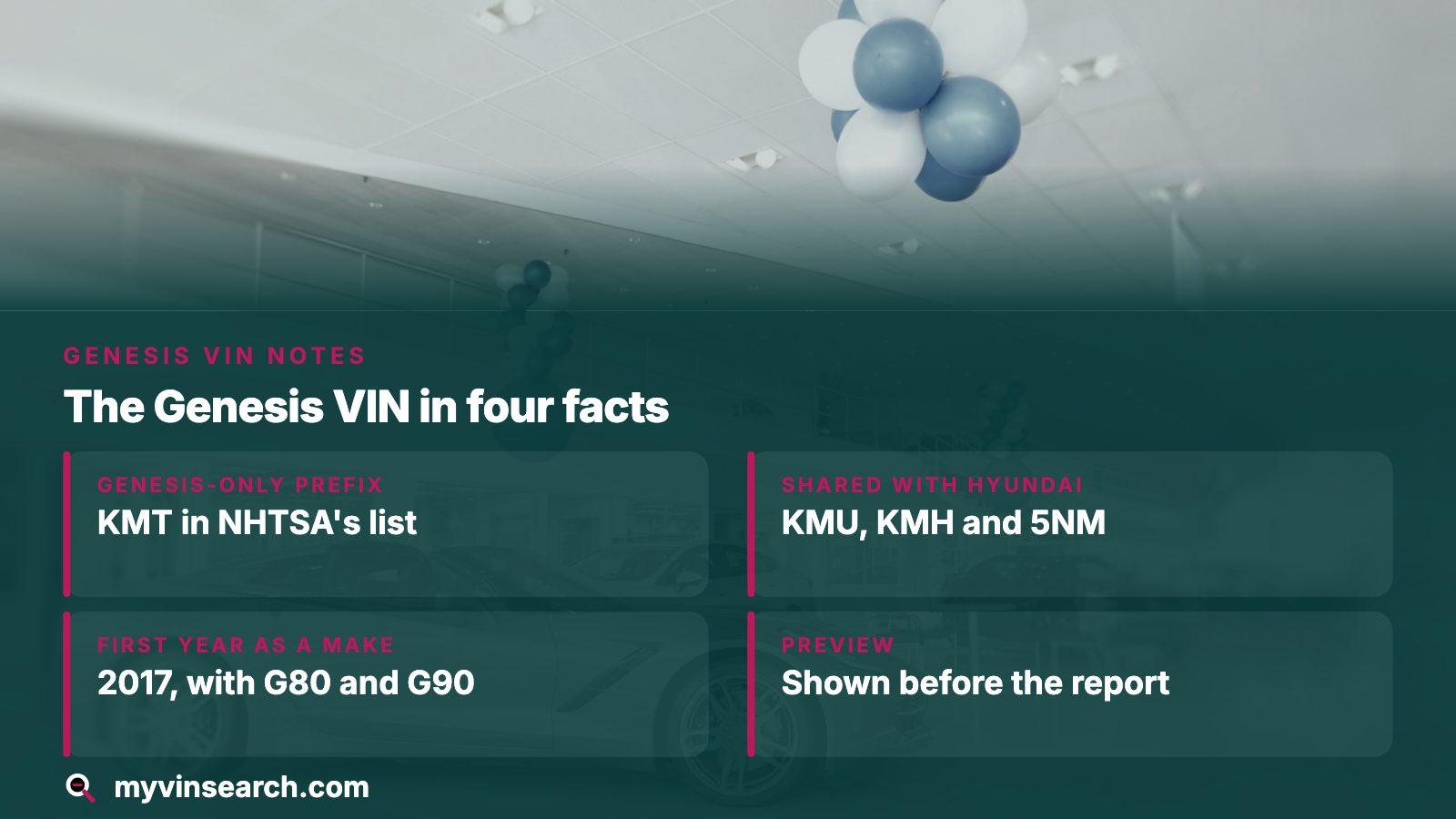
- Genesis-only prefix
- KMT in NHTSA's list
- Shared prefixes
- KMU, KMH and 5NM also appear under Hyundai
- First model year as its own make
- 2017, with G80 and G90
- Preview
- Free; the report is a single payment
What a Genesis VIN check shows for your car
Same badge, same year, and still two unrelated histories. The lookup is keyed to the number stamped on the car, so what comes back belongs to that vehicle alone.
- Salvage, flood or rebuilt brands and the state that applied each.
- Crash and damage entries, with sale photos if an insurer wrote the car off.
- Mileage recorded on different dates, which makes a rollback visible.
- Open recall campaigns for this VIN that no Genesis retailer has closed out.
- How many owners, what kind of use, and any lien, impound or theft record.
Which VINs are Genesis: prefixes the brand shares with Hyundai
Genesis is built by Hyundai Motor Company, and NHTSA's manufacturer list shows it. Only one of the four codes below belongs to Genesis alone, so a Hyundai-style start does not rule out a Genesis.
| Prefix | What NHTSA says it is |
|---|---|
| KMT | Sedans and coupes, Genesis alone |
| KMU | SUVs, filed for Hyundai, Genesis and HMC |
| KMH | Sedans and coupes, split between Hyundai and Genesis |
| 5NM | SUVs from Hyundai's Alabama plant company, either brand |
In one test, a number beginning 5NM decoded as a Hyundai Tucson. Always read the make and model the decoder returns before trusting the first three characters.
Genesis models and the year each one first appears
NHTSA's lists give each Genesis model a starting year. That matters when a seller's advert names a model the database cannot have for that year.
| Model | First model year listed |
|---|---|
| G80 and G90 | 2017 |
| G70 | 2019 |
| GV80 | 2021 |
| GV70 | 2022 |
| GV60 | 2023 |
Older cars sold as a Genesis sedan or coupe are filed under the Hyundai make, not under Genesis. If a listing calls a 2015 car a Genesis G80, treat the mismatch as a question for the seller before any money moves.
How to run a Genesis VIN check before you pay
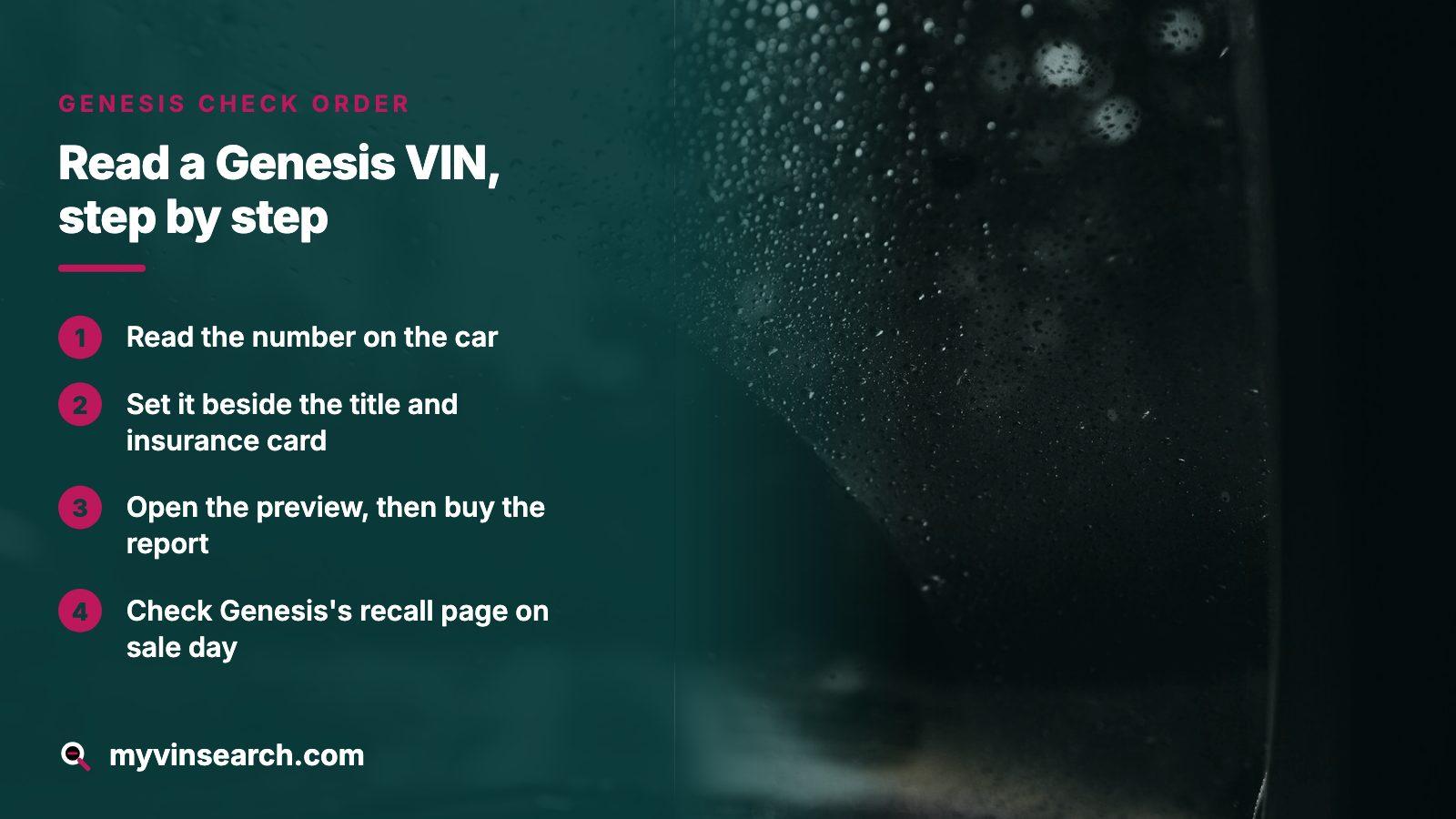
- Go to the car and read its number there. Dash corner under the glass or the label by the door latch on the driver's side are the usual spots.
- Compare it with the title and the insurance card one character at a time. One mismatch ends the deal until the seller explains it.
- Put the VIN into MyVINSearch and open the free preview. If it shows another model or year than the listing, you know early.
- When the preview fits, pay for that car's report and test it against the red flags below.
- The day you hand over money, query Genesis's own recall page with the same number too. Public lookups trail new filings by some time.
One campaign, several models: why the VIN decides
Genesis recalls follow a shared part, not a badge. The campaigns below each name more than one model, and NHTSA's own lookup returns a different count for each model year you type.
| Campaign | Models named | Fault |
|---|---|---|
| 24V191000 | G80, G90 and G70 with the 3.3-liter turbo V6 | Oil feed pipe may leak, fire risk |
| 24V107000 | G80, G90, G70 and the 2015-2016 Genesis | Water in the starter solenoid, fire risk |
| 23V630000 | G80, GV80 and GV70 | Fuel pump failure, loss of drive power |
| 26V229000 | GV70, G90, G80 and GV80 | Fuel leak at the pipe connection, fire risk |
A 2022 lookup returned two campaigns for the G70 and five for the GV70. Those counts shift as new filings arrive, which is why a result read last month is not enough.
From an NHTSA owner complaint
One owner of a 2018 G90 filed a complaint saying the car fell under recall 19V-538, but four attempts to book the repair went nowhere. The selling dealer had shut down, and the manufacturer's two phone contacts ended in promises.
Take from this that an open recall on the report is only half the job. Ask where the work can actually be done before you rely on the promise of a free repair.
What a decoder cannot tell you about a Genesis
NHTSA's decoder reports factory data as the maker filed it. For a 2019 G70 pattern it returned a 3.3-liter six-cylinder turbo engine and a Korean plant, but the trim came back as a list of five, from the 2.0T Elite to the 3.3T Design Edition.
So a decode narrows the car down without naming the exact trim, and it is silent on the car's life after it shipped from Korea. A decode also returns warnings when the ninth character fails its check or when the maker left some characters unspecified. Those warnings are your cue to recheck the number for a misread, not to ignore the result.
Reading the result: red flags on a used Genesis
- A salvage, rebuilt or flood brand on a model that still looks showroom-new.
- Mileage that falls between two readings, or a reading higher than the dash shows.
- An open campaign on a fire-risk fault, which can come with advice to park outdoors.
- A total-loss entry. The federal title database notes that an unrecovered stolen car can get that label and keep it even when later found undamaged.
A clean result is good news, with a limit. The Justice Department's NMVTIS page puts coverage at 87 percent of vehicles, and says over half the states report, so a search can come back without salvage history that exists. State title records also hold more than NMVTIS does, which is why you should ask the seller for the title itself.
Buying a used Genesis: what a stalling SUV teaches
From an NHTSA owner complaint
A used 2021 GV80 owner, who bought it at 15,500 miles, reported that power cut out before 100 miles had passed. Seven stalls followed in just over 1,000 miles, one while turning left at a busy junction. Dealer diagnostics were clean, and the owner said no recall applied then.
NHTSA's recall data shows a fuel pump campaign, 23V630000, covering 2021 and 2022 GV80 models, filed that same September. The complaint does not mention it, and nothing says the two are linked. The point for a buyer is timing: a campaign can land days after you sign. Run the VIN again on the day of purchase, and keep the service records, since intermittent faults often leave no code behind.
Paying once, then deciding on the Genesis
Nothing is charged for the preview, which shows whether the VIN fits the Genesis model and year. The full report is billed once for the one car, and nothing renews. For packs and their prices, check the pricing page before buying.
- Start with the preview and leave if the model, year or engine contradicts the advert.
- Pay for a report on the single car you mean to buy, then set its recall list beside the maker's.
- Get the seller's written explanation of any brand, mileage gap or open campaign.
- Book an independent shop inspection, since no database records a worn part.
Where this information comes from
- NHTSA vPIC: Genesis manufacturer identifiers — The KMT code and its Genesis-only make; the KMU, KMH and 5NM codes come from the same service.
- NHTSA vPIC: models for the Genesis make — Model names and the first model year each one appears in.
- NHTSA recalls data: Genesis GV80, model year 2021 — The fuel pump and fuel pipe campaigns; other campaigns and counts came from the same lookup for other models and years.
- Genesis USA: safety recalls and service campaigns — The maker's own VIN lookup and what it says about repairs at a retailer.
- NMVTIS consumer information — What federal title records hold, where they come from and why a clean result can miss history.
- NHTSA owner complaint 11299612 — owner experience, paraphrased
- NHTSA owner complaint 11544326 — owner experience, paraphrased
Sources and photos: Facts checked against the sources above in November 2026. Photos by Maurice Sahl, Justin Cron and Richard R on Unsplash; diagrams by MyVINSearch.
Keep reading
- Hyundai VIN check: match the VIN to your Hyundai's model and yearThe maker behind Genesis shares prefixes with it, so this page covers the other side.
- Hyundai recall check by VIN: open campaigns for your exact modelA recall-first look at the sister badge's campaigns.
- Sample reportLook through each section of a report before you pay for one.
- PricingHow single reports and larger packs are priced.
Frequently asked questions
Can I run a Genesis VIN check for free?
The preview is free: enter the VIN and see whether model and year match the car. The report is a separate one-time payment per car. For recalls alone, the maker and NHTSA both run VIN lookups you can use as a second opinion.
What does a Genesis VIN lookup return?
It returns the record linked to that number: title brands, damage, mileage readings, owner count and any open campaign. A plain decoder returns only factory details such as body, engine and plant, with no history at all.
Does a VIN starting with KMH mean the car is a Hyundai?
Not necessarily. NHTSA lists KMH, KMU and 5NM under both Hyundai and Genesis, so the first three characters cannot settle it. Read the make and model the decoder returns, and compare them with the badge and the title.
Why does my G80 show different recalls than my neighbor's?
Campaigns name model years, engines and build ranges, not just the badge. A turbo V6 car can be on the oil pipe list while a similar V8 car is not. Only the VIN lookup shows which campaigns apply to each car.
How do I check a Genesis I have not seen in person?
Request a sharp photo of the VIN plate and the title from the seller, then run the preview. Any mismatch in model, year or engine is reason enough to walk away. Even a good match calls for an independent inspection before money moves.
Now check the car itself
The guide explains what to look for. The report shows what this VIN has on record.