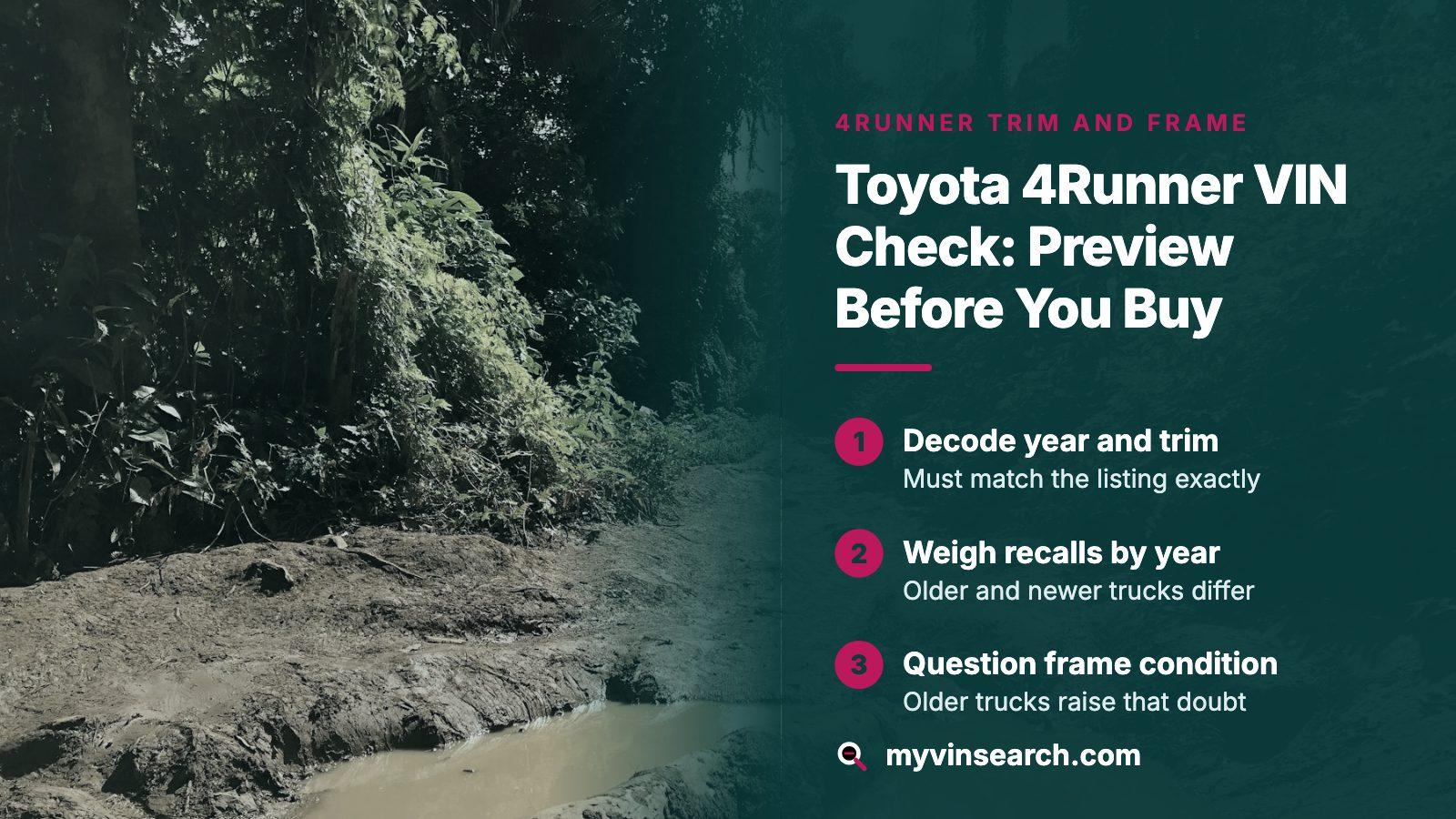
THE SHORT ANSWER
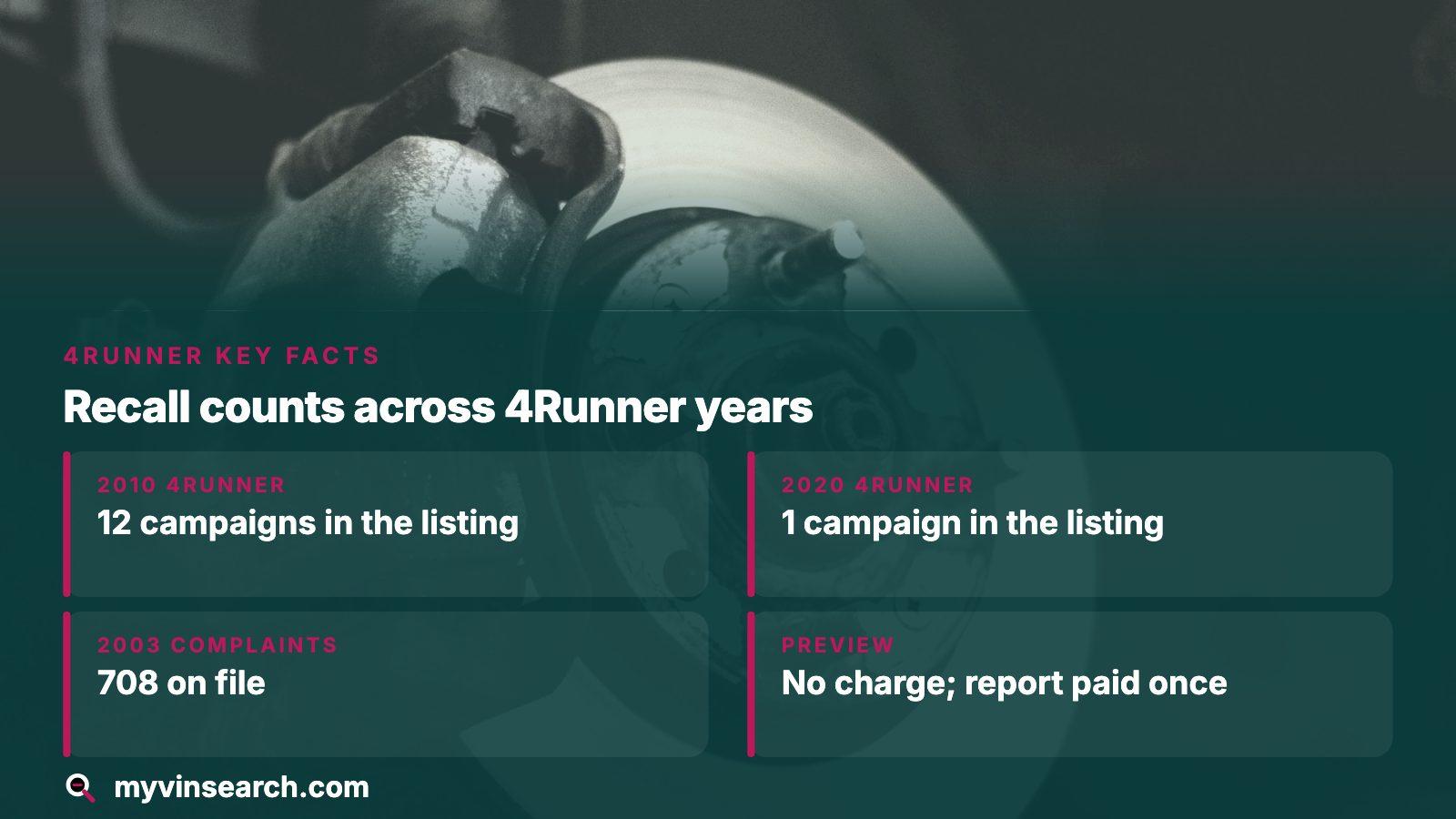
Read the VIN off the 4Runner, run the free preview to confirm it decodes to the year and trim in the ad, then buy the one-time report for title, salvage, mileage and open-recall records. Year changes the picture a lot. NHTSA lists 12 recall campaigns for a 2010 4Runner and 1 for a 2020. Costs are on the pricing page.
- Campaigns, 2010 4Runner
- 12 in NHTSA's listing
- Campaigns, 2020 4Runner
- 1 in NHTSA's listing
- Complaints, 2003 4Runner
- 708 on file
- Preview
- No charge; the full report is paid once
What a 4Runner check turns up
Most 4Runners are bought for towing, trails and winters, which means many have lived hard lives in more than one state. A history report cannot tell you what a skid plate looks like from underneath, but it can tell you what paperwork exists. The entries below do most of the work on a truck like this.
- Brands on the title (salvage, junk, flood) and any insurer total-loss entry.
- Odometer readings logged on different dates, which should climb and never step backward.
- Salvage auction sales, with photos when the truck went through one.
- Recalls still open on this exact VIN, which differs from the model-wide list.
Pair the report with a mechanic's inspection. The Justice Department's vehicle-history site advises both, plus a test drive on hills, highways and stop-and-go streets.
Before anything else: does the VIN decode to this truck?
Everything else on the page depends on the model year, so check it first. We fed NHTSA's vPIC decoder a partial number starting JTEBU5JR and ending L5. It named a 2020 Toyota 4Runner, an SUV with a 4 liter six-cylinder and four-wheel drive, assembled in Tahara, Aichi. Because the number was cut short, the decoder also returned an incomplete-VIN error, which is the response you want from a partial entry.
Run the number from the advert through the same step. If the advert names one year while the decode names another, or if the engine and drive type disagree with the seller's description, stop and ask why. A typo is the kindest explanation; a swapped part or a mismatched identity is less kind.
Recall campaigns by 4Runner model year
The counts below are taken from NHTSA's recalls and complaints data for the Toyota 4Runner. One campaign can cover several years, so rows overlap and a sum would double count.
| Year | Recall campaigns | NHTSA complaints |
|---|---|---|
| 2003 | 3 | 708 |
| 2005 | 5 | 425 |
| 2008 | 5 | 96 |
| 2010 | 12 | 147 |
| 2014 | 7 | 77 |
| 2016 | 8 | 81 |
| 2020 | 1 | 33 |
| 2022 | 3 | 39 |
Newer is not automatically clean. A 2025 4Runner already carries a campaign for an instrument panel software update delivered over the air. A high count is not a verdict either, since every campaign has a free dealer remedy. It does raise the odds that one of them was skipped.
The 2010 4Runner: twelve campaigns on paper
The 2010 is the most crowded entry in the table, and the reasons are specific. Four of its campaigns concern the front passenger air bag inflator: 16V340000, 18V024000, 19V005000 and 19V741000. In each, dealers swap the inflator or the whole air bag assembly at no charge. Air bags account for 92 of the 147 owner complaints filed against this year.
- 15V515000 and 16V577000: accessory exhaust tips fitted by a regional distributor or its dealers. The fix is a smaller tip set further back behind the bumper.
- 16V396000: dealer-installed seat heaters, which are disconnected and refunded.
- 13V014000: occupant-detection sensors that dealers test and recalibrate.
From an NHTSA owner complaint
One 2010 4Runner owner, who had purchased the truck used, wrote to NHTSA in 2017 that Toyota had said the replacement air bag part was about 2 weeks away before the purchase. Every call afterward brought the same answer, no loaner was offered, and passengers could not ride up front.
The lesson is practical: find out which campaigns are open on the VIN before you sign, and ask whether parts are in stock.
Older 4Runners and the frame question
The 2003 model year has 708 complaints in NHTSA's files, far above any later year in the table, and structure appears on 285 of them. Owners describe frames rusted through near the front, and one wrote that a mechanic could push a pen through it. Suspension turns up on 114. These are owner accounts, not findings by NHTSA, but they show where to point a flashlight.
A VIN report will not photograph the frame. What it can do is show where the truck spent its life: a title issued in a salt-belt state, or an earlier flood brand, tells you which inspection to insist on. Lift the truck on a hoist, tap along the frame rails and look at the brake lines before you talk price.
Reading the results and spotting a rolled-back odometer
The federal title database reports on five things: the state that holds the title along with the date of its latest change, any brand, the mileage, total-loss status and salvage status. Treat that as your checklist and read each line against the truck in front of you.
| Entry | What to do on a 4Runner |
|---|---|
| Salvage, junk or flood brand | Expect a lower price and demand a full inspection, frame included |
| Total loss with no repair record | Ask for repair paperwork before going further |
| Mileage lower than a previous entry | Leave, or have the seller explain it in writing |
| Campaign still open on the VIN | No charge at a dealer, but ask if the part is in stock |
| Clean title record | Encouraging, though it says nothing about wear |
From an NHTSA owner complaint
A person who investigated a 2003 4Runner told NHTSA in 2025 about a fraud ring touching roughly 15 trucks. Sellers advertising on Facebook Marketplace misted oil onto the motor so it smoked during the drive, pushed for a lower price, then wound back the odometer before reselling. One truck showed 150,000 miles when bought and 306,000 when it was sold on.
A private sale with no dealer paperwork is exactly where a mileage history earns its cost.
Running the check on your 4Runner
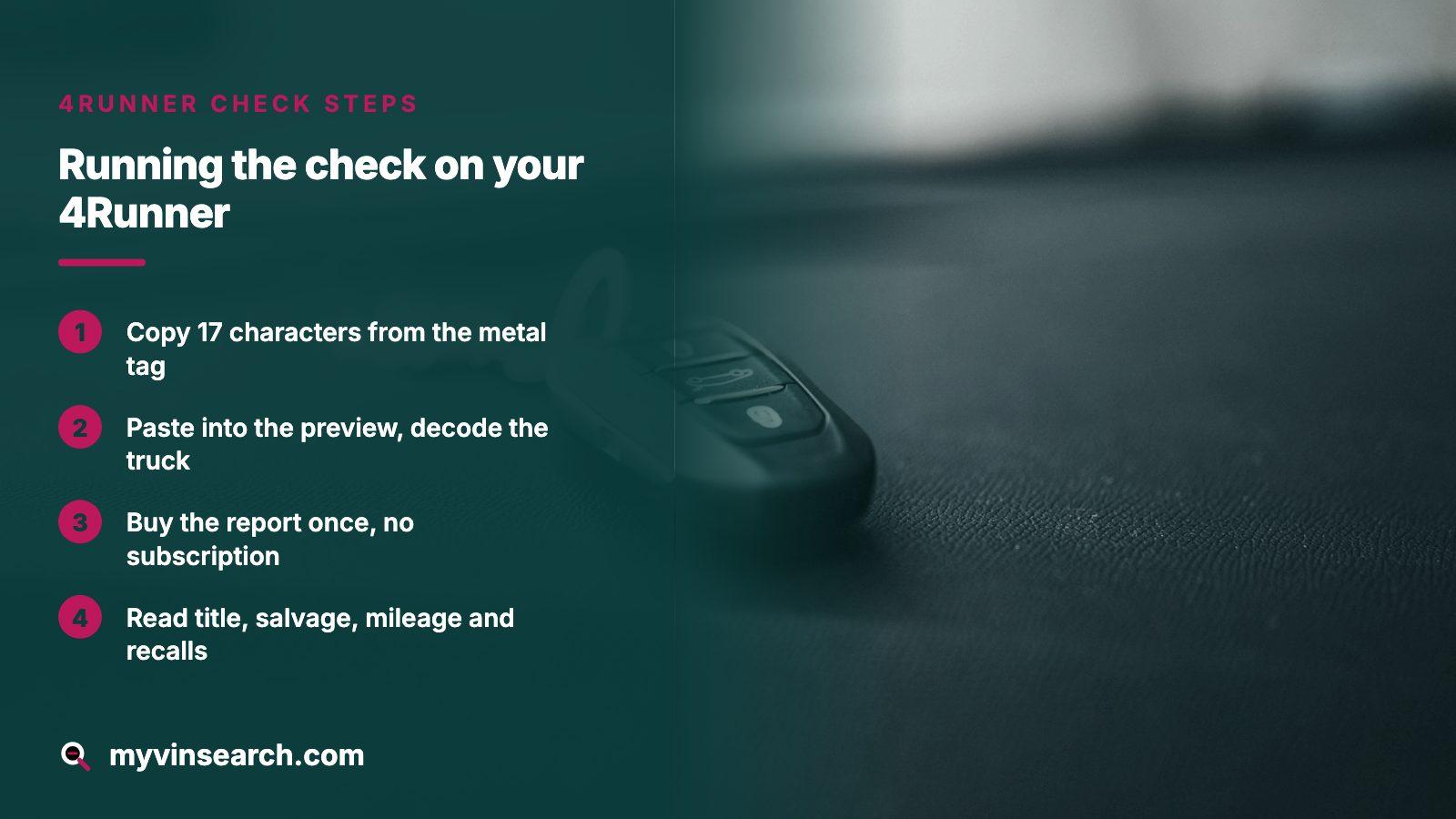
- Write down all 17 characters from the metal tag visible through the lower windshield, or the door-pillar sticker on the driver's side, then hold them up against the title.
- Paste the number into the preview. It is free and decodes the year, engine and drive type.
- Confirm those details match the listing and the truck itself.
- If they do, buy the report. You pay once, and no subscription follows.
- Read the title, salvage, mileage and recall sections, and take what you find to the inspection.
NHTSA offers its own recall search by VIN at no charge, and NICB keeps a free database that includes flood damage. Both are worth using. Neither shows odometer history.
Price and the next click
Previewing a 4Runner costs nothing. After the preview, the full report is paid for once, as one report or a bundle if you are looking at several trucks, and nothing renews afterward. Current amounts live on the pricing page, so none are repeated here.
For Toyota as a whole, the brand page shows how the same check applies to the rest of the lineup, and the sample report lets you read a completed one before paying. If you are weighing the 4Runner against a Tacoma, the Tacoma page covers that truck year by year.
Where this information comes from
- NHTSA recalls data for the 4Runner, 2010 — campaign numbers and free remedies listed for that year
- NHTSA vPIC decoder, partial VIN — the sample decode quoted in this page
- NHTSA owner complaint 11696425 — owner experience, paraphrased
- NHTSA owner complaint 11003785 — owner experience, paraphrased
- Vehiclehistory.gov: reading an NMVTIS report — what the five title-data indicators mean and why mileage matters
- Vehiclehistory.gov: used car buying tips — advice on inspections and test drives
Sources and photos: Facts checked against the sources above in November 2026. Photos by Frederick Rosa, Bence Balla-Schottner and Benjamin Brunner on Unsplash; diagrams by MyVINSearch.
Keep reading
- Toyota VIN check: match your Camry, RAV4 or Tundra to its own recordThe brand-level page, handy while you are still choosing a model.
- Toyota recalls by VIN: find the model line, then the campaigns still open on itLooking up open Toyota campaigns for a single VIN.
- Toyota Tacoma VIN check: read the truck's real history before you payThe pickup built on similar truck foundations.
- Sample reportA finished report, laid out before you spend anything.
Frequently asked questions
How do I run a Toyota 4Runner VIN check?
Take the VIN from the tag seen through the lower windshield or the door pillar, paste it in for the preview, and confirm the year and engine fit the ad. The purchased report adds brands, salvage, mileage and open recalls. Match the digits against the title as well.
Is a 4Runner VIN lookup only a recall check?
No. Recall lookups list safety campaigns and stop there. A history report brings in title, damage, salvage and mileage records. NHTSA's lookup costs nothing and should still be run, while the report speaks to the truck's paper trail.
Which 4Runner years have the most recalls?
NHTSA's data gives the 2010 the longest list at 12 campaigns, then the 2016 with 8 and the 2014 with 7. The 2020 has just 1. Because campaigns overlap between years, the VIN itself is the safer test than the year.
Can a VIN check expose a rolled-back odometer?
It lists readings captured at title changes and similar events, and a later number below an earlier one is the tell. Mileage that was never recorded stays invisible, so also check pedal rubber, seat bolsters and steering wheel wear.
What does the 4Runner VIN check cost?
Nothing for the preview. You pay once for the full report, either a single one or a pack, and it never renews. Today's amounts are on the pricing page. Preview first, so the year and trim are confirmed before any money moves.
Now check the car itself
The guide explains what to look for. The report shows what this VIN has on record.