THE SHORT ANSWER
Start with the Santa Fe's VIN in the MyVINSearch box, then compare year, engine and build country in the free preview with the ad. One payment gets the whole report, with title, damage, mileage and recall records. NHTSA's free recall page makes a useful second opinion on open campaigns.
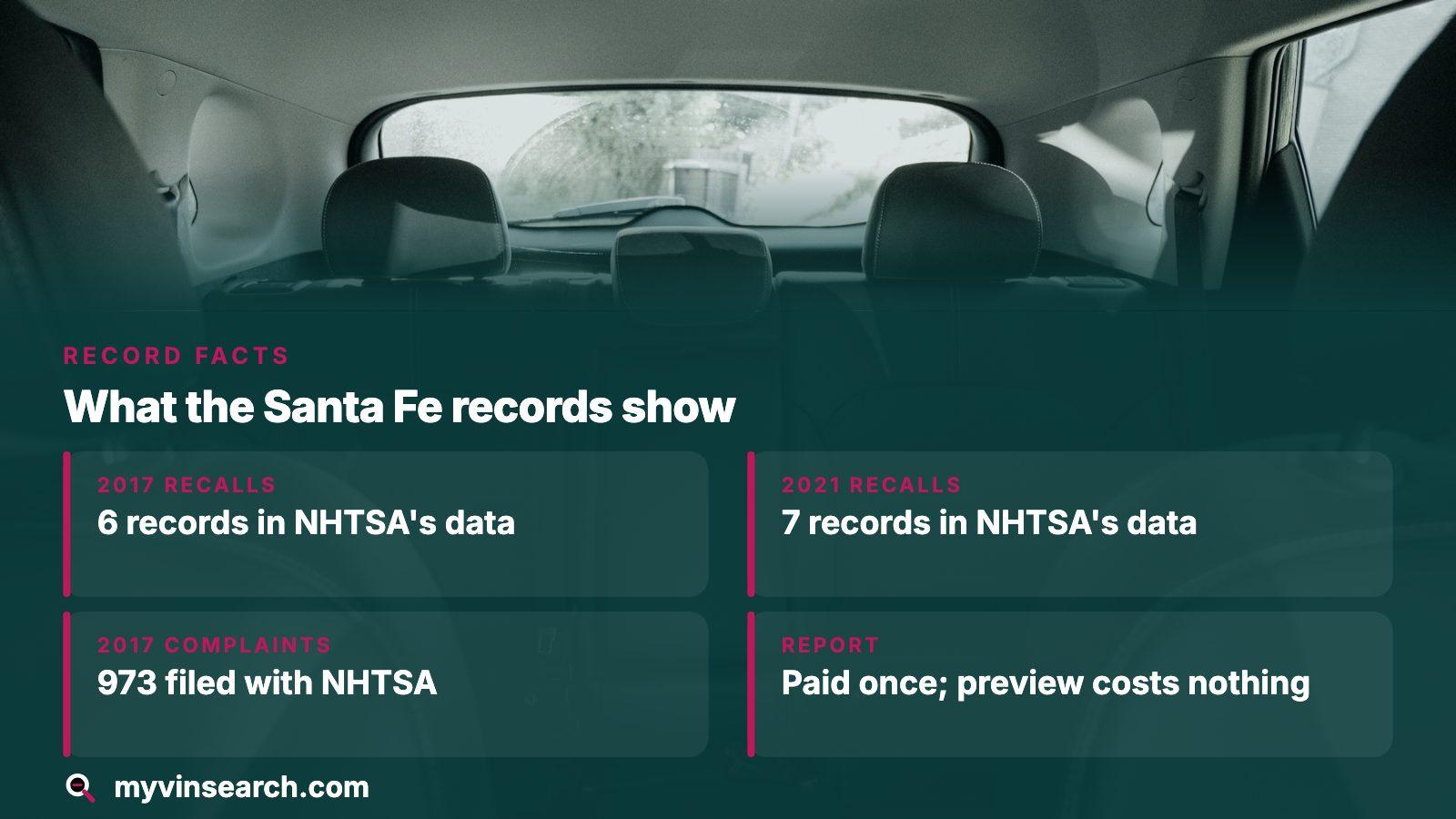
- Recalls on file, 2017 Santa Fe
- 6 records in NHTSA's data
- Recalls on file, 2021 Santa Fe
- 7 records in NHTSA's data
- Owner complaints, 2017 Santa Fe
- 973 filed with NHTSA
- Preview
- Preview costs nothing; report is paid once
What a Santa Fe VIN lookup covers
This site organizes its lookups by make and model, so a Santa Fe result gets read against typical Santa Fe lives: school runs, long highway commutes, a little fleet and rental duty. Each leaves a different kind of mark in the record.
- Brands on the title (salvage, flood, rebuilt) and the state that applied each one.
- Collision and total-loss records, with auction pictures where an insurer sold the wreck.
- Earlier odometer readings from titles and inspections; the numbers should only go up.
- Any recall campaign still open on this VIN, along with liens and theft flags.
- An estimated value for this Santa Fe's year and trim, to anchor price talks.
A Santa Fe totaled in one state and retitled in the next can feel fine on a short test drive. Only the record tells that story.
Decode the VIN against the ad first
Positions one through three point to the maker and region, and position ten stands for the model year. I fed partial Santa Fe patterns into NHTSA's vPIC decoder and got three quite different answers for what is sold under one nameplate.
| VIN pattern | Year | Decoder answer | Engine |
|---|---|---|---|
| KM8SM4HF | 2017 | Ulsan, South Korea | 3.3 L |
| 5XYZU3LB | 2017 | United States | 2.4 L |
| 5NMS3CAD | 2019 | United States | 2.4 L |
| 5NMS2DAJ | 2021 | Montgomery, United States | 2.5 L |
The tenth character was H on the 2017 patterns, K on 2019 and M on 2021. If the seller advertises a 3.3 liter V6 but the VIN decodes to a 2.4, stop and ask why. It is often a copy-pasted listing, though it can also mean a swapped dash plate.
Recall history by model year
NHTSA's recall data for the model it lists as Santa Fe shows 3 records for 2013, 3 for 2014, 2 for 2015, 3 for 2016, 6 for 2017, 2 for 2018, 2 for 2019, 2 for 2020, 7 for 2021 and 5 for 2022. Campaigns are often shared across several models, so a high count is not a verdict. The question is whether your VIN was repaired.
| Campaign | Santa Fe years | Problem in brief |
|---|---|---|
| 17V578000 | 2017, 3.3 L engines | Crankshaft surface flaws wear the bearings; engine may stall |
| 22V056000 | 2016-2018 Santa Fe | ABS module can short and start an engine compartment fire |
| 17V358000 | 2013-2017 | Secondary hood latch cable replaced |
| 18V715000 | 2019 | Side curtain air bag bolts may interfere with the bag |
| 21V524000 | 2021-2022, 2.5 L turbo | Fuel can leak at the pump-to-rail pipe |
| 22V746000 | 2021-2022 | Transmission oil pump fault can cut drive power |
According to the notices, dealers perform each of these remedies free of charge.
The 2017 engine question, in owners' words
Owners filed 973 complaints on the 2017 Santa Fe, against 238 for 2016 and 110 for 2018. The engine is the component named most often, 473 times. One complaint can list several components, so read the figure as a rough indicator rather than a ranking.
From an NHTSA owner complaint
An owner of a 2017 Santa Fe with the 3.3 liter engine told NHTSA the crankshaft and bearings had failed in the same way described in campaign 17V578000. Hyundai, the owner wrote, said the VIN was outside the recall, and the engine had never been replaced. A second 2017 owner, who bought the SUV used, reported limp mode at 92 thousand miles with no recall on the VIN and was told the warranty covered only the first buyer.
What to take from it: these are one-sided and unverified, and an empty recall result says nothing about engine health. When shopping a 2017, ask for oil change records and let a mechanic listen to the engine cold.
Running the check, step by step
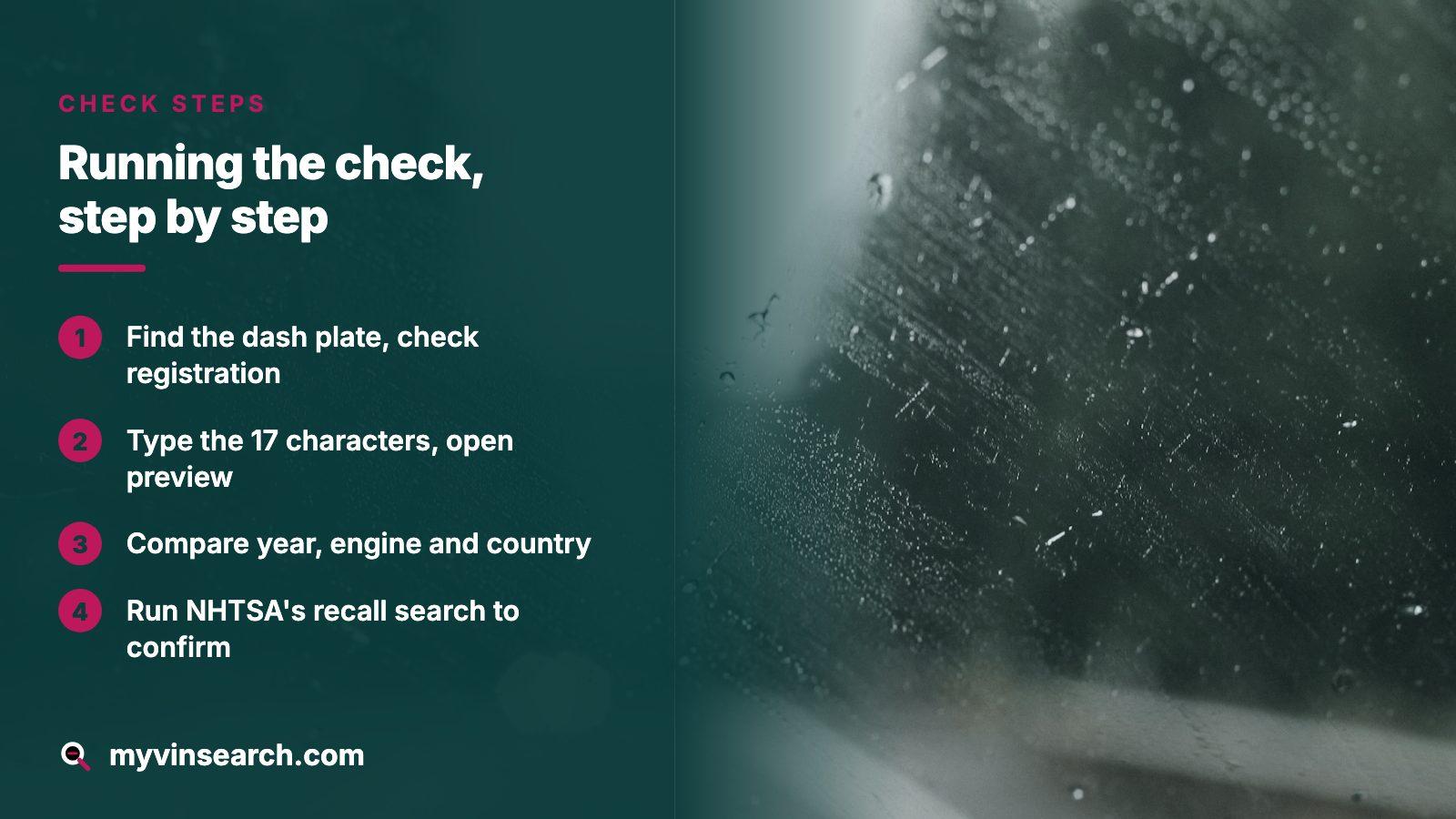
- Squat by the driver's door, find the stamped plate on the dash corner, and check what it says against the registration or insurance card.
- Type the full 17 characters in and open the preview.
- See whether year, engine and build country agree with the listing.
- Once they line up, pay for the report and work down it one section at a time.
- Finish by running the VIN on NHTSA's recall search to double-check open campaigns.
A single mistyped character may produce nothing, and nothing is not the same as clean. Photograph the plate rather than typing from memory.
Where free tools stop
NHTSA's decoder and recall lookups are free and good at what they cover: build details and campaigns. They do not list ownership changes, liens, auction photos or odometer readings. The federal title database called NMVTIS sits under the Justice Department, and its stated aims include protecting consumers from fraud and unsafe vehicles. A report that draws on it fills in the title side.
That gap is why a free recall check alone is thin for a SUV you are about to pay for. It answers whether a repair is outstanding, not whether the vehicle was flooded or rolled back.
Red flags on a Santa Fe record
- A salvage or flood brand when the price acts as if it were absent.
- Mileage that falls between entries, or sits still for years and then leaps.
- An unrepaired engine, fire or fuel recall the seller brushes aside.
- A tenth character or engine size that clashes with what the ad claims.
- A collision entry and no repair paperwork to match.
A single flag justifies pushing on price. Two or more justify walking to a different Santa Fe.
Price, and your move after the report
Nothing is charged to view the preview. After that it is one payment per report, bundles for several VINs are shown on the pricing page, and no plan auto-renews.
Let the findings steer the inspection: brakes and electrical for a fire-risk recall, frame and paint for a crash entry, a cold start and oil level for the engine. If a recall is open, ask for proof of repair or have a Hyundai dealer complete it before money changes hands.
Where this information comes from
- NHTSA recalls API: 2017 Hyundai Santa Fe — campaign numbers, components and remedies by year
- NHTSA vPIC VIN decoder — plant, country and engine returned for Santa Fe VIN patterns
- NHTSA owner complaint 11702987 — owner experience, paraphrased
- NHTSA owner complaint 11651405 — owner experience, paraphrased
- VehicleHistory.gov: NMVTIS — purpose of the federal title information system
Sources and photos: Facts checked against the sources above in November 2026. Photos by engin akyurt, Cole Keister and THLT LCX on Unsplash; diagrams by MyVINSearch.
Keep reading
- Hyundai VIN check: match the VIN to your Hyundai's model and yearSee the whole Hyundai lineup by VIN before narrowing to the Santa Fe.
- Hyundai recall check by VIN: open campaigns for your exact modelLearn how Hyundai recall lookups work across every model.
- Hyundai Tucson VIN check: what the number reveals before you buyCompare with the Tucson, a smaller Hyundai SUV.
- Sample reportLook at a finished report before you pay for one.
Frequently asked questions
Is there a free Hyundai Santa Fe VIN check?
Partly. NHTSA decodes VINs and looks up recalls at no charge, covering build details and open campaigns but not owners, liens, auction photos or mileage history. MyVINSearch shows a free preview; the full history is a report bought once.
Does a Santa Fe VIN lookup show open recalls?
Yes. Campaigns still open on the VIN appear in the report, and NHTSA's own search lists them as well. Once a recall is repaired it leaves the open list, so when your year has a campaign, ask the seller to produce the dealer's invoice.
Which Santa Fe has the engine recall?
Campaign 17V578000 covers certain 2017 Santa Fe vehicles with the 3.3 liter engine, where crankshaft flaws can wear the bearings. The decoder shows engine size from the VIN. Not every 2017 is included, so confirm the exact VIN on NHTSA's recall search.
My Santa Fe shows no recalls. Is it trouble-free?
Not necessarily. No open recall means no unrepaired campaign is attached to that VIN today. Owners have reported engine failures on VINs outside a recall, so ask for service records and pay a mechanic to inspect the SUV before you buy.
Can the VIN tell me where my Santa Fe was built?
Yes. In NHTSA's decoder, a 2017 pattern starting KM8 came from Ulsan in South Korea, while 5XY and 5NM patterns decoded to the United States. A 2021 pattern decoded to Montgomery. The full 17 characters fill in engine and trim.
Now check the car itself
The guide explains what to look for. The report shows what this VIN has on record.