THE SHORT ANSWER
Copy the VIN from the Tucson and enter it in MyVINSearch to see the preview, which costs nothing. Confirm the year and trim match the listing. If they do, buy the report once and read the title, damage, mileage and recall lines. Then repeat the VIN in NHTSA's recall search, because Tucson campaigns often cover only a slice of a model year.
- Recall campaigns, 2016 Tucson
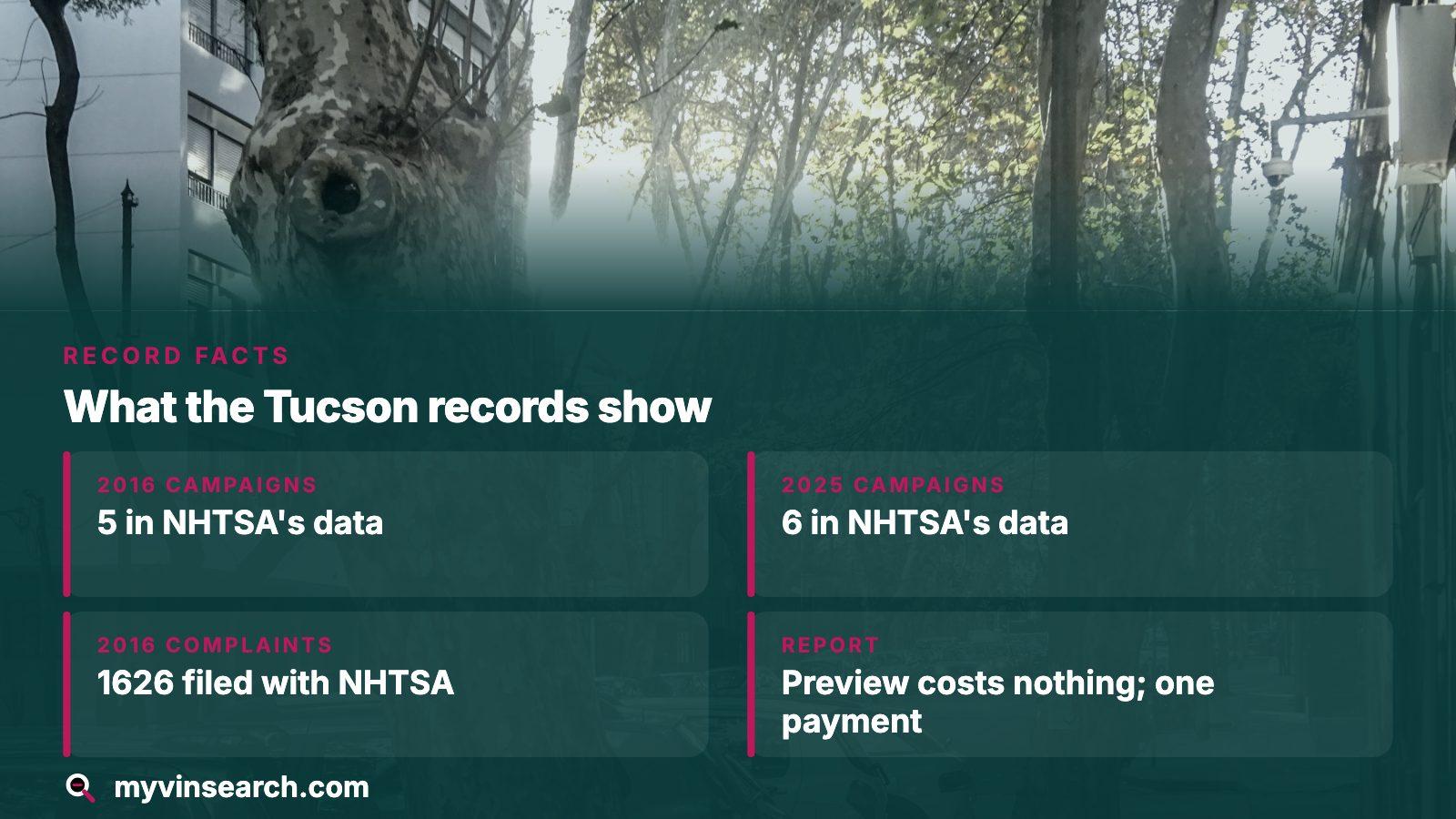
- 5 in NHTSA's data
- Recall campaigns, 2025 Tucson
- 6 in NHTSA's data
- Complaints, 2016 model year
- 1626 filed with NHTSA
- Preview
- Free; the report is one payment
What a Tucson's record can tell you that a test drive cannot
Compact crossovers change hands often, and a Tucson with high mileage may have lived in several states. MyVINSearch sorts its checks by make and model, so you read the file knowing what a Tucson tends to carry instead of scanning a generic printout. These are the lines to look for.
- A salvage, junk or flood brand, and which state assigned it.
- Insurer total-loss entries and auction photos after a claim.
- Odometer readings from different dates; they should only climb.
- Safety campaigns still open against this VIN.
- Liens, theft entries and a market value for the year and trim.
Ulsan or Alabama: what the decoder says about the build
I ran made-up VIN patterns through NHTSA's decoder to see how it reads a Tucson. They are test strings, not real vehicles, but they show what comes back when a seller recites a number to you.
| Pattern starts | Model year tried | Decoder answer |
|---|---|---|
| KM8J | 2016 and 2018 | Tucson SUV, built in Ulsan, South Korea |
| 5NMJ | 2022 | Tucson SUV, built in Alabama |
Neither factory is a flaw. What matters is the cross-check. NHTSA says the decoder shows what the maker reported, so if the listing says one thing and the number says another, somebody copied the ad carelessly or the number is wrong. The ninth character works as a checksum, so a single mistyped character usually trips an error.
How many campaigns NHTSA lists for each Tucson year
NHTSA's recalls data returns a separate list per model year. Older cars are not always the busy ones; the 2018 through 2021 years carry one campaign each, while 2016 and 2025 carry the longest lists. Here is a sample of years used shoppers ask about.
| Model year | Campaigns | Example |
|---|---|---|
| 2012 | 3 | 19V063000: oil pan leak, 2011-2013 |
| 2016 | 5 | 16V348000: secondary hood latch |
| 2017 | 3 | 21V727000: connecting rod bearings |
| 2019 | 1 | 20V543000: ABS control unit fuse |
| 2022 | 3 | 23V038000: roof moldings |
| 2025 | 6 | 25V549000: connecting rod bolts |
Counts overlap, since some campaigns span several years or cover Santa Fe and Sonata too. Treat the table as a guide to which summaries to read, and let the VIN show which ones are still unrepaired.
Two campaigns that deserve a direct question to the seller
Campaign 21V727000, filed in September 2021, covers certain 2017 Tucsons. Hyundai said connecting rod bearings can wear early, which may damage the engine, stall it or start a fire. A dealer inspects the engine, replaces it if the bearings are damaged, and adds knock-sensing software. There is no charge, and letters went out in January 2022.
Campaign 20V543000 began with 2019 to 2021 cars in September 2020 and was widened that December to certain 2016 to 2018 Tucsons. Inside the ABS hydraulic control unit, corrosion can cause a short, and the hazard named is fire under the hood. Dealers swap a fuse. Until that is done, the notice tells owners to leave the SUV outdoors, clear of buildings. A used Tucson from these years should come with proof that both were handled, or the work should be done before you pay.
What owners say when their VIN fell outside the list
Two owners described the same trap in complaints to NHTSA: a problem that looks like a known recall, on a car the recall does not include. A clean recall result is useful, but it is not a mechanical clearance.
From an NHTSA owner complaint
The owner of a 2017 Tucson reported shaking, vibration and odd engine noise with the check engine light on, at roughly 97,000 miles. A non-dealer shop changed the oil in connection with campaign 21V727000, yet according to the filing this car's number was never part of that recall, and nothing was fixed.
From an NHTSA owner complaint
Another owner, driving a 2016 Tucson at about 15 MPH, found it would not pick up speed after repeated pedal taps, and a transmission warning lit. They suspected campaign 16V628000. A dealer said no recall was attached to that VIN. Odometer: close to 95,000.
Takeaway: with a 2016 or 2017 Tucson, ask for service invoices and pay for a third-party inspection no matter what the lookup says.
Running the lookup on a Tucson, step by step
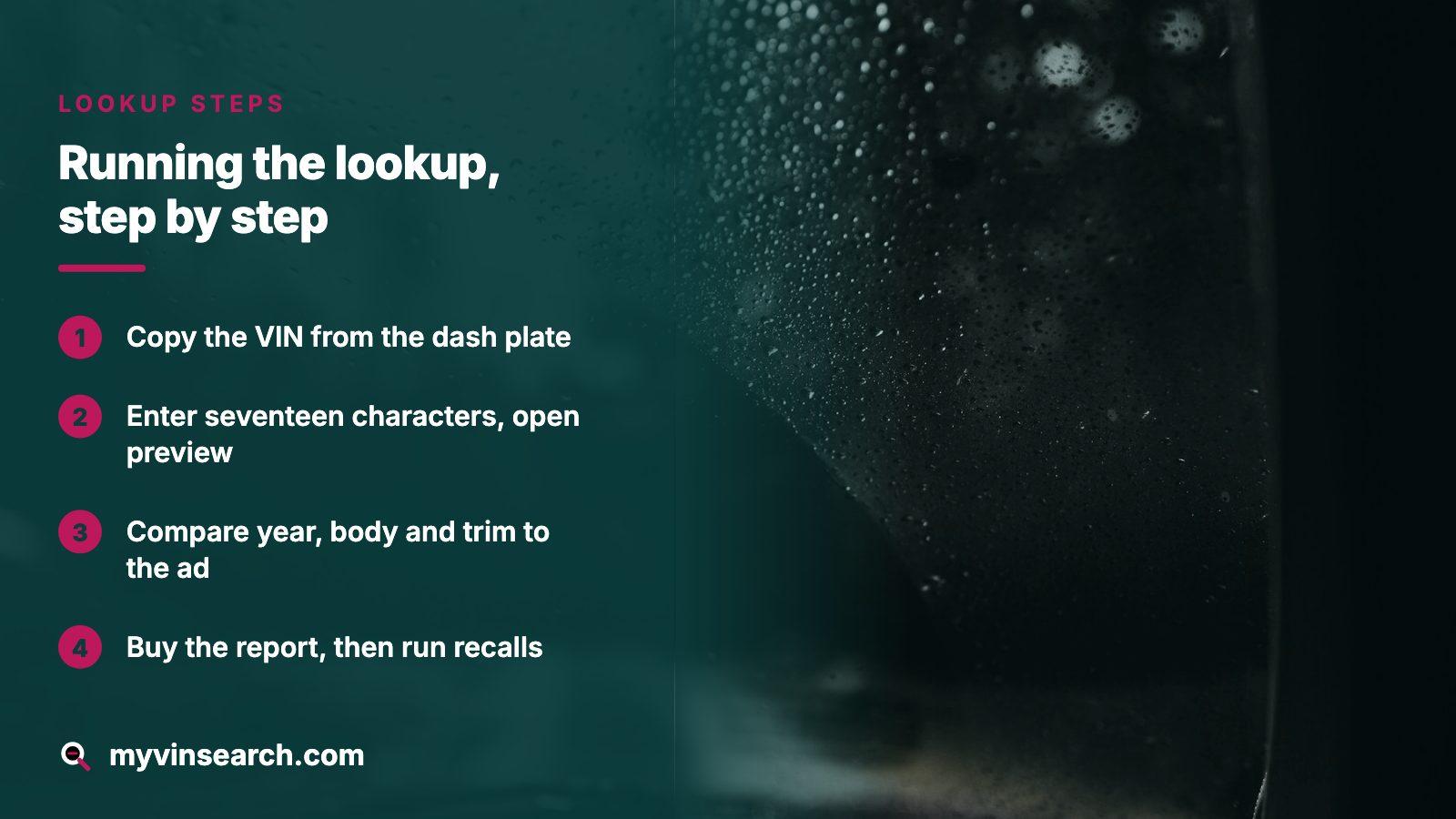
- Copy the VIN from the plate visible at the dashboard's driver end, then confirm it against the registration. An insurance card may carry it as well, according to NHTSA.
- Enter all seventeen characters in MyVINSearch and open the preview.
- Compare the year, body and trim in the preview with the advert before spending anything.
- If they agree, buy the report and read every section, starting with the headline summary.
- Run the same VIN through NHTSA's recall search and NICB's VINCheck.
One wrong character is the usual mistake. NICB warns that an incorrect number may return no match at all, which looks identical to a clean result.
Where NHTSA and NICB stop
NHTSA's search shows only recalls not yet repaired. It also omits very new campaigns whose VINs are still being added, and recalls older than 15 years unless the maker extends them. Its box takes up to 100 VINs together, which suits a shortlist of Tucsons.
NICB's VINCheck costs nothing and draws on theft, salvage and flood reports from participating insurers, capped at five searches a day per address. The bureau says plainly that it is no full history report. Neither tool lists mileage over time, liens or title transfers, and the federal NMVTIS page adds that states differ on when they brand a car, so a search can miss a brand.
Signs that should end the conversation
- A salvage or flood brand, whichever state issued it.
- An odometer that falls or stands still from one date to the next.
- An engine or brake fire campaign the seller calls minor and cannot document.
- Decoded year, plant or trim that contradicts the advert.
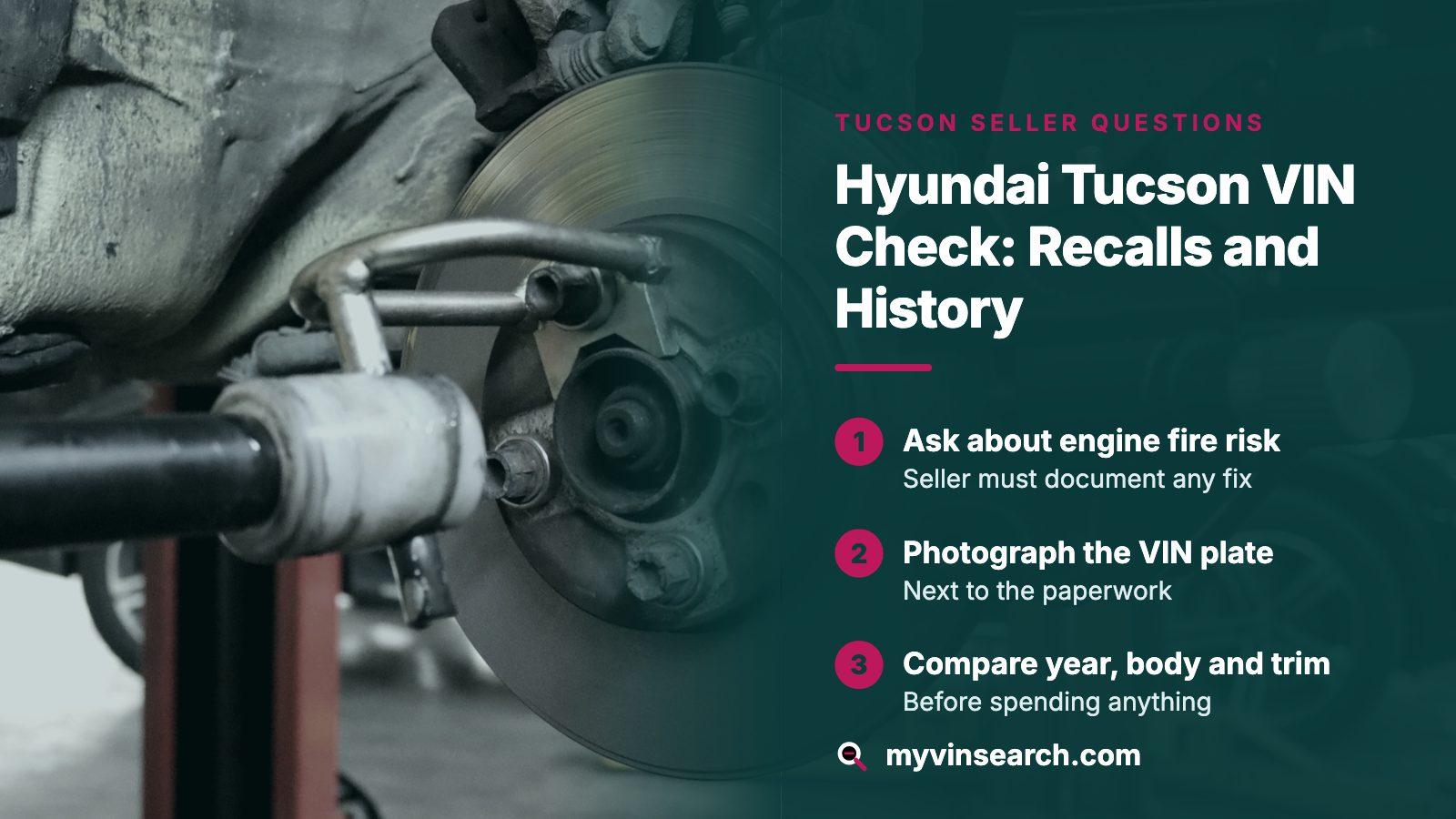
- A seller who objects when you photograph the VIN plate next to the paperwork.
NMVTIS describes cloned cars, where thieves put a VIN from a matching vehicle on a stolen one. If the paperwork and the car do not feel right together, walk. One flag is a reason to negotiate; two is a reason to look at a different Tucson.
What it costs and what to do after reading the report
Seeing the preview costs nothing. The report is a single payment, nothing renews, and multi-car packs are listed on the pricing page.
Let the findings pick your next move. A crash line means checking panels and frame. An open campaign means asking for repair proof, or getting a dealer to complete it before money changes hands. Recall repairs cost the owner nothing.
Where this information comes from
- NHTSA: Check for recalls — what a VIN recall search shows and leaves out
- NHTSA recalls API: 2017 Hyundai Tucson — engine and brake campaign details
- NHTSA recalls API: 2025 Hyundai Tucson — newest campaigns and their remedies
- NHTSA vPIC VIN decoder — plant and year returned for Tucson patterns
- NHTSA owner complaint 11753739 — owner experience, paraphrased
- NHTSA owner complaint 11771213 — owner experience, paraphrased
- NICB: VINCheck — theft, salvage and flood flags with caveats
Sources and photos: Facts checked against the sources above in November 2026. Photos by Media Digital, Justin Cron and Nikolai Kolosov on Unsplash; diagrams by MyVINSearch.
Keep reading
- Hyundai VIN check: match the VIN to your Hyundai's model and yearSee how checks work across the whole Hyundai lineup.
- Hyundai recall check by VIN: open campaigns for your exact modelLearn how Hyundai recall lookups work for every model.
- Hyundai Santa Fe VIN check: what one Santa Fe's record should showCross-shopping the larger Hyundai SUV? Check the Santa Fe.
- Sample reportLook over a finished report before you buy one.
Frequently asked questions
Is there a free Hyundai Tucson VIN lookup?
Partly. NHTSA lists open recalls for a VIN and NICB flags stolen, salvage and flood records from member insurers. Neither shows mileage history, liens or title transfers. MyVINSearch gives a free preview, and the deeper history is a one-time paid report.
Can a VIN tell me where my Tucson was assembled?
Yes. In NHTSA's decoder, a pattern starting KM8J returned a Tucson from Ulsan, South Korea, and one starting 5NMJ returned a Tucson from Alabama. Compare the decoded year and trim with the listing, since mismatches suggest a wrong number or a careless ad.
Does a clean recall result mean the Tucson engine is fine?
No. A recall search lists only campaigns naming that VIN. One 2017 owner told NHTSA the SUV shook and made noises near 97,000 miles while sitting outside the engine recall. Get service records and book an outside inspection.
Which Tucson year draws the most owner complaints?
Among the years I pulled, 2016 leads with 1626 complaints, then 2017 with 1097. The 2021 model year shows 80. Sales volume and time on the road push totals around, so use the counts as a prompt to inspect, not a verdict.
What should I do if the check shows an open recall?
Request proof of the repair from the seller, or have a franchised Hyundai dealer perform it before you pay. Recall work is not billed to owners. For the brake control unit campaign, NHTSA's record also says to park outside until the fuse is replaced.
Now check the car itself
The guide explains what to look for. The report shows what this VIN has on record.