THE SHORT ANSWER
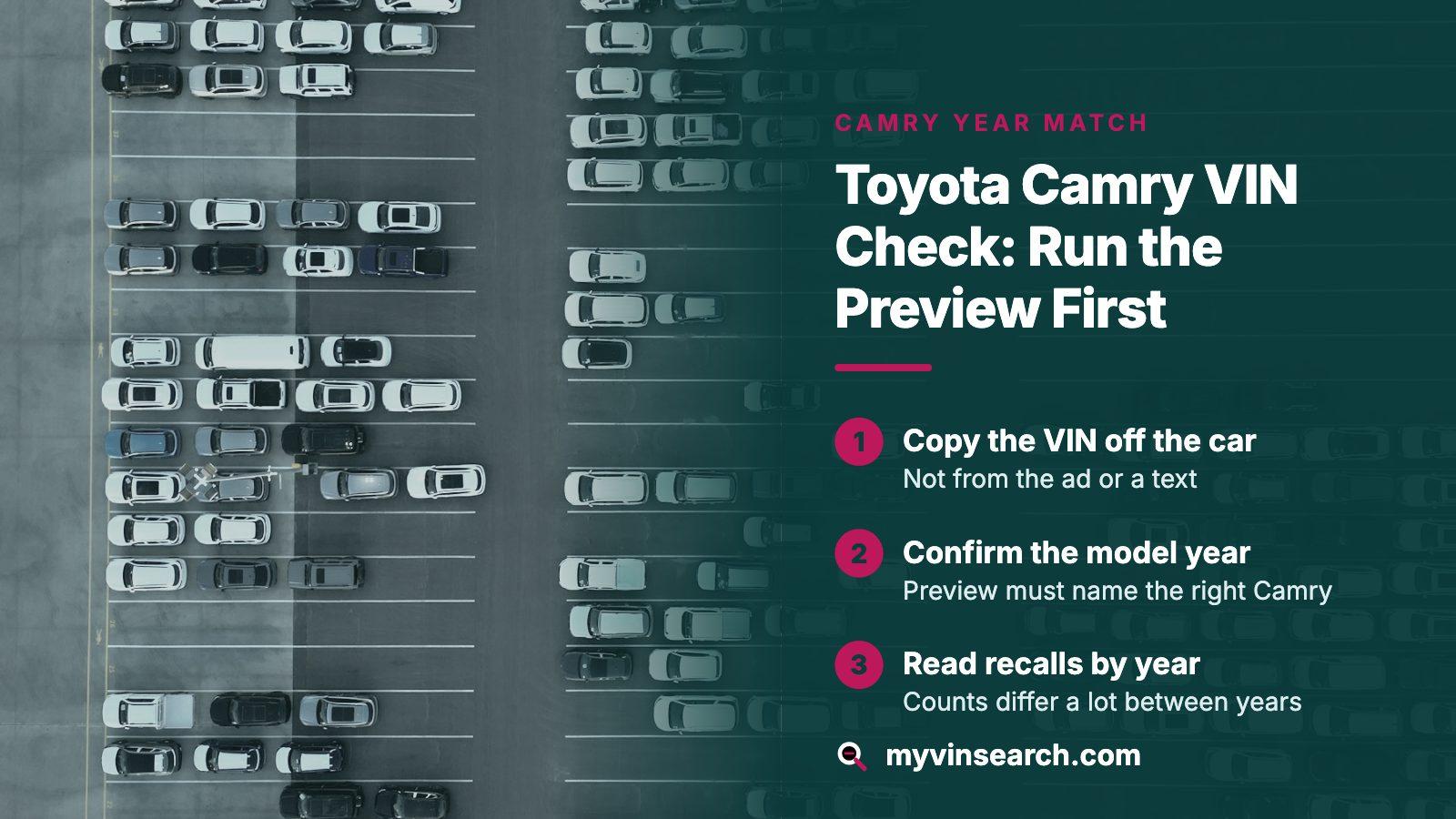
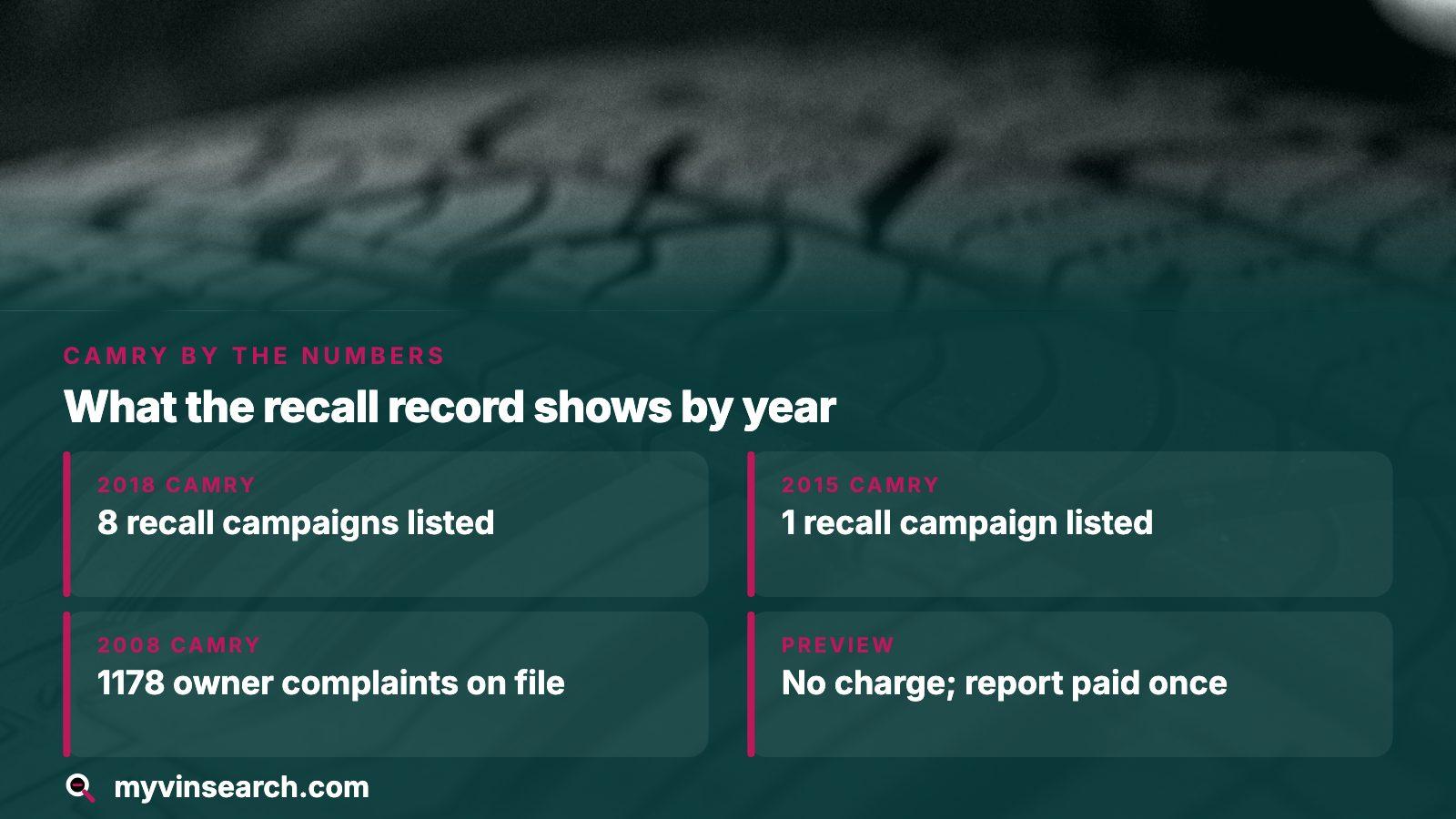
Copy the VIN off the Camry itself, run the preview at no charge, and confirm it names the right model year before paying anything. The single-payment report then lists brands, salvage and total-loss history, odometer entries and open recalls. Year matters: NHTSA lists 8 recall campaigns for a 2018 Camry and just 1 for a 2015. Prices are on the pricing page.
- Recall campaigns, 2018 Camry
- 8 listed by NHTSA
- Recall campaigns, 2015 Camry
- 1 listed by NHTSA
- Owner complaints on file, 2008 Camry
- 1178
- Preview
- Free; the report is one payment
What the check finds on a used Camry
Camrys are traded constantly and often carry high mileage, so what happened to one particular car counts for more than the nameplate. Four kinds of entry do most of the work.
- Title brands (junk, salvage, flood) and the insurer total-loss entry that tends to come first.
- Odometer readings from different dates, which should only rise.
- Auction sales of damaged cars, with photos when a sale happened.
- Recalls still open against this VIN, as opposed to the model in general.
A history report reads records and cannot judge worn brakes or a tired suspension. The Justice Department's vehicle-history site recommends an independent mechanic and a drive on varied roads alongside it.
Making sure the VIN really describes a Camry of that year
Decoding comes first because everything after it hangs on the model year. NHTSA's vPIC decoder, given a partial number beginning 4T1B11HK and ending JU, answered Toyota Camry, model year 2018, sedan, 2.5 liter four-cylinder, built by Toyota Motor Manufacturing in Georgetown, Kentucky. It also flagged the number as incomplete, which is the right reaction to a partial VIN.
Run your listing through the same step. When the ad claims one year and the decode says another, or the preview returns a different model, pause. That points to a typo in the ad, a swapped part, or a seller whose story does not hold.
Recall campaigns by Camry model year
The figures below come from NHTSA's recalls API for the Toyota Camry. A single campaign can span several model years, so rows overlap and should not be summed.
| Model year | Campaigns listed | Owner complaints on file |
|---|---|---|
| 2008 | 8 | 1178 |
| 2009 | 10 | 1413 |
| 2012 | 2 | 646 |
| 2015 | 1 | 271 |
| 2018 | 8 | 755 |
| 2019 | 6 | 403 |
| 2020 | 3 | 276 |
| 2024 | 1 | 53 |
The spread is wide. A 2009 carries ten campaigns on paper, a 2015 just one. A high count does not make a car bad, since each campaign has a free dealer remedy, but it does mean more chances that one was never done.
The 2018 Camry: eight campaigns and a fix that arrived in 2025
A 2018 shows how a clean-looking sedan can still hold open items. NHTSA lists three campaigns from the first half of 2018 alone, each tied to the build rather than to wear.
- 18V108000, V6 cars: fuel pipes may not be properly joined to the engine-bay hoses, so fuel could leak and add fire risk. Dealers inspect and fix the connection.
- 18V200000, 2.5 liter four-cylinder: pistons larger than specified may stall the engine. Dealers read production date codes and swap the engine assembly when an affected piston turns up.
- 18V211000: a brake booster vacuum pump that might suddenly lose assist. Dealers replace the pump.
Later filings kept coming. Campaign 21V890000, received in November 2021 for 2018 and 2019 Camrys, covers a vacuum pump vane cap that may break. Campaign 25V028000, received in January 2025, covers an in-tank fuel pump that may fail and stall the engine. Owner letters for that one went out in March 2025, so a 2018 bought in 2024 could have had nothing flagged at the time and an open recall today.
Older Camrys: what the 2008 and 2009 counts reflect
The 2008 and 2009 years top the table for both recalls and complaints. Shared items include the accelerator pedal campaign 09V388000, received in October 2009, and two seat heater campaigns, 14V743000 and 16V396000, which have dealers switch the heaters off and refund the accessory cost.
On an older car, the VIN check does two jobs. It confirms which of those campaigns apply to this build, and it shows whether the title and mileage history held up through what is usually more than one owner.
From an NHTSA owner complaint
A 2008 Camry owner who bought the car used told NHTSA in 2019 that the dashboard had turned sticky and shiny enough to be distracting. Toyota's answer, in their account, was that the warranty had run out and the first owner should have handled it. As the second owner, they said no letters or emails ever reached them about coverage or repairs.
The lesson for a buyer is plain: notices and repair offers follow the original registration, and a second owner may never see them. Looking the VIN up yourself is how you find out.
Reading the results: what should slow you down
Federal NMVTIS data, behind title-based reports, rests on five indicators: where the title is held and when it last changed, brands, odometer, total losses and salvage. State title agencies, insurers, junk and salvage yards and auto recyclers all owe it reports by law. Treat those five as your checklist.
| Entry on the report | Reading it on a Camry |
|---|---|
| Salvage, junk or flood brand | Severe past damage; price should reflect it, and a pre-purchase inspection becomes mandatory |
| Total loss without a matching repair record | Ask the seller for the repair paperwork before going further |
| Odometer lower than an earlier reading | Walk away or demand an explanation in writing |
| Open recall on the VIN | Repaired free at a dealer, but confirm parts exist and book the visit |
| Clean title record | A good sign, not a guarantee of mechanical condition |
One reassuring note on mileage: in all 17 Camry model years from 2008 to 2024, none of the owner complaints in NHTSA's files lists the odometer as the component. That does not make rollback impossible, only unusual enough that a falling reading deserves attention.
Running the check, step by step
- Stand at the Camry and photograph its VIN; the number typed into an ad may carry an error.
- Enter the number in the MyVINSearch preview, which costs nothing and tells you which model and year it matches.
- Set that year against the listing and the table above, so you know roughly how many campaigns to expect.
- Pay for the report once the details agree, then go to the brand and mileage lines first.
- Request proof from the seller of any recall repair, or arrange it yourself at a Toyota dealership.

What it costs and what comes next
The Camry preview is yours to run without paying. After it you choose between one report and a bundle of 3, 5 or 10, each a one-off purchase with nothing renewing later. Prices are posted on the pricing page; a finished example is on the sample report page.
If the report is clean, schedule the mechanic inspection and a test drive over hills, highway and stop-and-go. If it shows a brand or a mileage drop, you have a documented reason to renegotiate or leave.
Where this information comes from
- NHTSA recalls API: Toyota Camry 2018 — campaign numbers, dates and remedies for the 2018 model year
- NHTSA vPIC VIN decoder — partial VIN decode used as the example
- NHTSA owner complaint 11196802 — owner experience, paraphrased
- Vehiclehistory.gov: Understanding an NMVTIS report — the five indicators and who reports them
- Vehiclehistory.gov: Used car buying tips — inspection and test drive advice
Sources and photos: Facts checked against the sources above in November 2026. Photos by Iain, Alejandro Escamilla and Yvette S on Unsplash; diagrams by MyVINSearch.
Keep reading
- Toyota VIN check: match your Camry, RAV4 or Tundra to its own recordThe Toyota-wide view if you are comparing the Camry with a Corolla or RAV4.
- Toyota recalls by VIN: find the model line, then the campaigns still open on itHow to look up open Toyota recalls on one VIN.
- Honda Accord VIN check: lookup, recalls and history for one specific AccordThe Accord check, the Camry's closest rival.
- Sample reportSee the layout of a finished report before you buy.
Frequently asked questions
How do I run a Toyota Camry VIN check?
Copy the VIN from the dash plate or door jamb label, paste it into the preview and make sure the Camry it describes matches the ad. A purchased report then adds title brands, salvage history, odometer entries and open recalls. Compare the number with the title paperwork too.
Is a Camry VIN lookup just a recall check?
No. A recall check lists safety campaigns only. A history report adds title, damage, salvage and mileage records. Use both: NHTSA's recall lookup is free and covers recalls, while a history report covers the car's paperwork past.
Which Camry years have the most recalls?
In NHTSA's listing, 2009 shows 10 campaigns, 2010 shows 9, and 2008 and 2018 show 8 each. The newest years show fewer, though a late campaign such as the 2025 fuel pump one can still land on a 2018.
Can a VIN check show if a Camry's odometer was rolled back?
It shows recorded readings from title transfers, inspections and similar events. A reading that drops against an earlier one is the warning sign. It cannot see mileage that was never recorded, so a mechanic's look at wear is still worthwhile.
What does the Camry VIN check cost?
Previewing a Camry is free of charge. Camry shoppers buy the full report outright, alone or in a bundle when several cars are on the list, and nothing recurs. Today's amounts appear on the pricing page. Preview first so you know model and year are right.
Now check the car itself
The guide explains what to look for. The report shows what this VIN has on record.